Written by Praveen Kumar
Thursday, May 21, 2026
The Critical Role of Valves in Data Centers
By
Praveen Kumar

Behind every search query, online transaction, streaming session, and Artificial Intelligence (AI) prompting is a data center working continuously to process, store, and move information. As digital demand accelerates, data centers are expanding rapidly and operating under increasingly demanding uptime and energy-efficiency expectations. Unlike office computers that run intermittently, data center servers operate twenty-four hours a day, every day of the year. This continuous operation generates enormous heat, making cooling one of the most critical systems in any facility. Valves play a vital role in keeping these systems running reliably.
Global data center demand is increasing at unprecedented rates, with capacity projected to reach 200 GW by 2030. Every 50MW can require more than 1000 valves. That means millions of valves will be needed to support new data center infrastructure over the next few years.
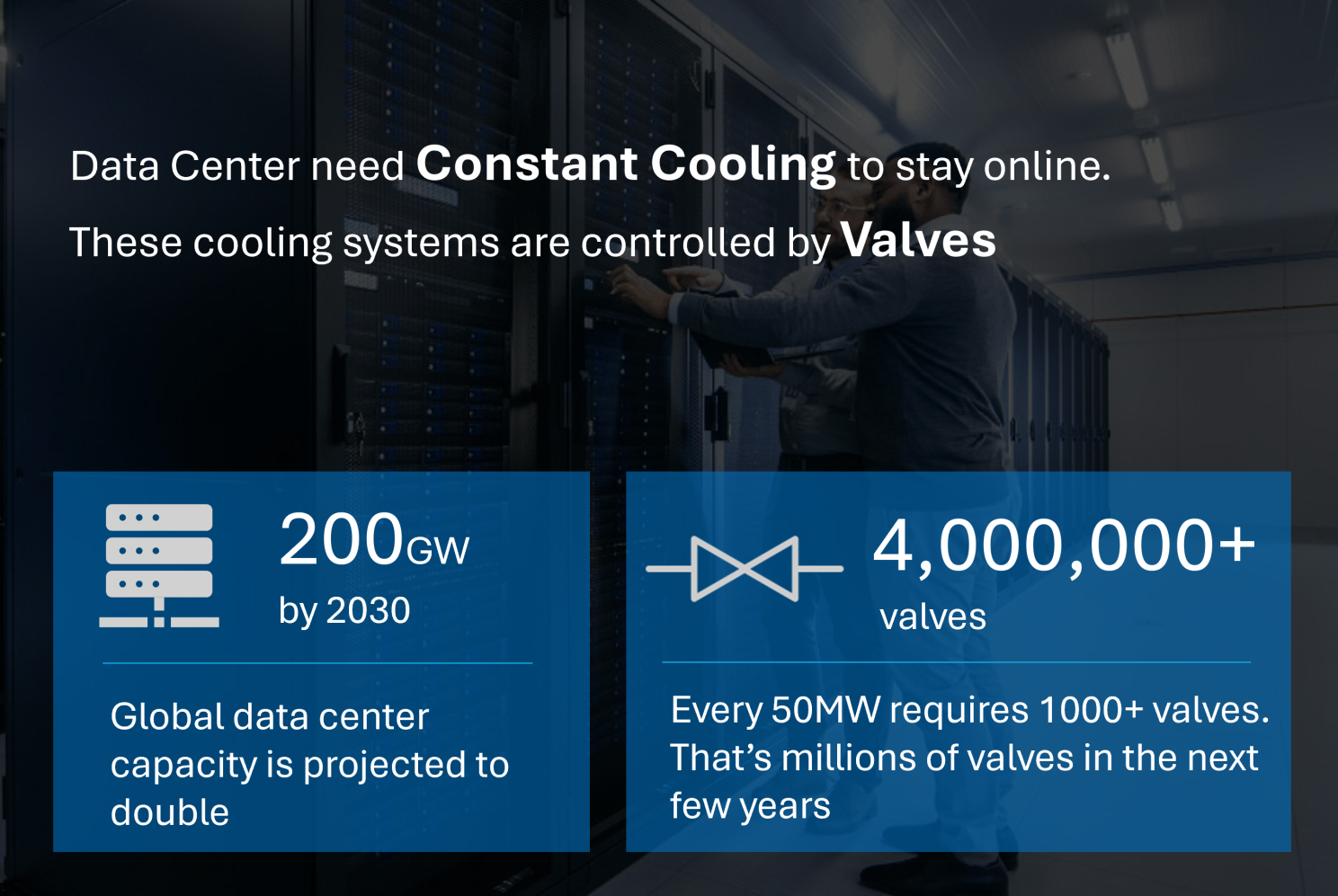
Growth projection of data center and valves
In this environment, valve design is directly connected to uptime and energy efficiency. Making the right selection and usage of valves facilitates a more cost-efficient system design, impacting both capital expenditures and operating expenditures.
Valves for Data Center Systems
Valves are essential to maintaining uptime and operational integrity across key data center systems. They provide control, isolation, balancing, and protection required across cooling, power, water, and utility systems.
Mechanical & Cooling: Mechanical and cooling systems are the backbone of thermal management in data centers. These systems ensure servers and IT equipment operate within safe temperature ranges, preventing downtime and protecting critical infrastructure. Valves play a vital role in regulating flow and pressure within these systems, delivering precision and reliability where it matters most.
IT Spaces: Inside the extensive halls of server racks, environmental conditions must be carefully managed to ensure equipment operates safely and efficiently. These spaces require precise monitoring of airflow, pressure, and temperature to prevent contamination, optimize cooling, and avoid unnecessary energy consumption. Valves play a key role in optimizing CRAH performance, enabling precise control and responsiveness that support uptime and energy efficiency in mission-critical environments.
Backup Power Generation: Uninterrupted power is essential for data centers to meet high-availability service-level agreements and maintain customer trust. Backup power systems ensure critical operations continue even during grid failures or unexpected outages. Valves support these systems by regulating fuel flow and pressure with speed and accuracy, helping operators respond quickly and confidently when backup support is needed.
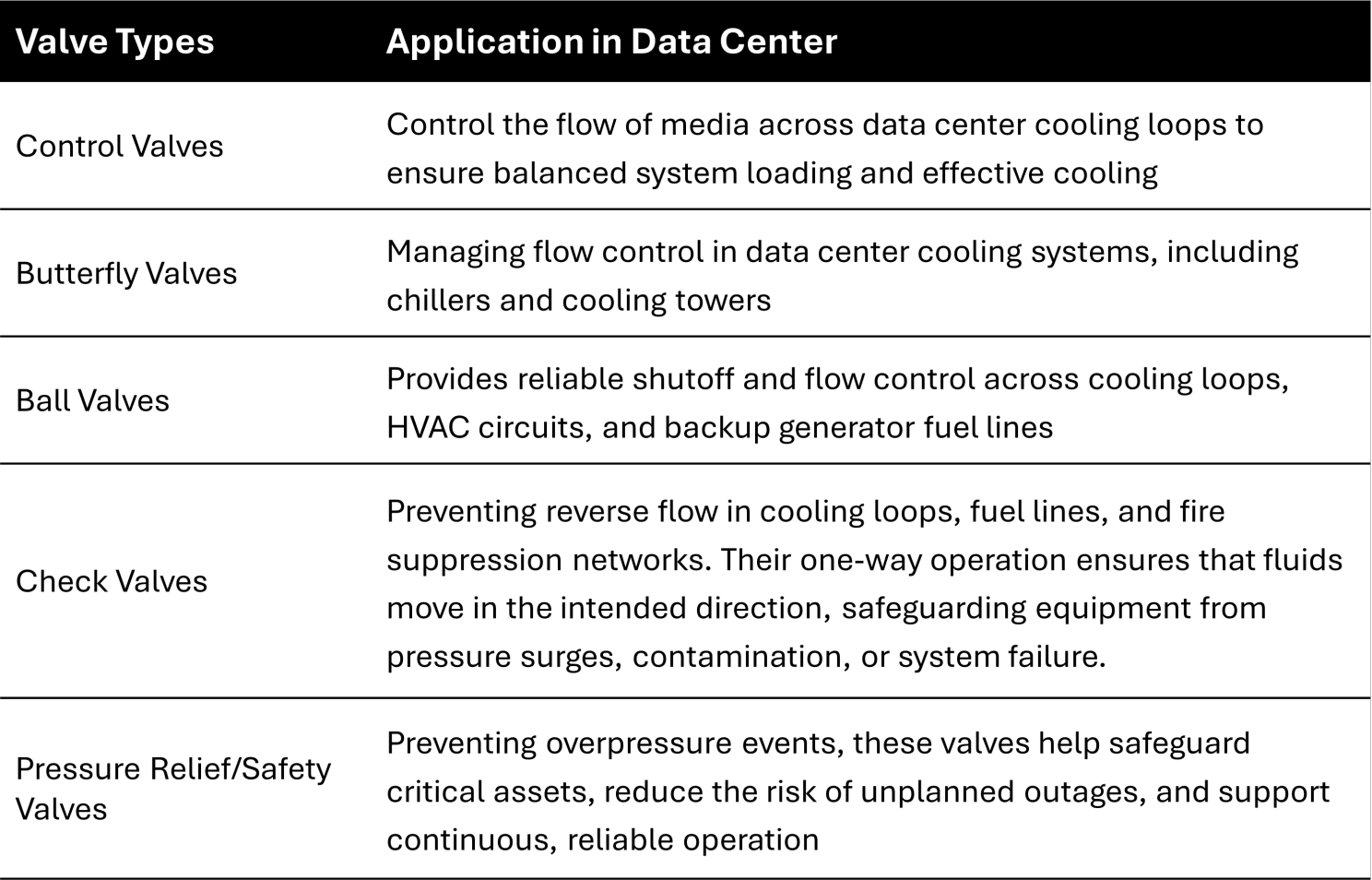
Application of different valve types in data center (Source: Emerson)
Role of Valves in Data Center Cooling
Traditional data centers commonly use air cooling, where cold air is delivered to server racks in the cold aisles, and warm air is returned from the hot aisles for re-cooling. In CRAC (Computer Room Air Conditioner) systems, refrigerant-based equipment uses compressors, pumps, and valves to circulate refrigerant and maintain room temperature and humidity. In CRAH (Computer Room Air Handler) systems, chilled water passes through cooling coils, and air is blown across those coils to remove heat from the server room. Here, valves become especially important: isolation valves are used for shutoff, while control valves regulate chilled water flow through the coils based on cooling demand, helping optimize temperature control while reducing unnecessary energy use. The image below shows an illustration of valves (highlighted in Red) installed in a data center cooling system. (Source: Bray)
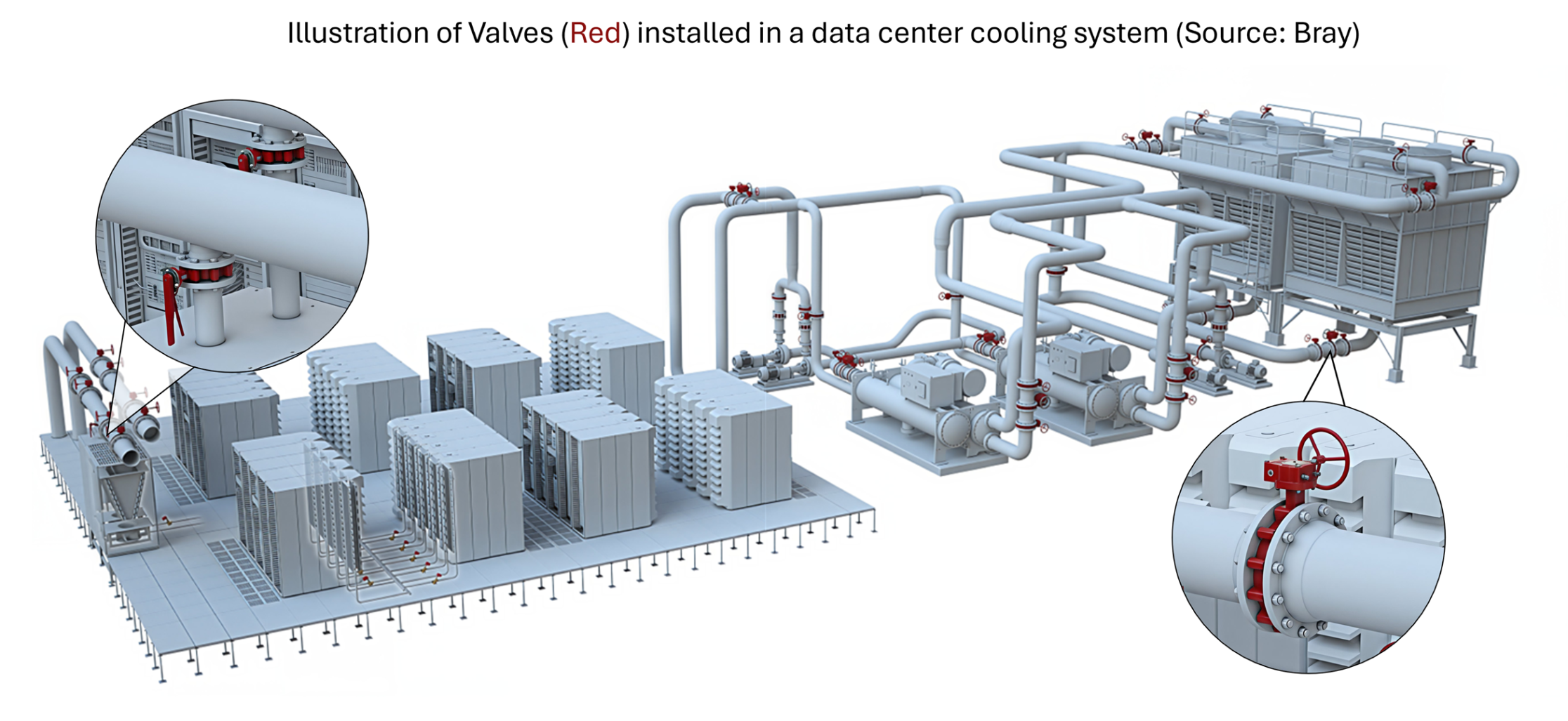
Illustration of valves installed in a data center cooling system (Source: Bray)
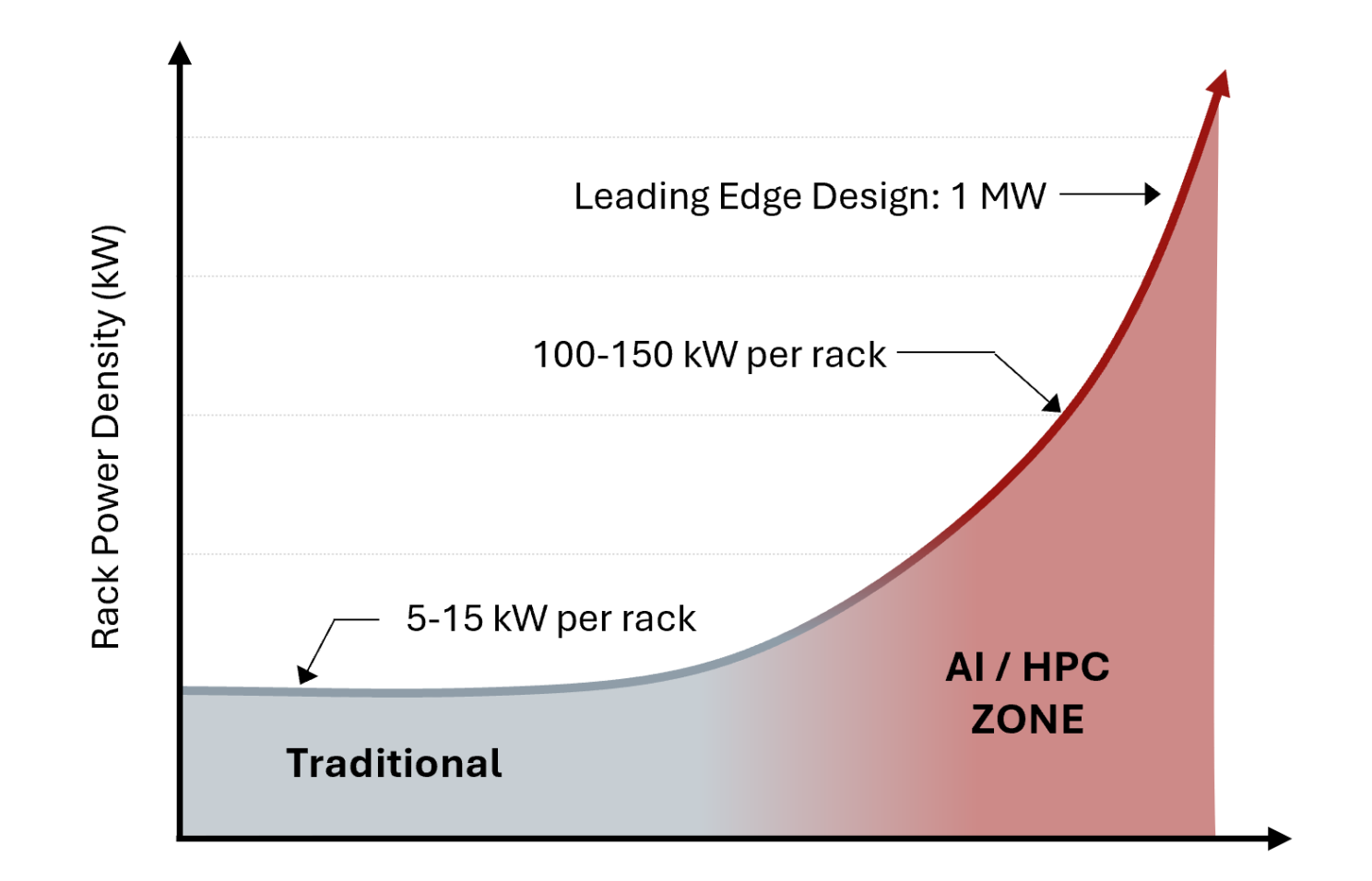
As artificial intelligence (AI) and high-performance computing (HPC) accelerate, data centers are moving beyond the physical limits of air cooling. Modern rack densities have surged from a traditional 5–10 kW to over 100 kW, with specialized AI clusters now pushing 200 kW per rack.
Data centers are moving toward liquid cooling, including direct-to-chip cooling, where coolant flows through cold plates attached to high-heat components, and rear-door heat exchangers, where chilled water removes heat directly from the back of server racks. For the most demanding AI and high-performance computing workloads, immersion cooling submerges servers in nonconductive dielectric fluid, transferring heat directly from electronics into the cooling medium.
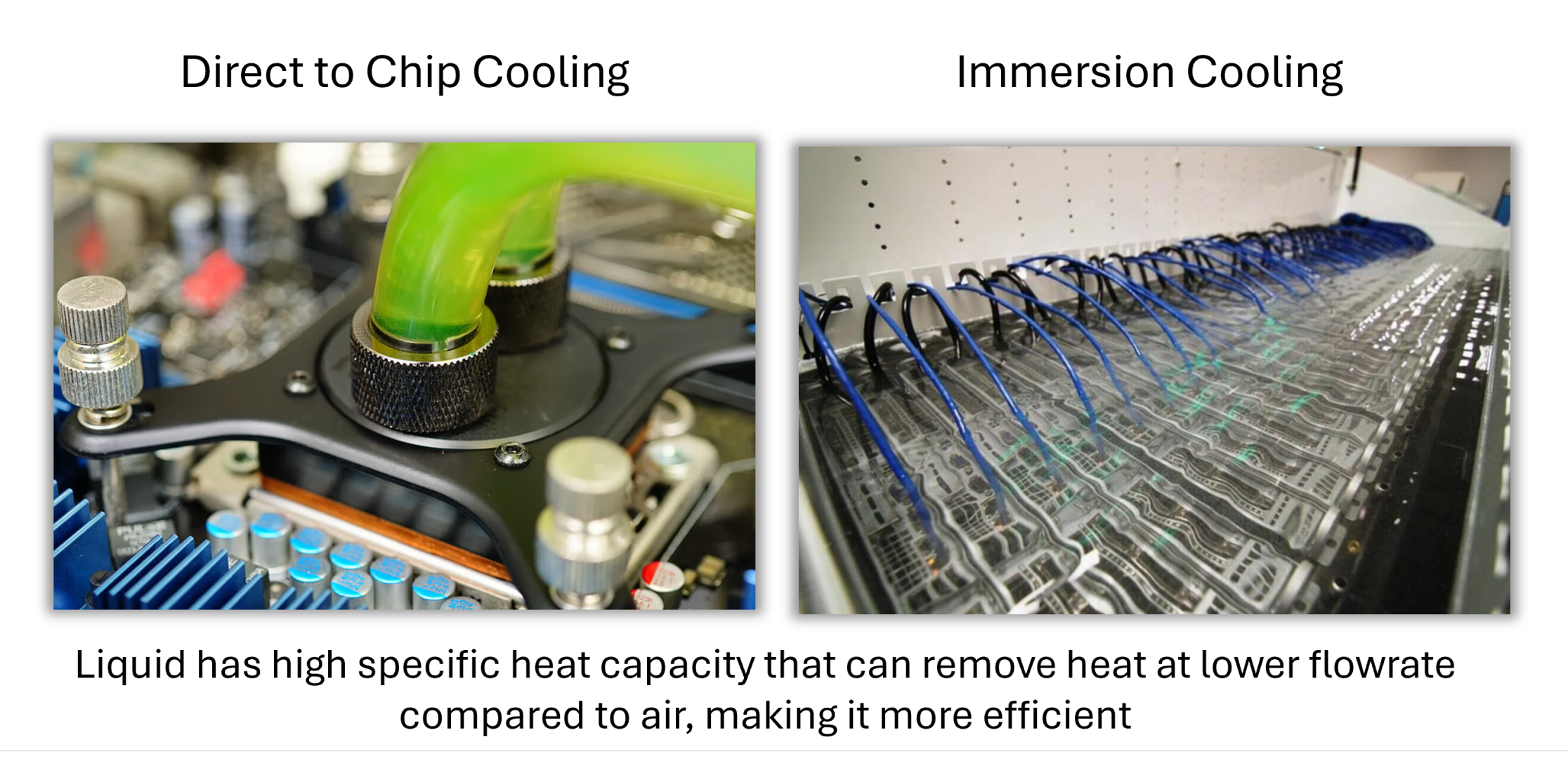
Liquid Cooling methods to address new age data center cooling needs
Across all these cooling methods, valves are the control points that keep the system reliable, efficient, and maintainable. In hydronic loops, valves are used across chillers, cooling towers, pump skids, heat exchangers, coolant distribution units, and liquid-cooling connections for isolation, modulation, staging, bypass, and backflow prevention. In direct-to-chip and rear-door heat exchanger systems, valves help deliver the right coolant flow to each rack or circuit while allowing safe isolation during maintenance. In immersion cooling, valves must support precise fluid control, tight shutoff, and contamination prevention. Because cooling systems must operate continuously, valve performance directly affects uptime, energy consumption, and system resilience.
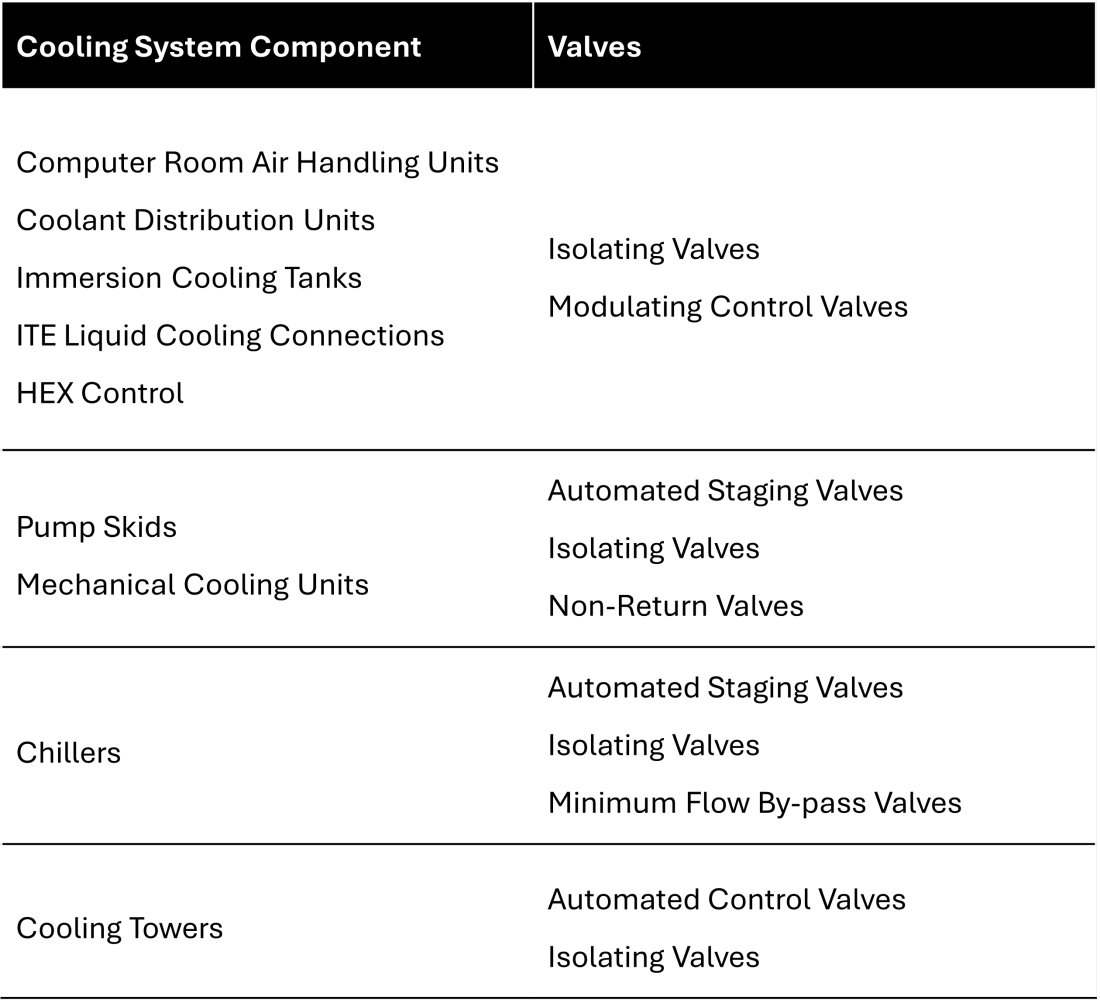
Valves used in different data center cooling systems (Source: Bray)
The hidden link between valves and energy efficiency
The International Energy Agency estimates that, in 2022, data centers consumed an estimated 460-terawatt hours (TWh) of electricity, making up nearly 2% of global electricity demand. Cooling of data centers alone accounts for up to 40 percent of the site’s total energy usage.
In water-cooled applications, pump energy costs are a significant contributor to the total electrical load and Power Usage Effectiveness (PUE) rating of the facility. The correct selection of isolation and control valves can help reduce overall pump energy costs. Valves with high Cv values minimize system pressure loss, reduce pumping costs, and improve Power Usage Effectiveness (PUE) rating, with significant annual savings per MW.
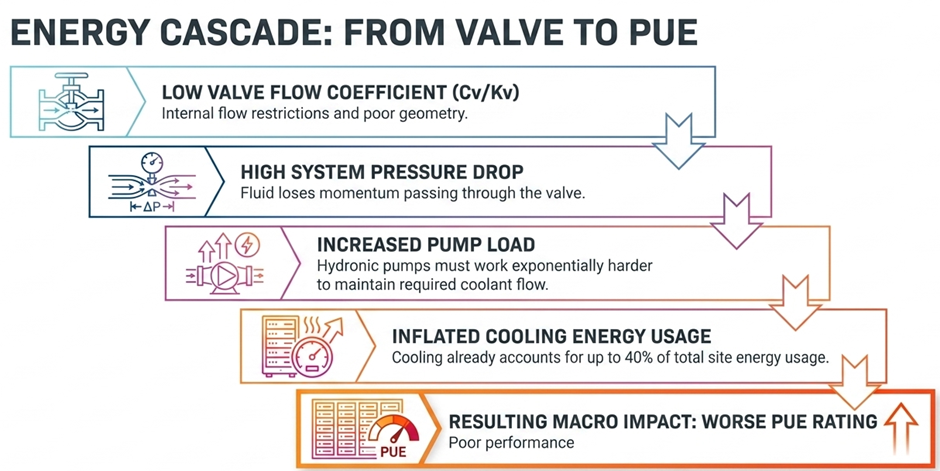
A higher Cv, or Kv in metric terms, means the valve can pass more flow with less pressure drop. Lower pressure drop reduces the energy required from pumps. In hydronic cooling systems, this directly supports lower pumping costs and improved Power Usage Effectiveness (PUE), with significant annual savings.
For data center owners and operators, the implication is clear: valve design is not just a component-level detail. It is an energy strategy. A valve design with an optimized internal flow path can reduce restrictions, improve flow stability, and support more efficient system operation. Across hundreds or thousands of valves in a large facility, these savings can become significan
From physical testing to CFD-driven valve optimization
Traditionally, Cv is determined through flow loop testing in certified laboratories. This remains important, but it has practical limits. Each design change may require a new prototype, transport to a test facility, and weeks of waiting for results. Physical testing also provides limited visibility into what is happening inside the valve, such as flow separation, low-pressure zones, cavitation risk, and high-velocity regions.
Computational Fluid Dynamics (CFD), changes this. CFD allows engineers to virtually study fluid flow through a valve before manufacturing. For data center valve design, this is powerful. Engineers can use CFD to identify pressure losses, optimize internal geometry, improve flow capacity, reduce cavitation risk, and validate performance across operating positions. This helps create valves that are not only reliable, but also energy efficient.
The challenge is that conventional CFD requires specialized expertise, CAD cleanup, fluid volume extraction, meshing, solver setup, high-performance computing, and post-processing. For many valve manufacturers and design teams, this makes CFD too slow or specialized for everyday design decisions.
How Autonomous Valve CFD makes optimization practical
Autonomous Valve CFD (AVC), bridges this gap by making valve CFD accessible to design engineers.
Autonomous Valve CFD (AVC) is a specialized app for valve simulations and virtual flow loop testing. It supports performance parameters such as Cv, Kv, hydrodynamic torque coefficient, head loss coefficient, and cavitation index. The workflow is designed around the valve designer: the user provides the valve CAD model, flow direction, and opening conditions, and the app generates CFD results and a ready-to-use performance report.
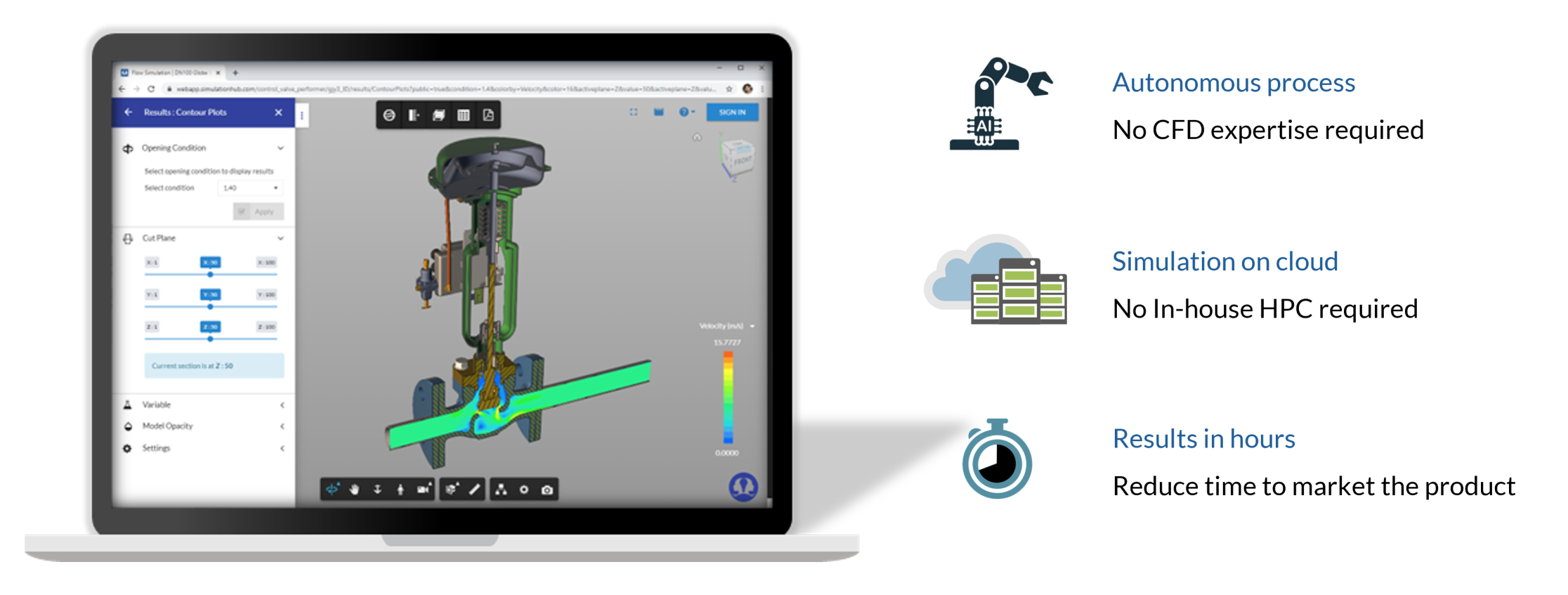
Benefits of Autonomous Valve CFD
For data center valve manufacturers, this has direct commercial value. It helps teams:
- Verify Cv and Cdt before physical testing
- Optimize valve design for lower pressure loss
- Reduce cavitation and erosion risks
- Shorten design cycles
- Publish more reliable performance data
- Support energy-efficient valve selection for mission-critical cooling systems
Conclusion
Valves may not be the most visible part of a data center, but they are central to uptime and energy efficiency. They determine how cooling media flows, how equipment is isolated, how systems are maintained, and how much pumping energy is consumed.
For data centers, the right valve is not simply a component choice. It is a reliability decision, an energy decision, and an uptime decision. As demand for data center capacity accelerates, valve manufacturers and data center designers need verified performance data and optimized valve designs. Accurate Cv, optimum flow capacity, tight shutoff, and reliable control are becoming essential. With Autonomous Valve CFD, valve teams can move faster, design smarter, and support the next generation of efficient, high-uptime data centers.
For data center valve manufacturers, we accelerate the design team and de-risk delivery through verified design performance, ensuring uptime and energy efficiency.
Explore the Updated AVC Website
Book a Free Demo
Comments
Recent posts