Written by Aaditya Ruiker
Tuesday, June 09, 2026
Buildings AI: A Real Showroom for Every Building Product
By
Aaditya Ruikar
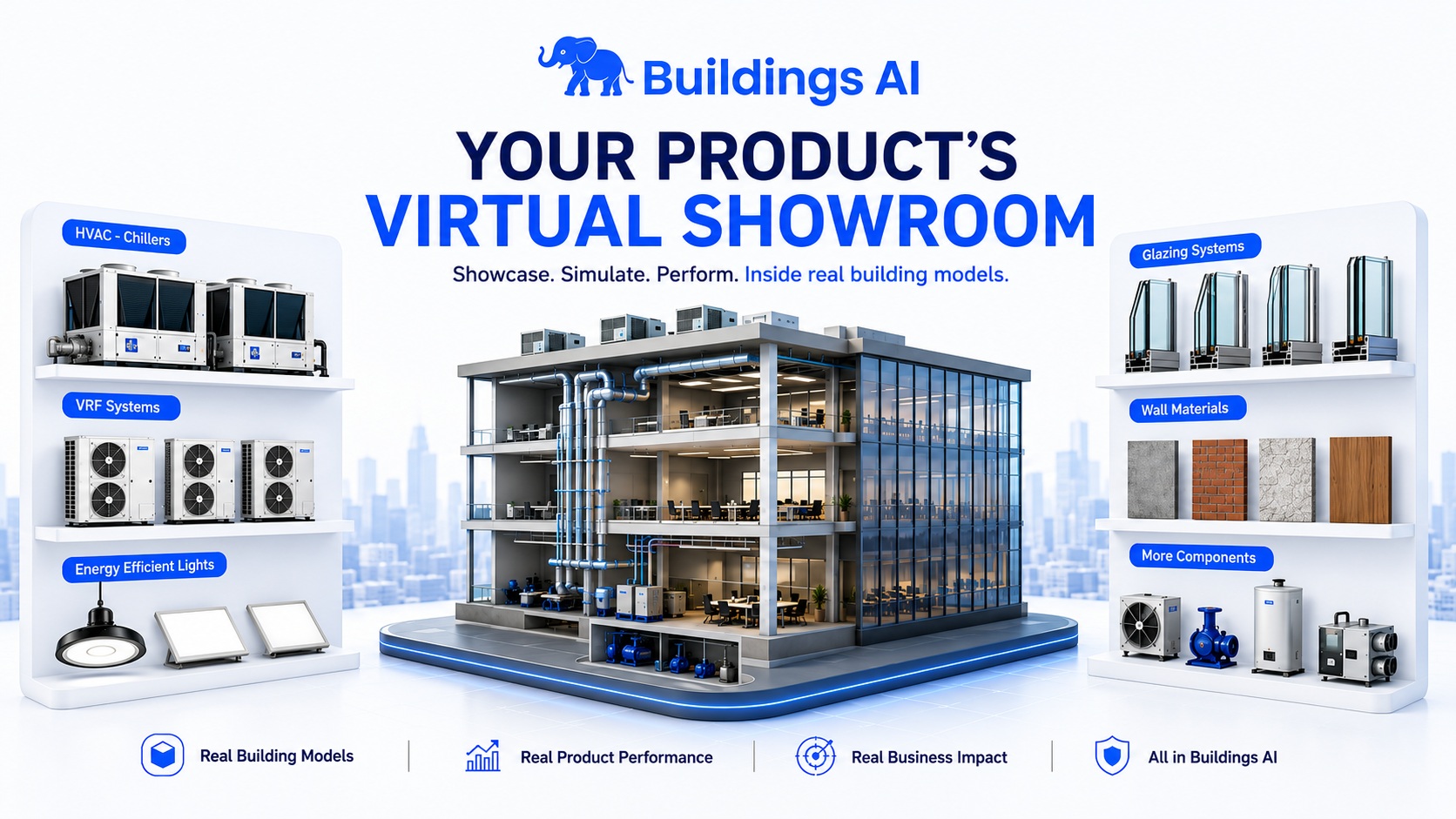

Introducing Buildings AI: Your Product's Virtual Showroom
The journey of building design — from rules of thumb and hand calculations to today's whole-building performance simulation — has been remarkable to watch. A generation ago, predicting how a building would perform meant thick reference tables, conservative assumptions, and a lot of faith. Today we can model an entire building — its loads, its energy, the comfort of the people inside it — before a single brick is laid.
But let me ask the questions that really matter. Has that simulation become a tool every designer reaches for? Is every manufacturer's product available inside it, ready to be chosen? Can a building owner trust the numbers enough to confidently pick a newer, better technology over the familiar one? Too often, the honest answer is still no.
I have spent most of my career on one stubborn idea: that powerful simulation should belong to everyone who designs, not just to a few specialists with big budgets. At CCTech and simulationHub we call it democratizing simulation. We have chased it through our autonomous CFD apps, putting flow simulation into the hands of valve and HVAC designers who once thought CFD was out of reach. Buildings AI is the next step on that same road — and this time, it isn't only about the designer. It's about you, the manufacturer.
Think about how a product gets chosen today
Picture a building owner, or the engineer advising them. They are standing in a crowded room, and every manufacturer is shouting at once — my chiller is best, my fan is best, my envelope is best. Every claim sounds reasonable. None is easy to check against the actual building in question. So what does a sensible person do when surrounded by confident strangers all promising the world? They retreat to the familiar. They pick what they already trust, because the unfamiliar option — even if it is genuinely better and cheaper to run — feels like a financial risk.
That is the quiet tragedy of our industry. Good products lose, not because they perform badly, but because nobody could prove they were the right choice at the right moment. And from your side of the table, it is just as frustrating. You have a genuinely better product, and you are left asking: I have exactly what they need — why can't I be heard?
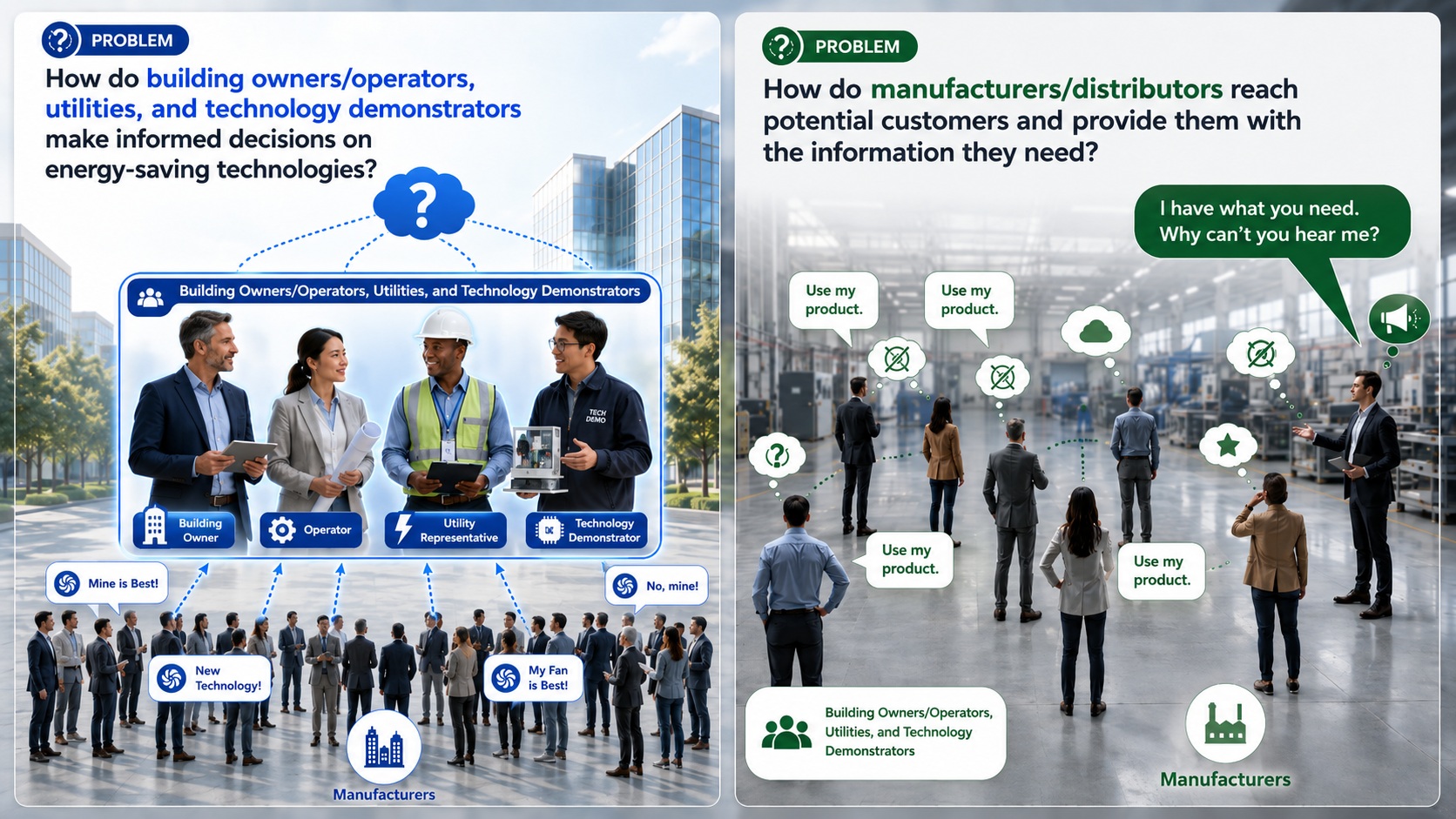
Here is the thing I have come to believe deeply: simulation is how you cut through that noise. A credible model does not take anyone's word for it. It tests your product against the real building, the real climate, the real code — and produces numbers anyone can check. The shouting collapses into one honest comparison. For the owner, an act of faith becomes an informed decision. For you, it is finally a way to be heard — not by shouting louder, but by letting your product's performance speak for itself, in the exact place the decision is made.
Why no two buildings can be sold the same product
There is no single "best" chiller, "best" wall, or "best" pump that wins everywhere. Every building is different. Every climate zone loads a system differently. People behave differently, and codes change from one city to the next. The same high-efficiency chiller can be the hero in a humid coastal tower and an also-ran in a dry inland warehouse — same product, opposite outcome — simply because the context is different.
No spec sheet can capture that. Only a model can. And that changes how you should think about marketing your product: instead of claiming it is good in general, you let it prove it is the right fit for this project, in this climate, under this code. That is not a brochure. That is a sale waiting to happen.
Simulation is a sales enablement tool, not just a design tool
Here is a shift I don't think our industry has fully absorbed yet. We keep treating simulation as the designer's job — something that happens on the other side of the wall. But its deeper power is something else entirely: it is how a product earns trust and gets chosen.
And why does trust matter so much here? Because every building is different. A number printed on your brochure was measured in some other building, under some other conditions — and a careful client knows it. So a generic claim, however true, never fully convinces, because it was never about their building. The only thing that genuinely builds trust is proof grounded in the project actually in front of them: how your product performs in this building, in this climate, under this code.
That is exactly what simulation provides. It turns your claim into a result the client can see in the context of their own building — and that is what closes the gap between "sounds good" and "let's specify it." This is the hypothesis we are betting on: simulation is not only a design tool, it is a sales enablement tool. In a world where no two buildings are alike, the only convincing proof is the one built on the customer's own building — and that proof is what earns trust, and wins the sale.
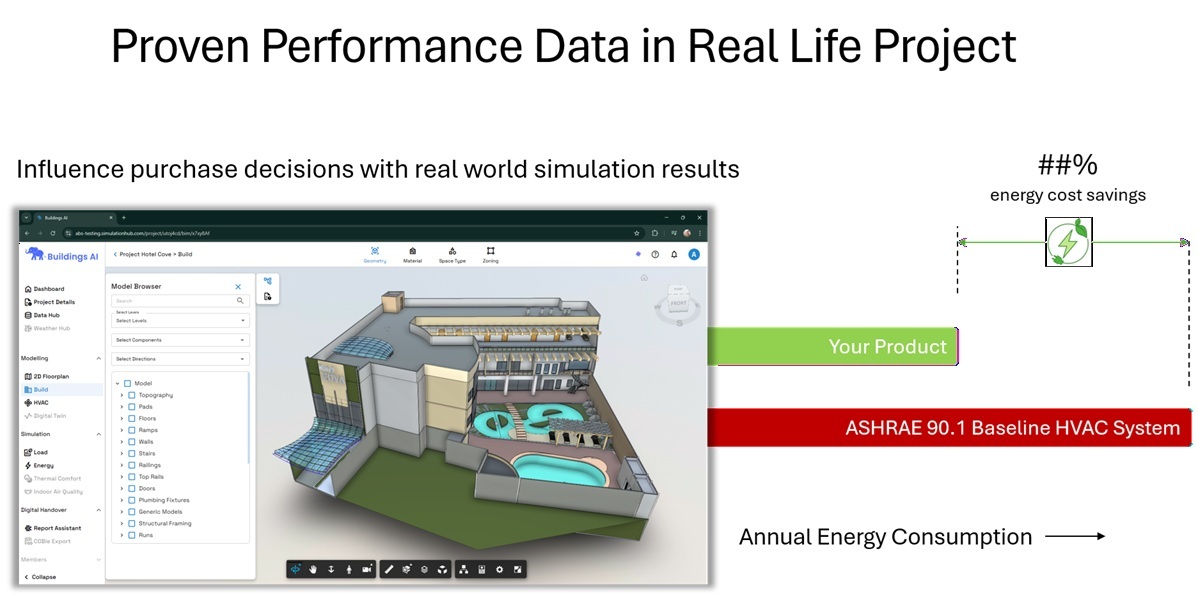
And it is not only the buyer who gains from that proof. The designer making the decision gets the same clarity. Right inside the model, they can check the actual return on investment of the choice in front of them — which product pays back faster in this building, which one the owner will thank them for in five years — before they commit to anything. Instead of specifying on habit and hoping for the best, they specify on numbers and know. A designer who can see the ROI of a decision specifies it with confidence, and that confidence is good for everyone — most of all for the manufacturer whose product the numbers favour.
Why this matters more every single year
This is not a "nice to have." Three forces are making whole-building simulation unavoidable, and they are all moving in one direction — toward you needing your products inside the model.
Codes keep getting stricter, every cycle. Buildings consume roughly 40% of the world's energy, and the bar keeps rising. A building designed to today's leading energy standard uses about half the energy of one designed in the mid-1970s. Each new edition of the codes, and each new green-building rating, ratchets it tighter. You cannot meet that bar with a rule of thumb anymore. You have to prove it — and proving it means simulation.
Carbon is no longer just about operation. For years we counted only the energy a building burns once it is running. Now the industry is waking up to embodied carbon — the carbon locked into your materials and equipment before the doors even open. The right place to weigh that is the same model where the building is designed, and it is a direction we are actively building toward.
The climate itself is changing under our feet. We have always sized systems against historical weather. But the past no longer predicts the future. A system sized for yesterday's summers can be undersized for the heat of the decades it will run in. Designing responsibly now means simulating the future, not looking up the past.
And here is the good news: as the bar has risen, the technology to clear it has finally caught up. BIM now carries the design data we need. Computing power that once lived only in research labs is ordinary today. And trusted, validated engines like EnergyPlus give us results we can stand behind. The pieces are all on the table at last.
The honest problem we set out to solve
So why isn't every product already in every model? Two reasons, and they feed each other.
The first is data. Designers simply cannot get credible, product-specific performance data, so they fall back on generic assumptions that erase everything that makes your product special. The second is the tools. Too much of the software in daily use is fragmented and rigid — a maze of spreadsheets, pop-ups, and disconnected forms — and much of it still leans on shortcuts like CLTD and RTS, hand-calculation methods from decades ago when computing was scarce. They were clever compromises for their time. But a compromise is still a compromise, and it costs you accuracy exactly where it matters.
What we set out to build with Buildings AI
When we designed Buildings AI, we held ourselves to a few simple goals — the same discipline that has guided every product we have ever shipped:
- Accurate, no compromise. It runs the rigorous heat-balance method on EnergyPlus, the solver the industry trusts — not the old simplifications.
- Easy enough to actually use. Through capabilities like HVAC Canvas, a designer selects real equipment with fully modeled performance and drops it straight into the model. No jargon, no maze.
- AI that does the hard work. This is where the name comes from. An agentic AI assistant builds, calibrates, and runs the model itself — turning a job that used to take days into one that takes minutes, and freeing the designer to weigh real options instead of wrestling with data entry. It is genuine assistance for making better, faster decisions — and a human stays in the loop at every step, so you get the speed without ever giving up control.
- Built for the modern world. It works straight from the BIM and design files a project already produces — no rebuilding everything from scratch just to run a simulation.
- A home for every product. HVAC, yes — but also envelopes, glazing, pumps, and motors. If it shapes how a building performs, it belongs in the model.
- Trusted by everyone in the room. Real numbers, on a validated engine, that an owner and a designer can both believe.
And getting your products in is light work. You share the documentation you already have — spec sheets, performance tables, BIM families, catalogs. We convert it into modeling-ready performance. Your team reviews and confirms. Your products go live, ready for designers to select. That is it.
This is already happening
I want to be honest about where we are, because we have been here before. When we launched our first simulation app, we were thrilled to cross a few hundred early users who believed in the idea. Buildings AI has already crossed 700+ signups — designers, consultants, and manufacturers who can feel where this is going. The library is filling. The designers are arriving. And every product that joins makes the platform more valuable for the next one — which is exactly why the manufacturers who come in early are the ones who compound the longest.
Now it's your turn
Your most important showroom is no longer a booth at a trade show. It is the model on the designer's screen, at the moment they decide what goes into the building. We would love to put your products there.
There is nothing to hand over today and no commitment to begin. Just tell us who you are and what you make, and we will show you what your catalogue could look like at the moment of specification.
Tell us about your products →
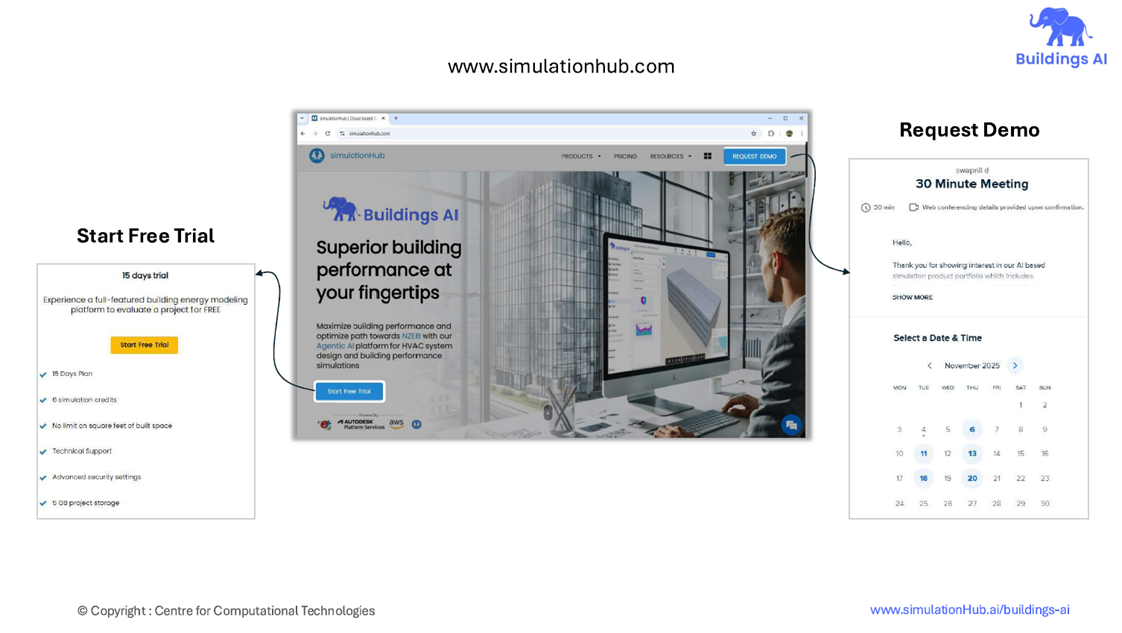
Take the Next Step: Start Your Free Trial or Book a Demo
Comments
Recent posts