Written by Praveen Kumar
Tuesday, July 07, 2026
Autonomous Valve CFD: Making Valve Simulation Repeatable, Faster, and Designer Friendly
By
Praveen Kumar
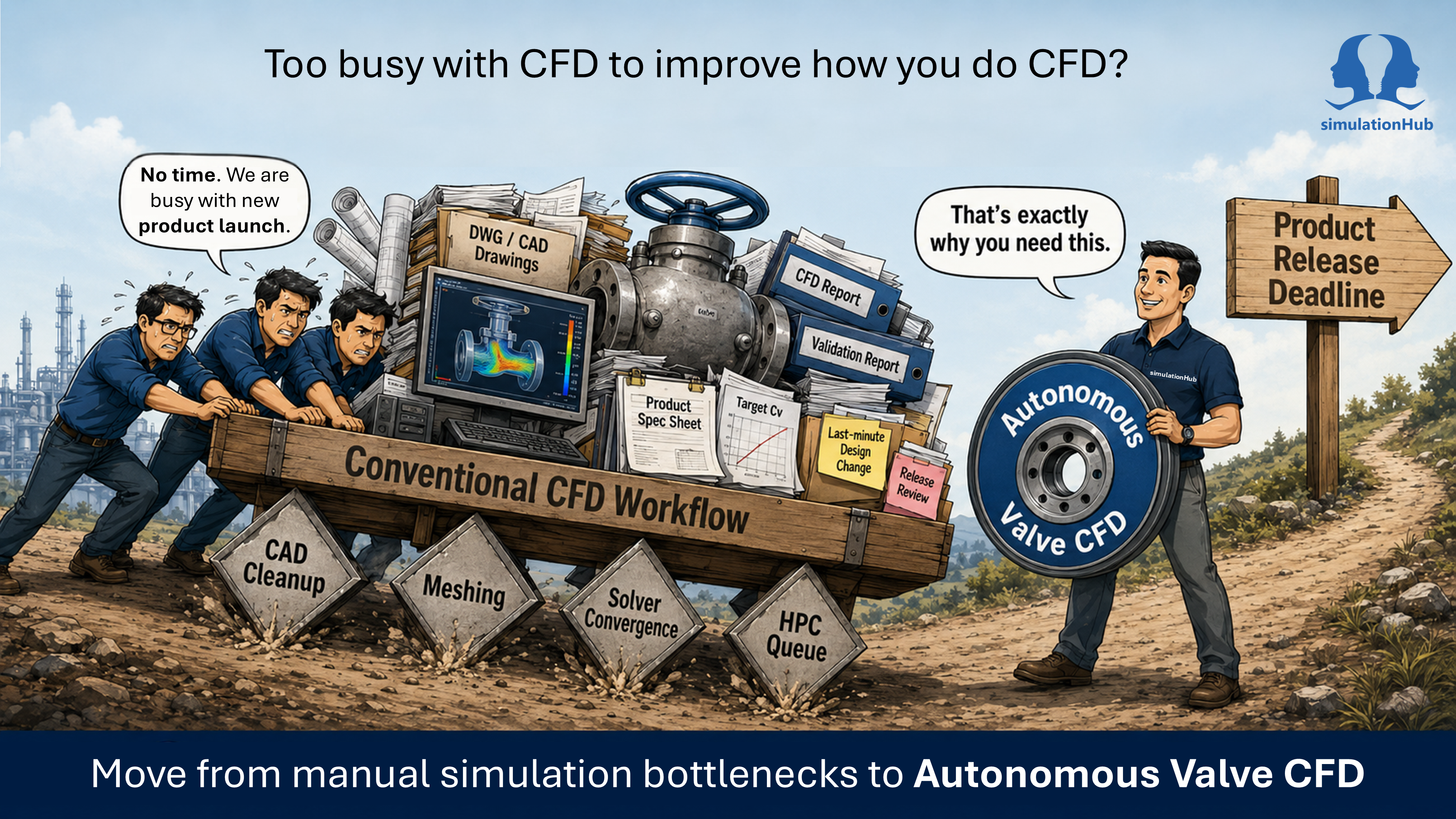

Every valve design team understands the pressure of a high-stakes product launch. The valve design must be locked, performance data must be generated, reports must be prepared, and the review is already on the calendar.
This is exactly when Computational Fluid Dynamics (CFD) is supposed to help the team move faster. It should support faster design iteration, validate performance, compare alternatives, and give engineers confidence before committing to a final design. But in many organizations, the conventional CFD workflow itself becomes part of the bottleneck due to its vicious cycle of manual labour. A gruelling sequence of CAD cleanup, fluid volume extraction, meshing, boundary conditions, turbulence model selection, solver convergence, HPC time, post-processing, and report writing all demand time and expertise. Each step is necessary, but together they can become a heavy cart that the design team has to push while the product release deadline keeps moving closer.
For teams without in-house CFD capability, the pressure looks different but often lands in the same place. Physical flow loop testing can take months and a significant budget to validate a single design point. Outsourcing to a consultancy is faster than building a prototype, but it still means a multi-week turnaround and a report handed back with limited visibility into how the number was actually reached - another design cycle spent waiting on someone outside the team.
Either way, when leadership suggests CFD process improvements, the response from the team is usually the same: “No time. We are busy with the product launch.”
The team is not resisting improvement. They are so consumed by the sheer manual labour of pulling the heavy, clunky cart of conventional CFD workflows. The heavy cart is not only slow because it is overloaded. It is slow because every square wheel represents a manual decision point. And every manual decision point introduces the possibility of variation.
When the User Becomes the Variable
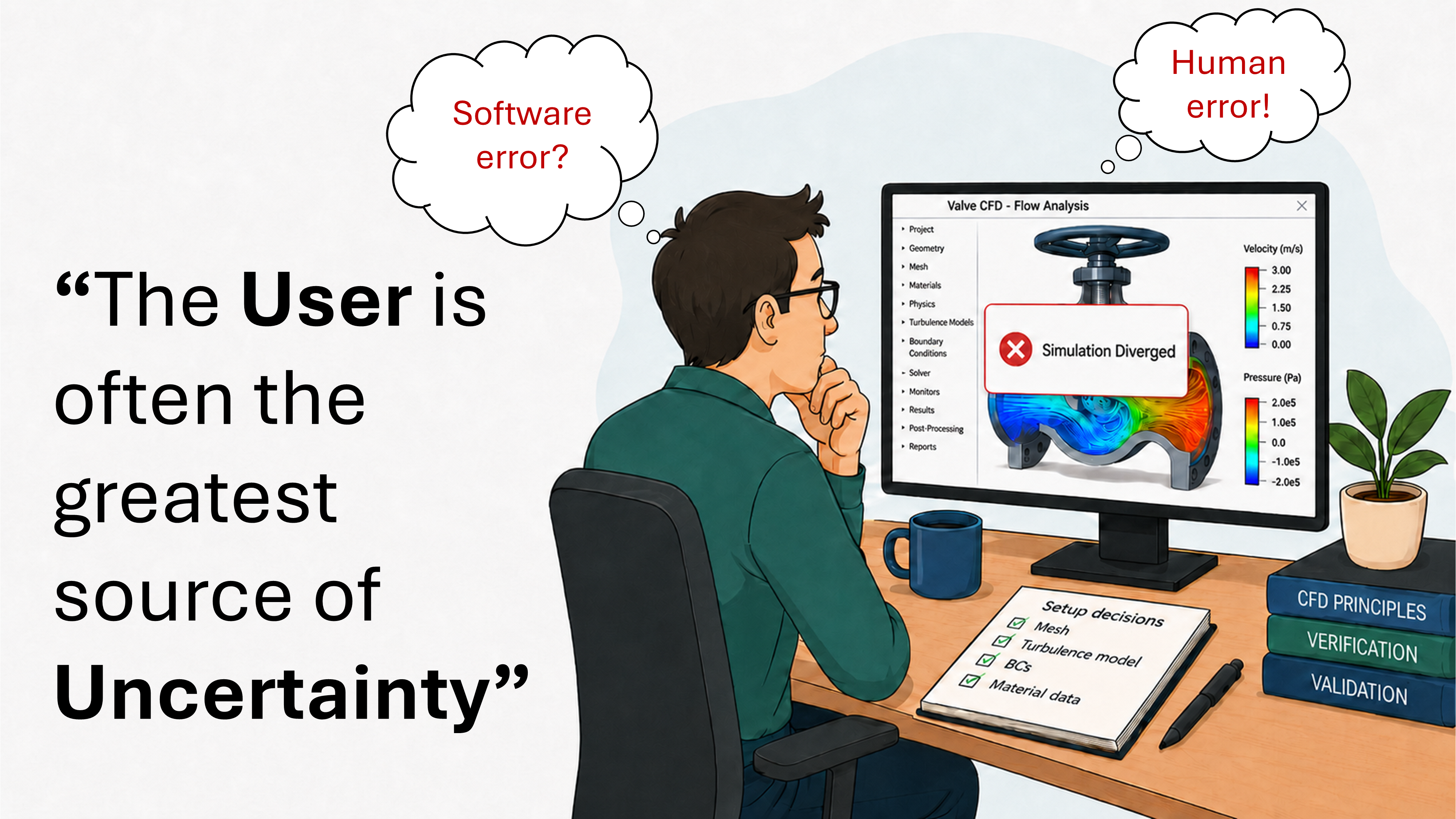
When a complex valve simulation crashes or produces an unexpected result, the first instinct is often to blame the software. But in conventional CFD workflows, the more uncomfortable truth is that the user can become one of the greatest sources of uncertainty.
CFD Users Uncertainty
The process depends too heavily on individual users’ experience. Mesh strategy, boundary conditions, turbulence model selection, convergence criteria, y+ requirements, material assumptions, and post-processing methods can all influence the final result. When these decisions are made manually, two users can follow broadly similar intentions and still arrive at different answers.
In this environment, the simulation is no longer a pure reflection of physics; it is also a reflection of the person behind the screen.
CFD is Colourful. But it is Not Art.
CFD results often look beautiful and colourful. Velocity contours, pressure fields, streamlines, and flow patterns can look impressive. But CFD is not art. It is science. And science should be repeatable by anyone who follows the correct process.
This is where conventional CFD can become difficult for product development teams. The conventional simulation workflows require a long chain of subjective micro-decisions: how fine the mesh is, which turbulence model to use, whether the Y+ criteria are met, whether the results converged... The physics is scientific, but the workflow often behaves like a craft that depends on the skill of the individual user.
Same valve. Different user. Differet Cv.
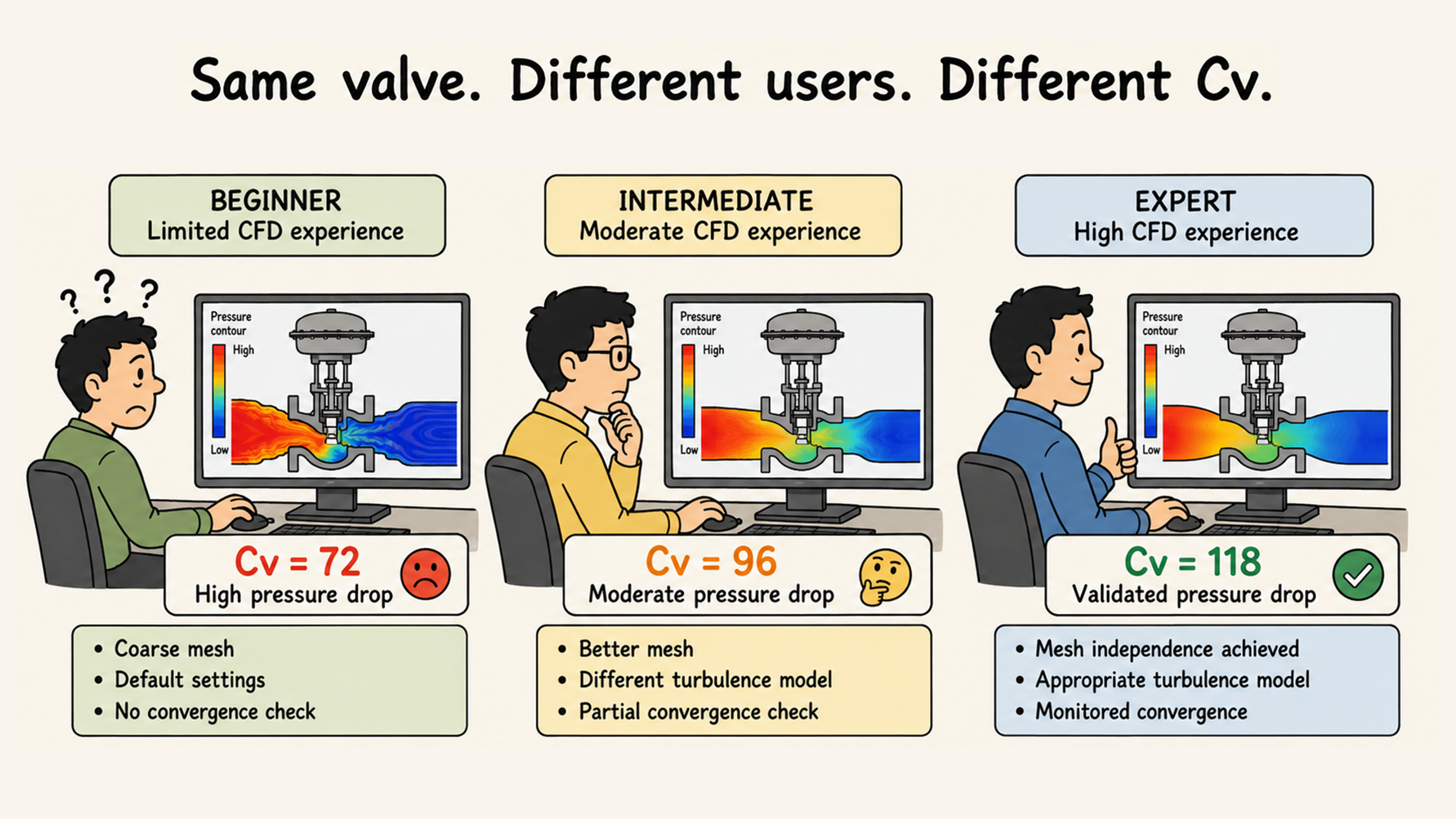
Consider the exact same valve geometry analyzed by three different engineers. A beginner may rely on default settings and a coarse mesh. An intermediate user may refine the mesh and try a different turbulence model. An expert may spend days checking mesh independence, monitoring convergence, and validating assumptions.
Same valve. Same physics. Different users. Different Cv.
For product development, that is a serious risk. If the valve has not changed, the operating condition has not changed, and the physics has not changed, the result should not vary significantly because of who ran the simulation. When results become user-dependent, simulation data becomes harder to trust for release decisions, customer commitments, and design optimization.
Now ask the harder question: which of those three engineers is running your next valve simulation? And are you willing to bet a product release on the answer? Can the team afford to keep doing CFD the old way?
The Shift to Autonomous CFD
This is where Autonomous CFD becomes important.
Autonomous CFD is not just about automating workflows or running simulations faster. Speed matters, but the greater value is standardization. An autonomous process brings intelligence into the simulation workflow by guiding critical decisions such as mesh refinement, turbulence model selection, and convergence handling. This reduces user-to-user variation and helps ensure that the same valve inputs lead to the same reliable engineering output.
It does not remove engineering judgment from valve design. It removes avoidable uncertainty from routine simulation setup. Engineering judgment should be applied where it matters most: comparing design alternatives, interpreting performance, understanding trade-offs, and making confident product decisions.
Explore Autonomous Valve CFD (AVC)
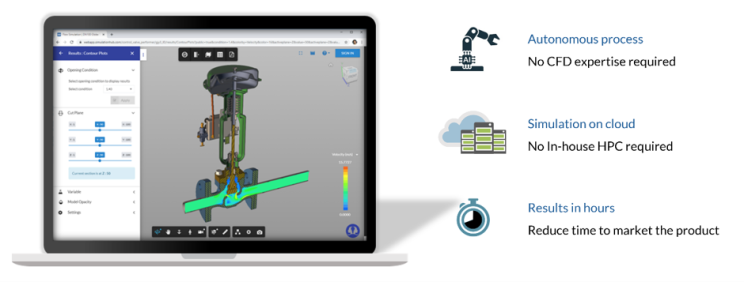
Autonomous Valve CFD (AVC) is a specialized app for valve simulations and virtual flow loop testing, built to help valve design teams standardize simulation workflows, reduce expert dependency, and generate repeatable valve performance insights faster.
AVC Key Features
AVC's autonomous workflow automates CAD cleanup, fluid volume extraction, meshing, and solver convergence, trained specifically on different valve geometries, following recognized flow-testing standards, so that the workflow itself determines the result and not the individual running it.
What that looks like in practice:
- Same valve, same inputs, same answer — every time, regardless of who submits the job
- Full simulations in under 1-2 hrs, compared with 3–5 days for a manual CFD study or 3–4 months for physical flow loop testing
- No CAD cleanup and no in-house HPC — upload the CAD model, set flow direction and opening conditions, done
- Cv, Kv, Cdt, cavitation index, and full pressure/velocity fields, delivered with a complete technical report
For valve design teams, this changes the role of CFD in the product development cycle. CFD no longer remains a specialist-gated checkpoint at the end of the design process. It becomes a practical design tool that engineers use earlier and more often to compare options, estimate Cv, understand pressure drop, evaluate performance, and reduce uncertainty before physical testing.
That is the real shift: From manual bottlenecks to automated workflows. From expert-dependent to standardized. From "who ran this simulation?" to "what does the simulation say?"
In a competitive market, uncertainty is a liability. Reduce your time-to-market, eliminate human error, and secure your product release. Don't let your simulation tools be the reason you miss your next product deadline.
This is where Autonomous Valve CFD becomes important.
Schedule a call with our product expert to discover how Autonomous Valve CFD can support your valve design process, improve design iteration, and bring more confidence before product release.
Explore the Updated AVC Website
Book a Free Demo
Comments
Recent posts