Written by Angirekula Venu
Sunday, April 19, 2026
From Sketch to Stitch with the Fabric Duct Design Suite
By
Angirekula Venu
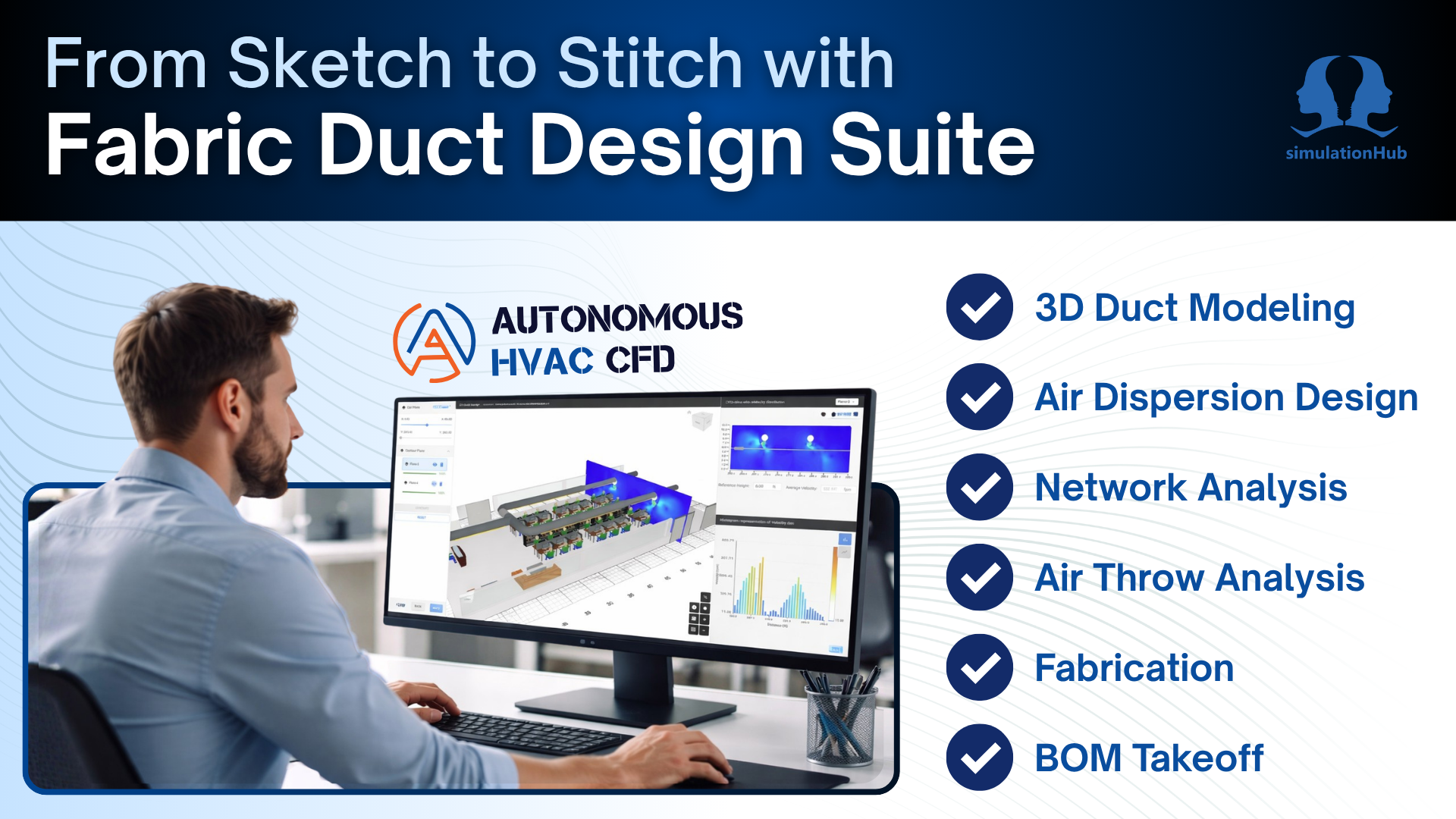

Designing high-performance Fabric/Textile duct HVAC systems today still involves fragmented workflows. Consultants handle calculations separately; layouts are created in CAD tools, and fabrication details are developed downstream. This disconnect introduces inefficiencies, repeated effort, and design uncertainty.
Consider Alex, an HVAC consultant. His workflow starts with spreadsheets for duct sizing and airflow calculations, followed by manual drafting in CAD. When architectural layouts change, the process often restarts - requiring recalculation and redrawing. This iterative loop is time-consuming and prone to errors.
The AHC-Fabric Duct Design Suite is designed to address this fragmentation by connecting the entire fabric duct project workflow within a single platform.
Chapter 1: The Contextual Blueprint
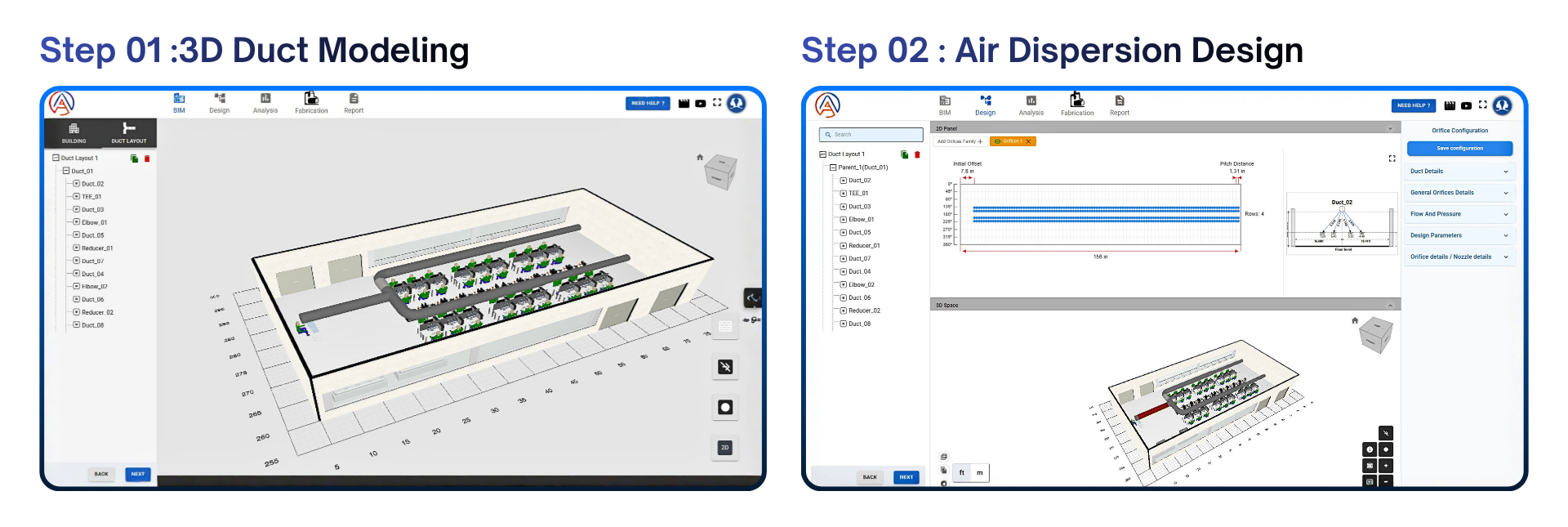
Alex begins within a 2D workspace that is purpose-built for HVAC design. Instead of working with abstract geometry, he defines the actual design context - walls, windows, occupancy, and furniture - along with textile properties that influence airflow behavior. This ensures that system design is aligned with spatial and environmental conditions from the start, reducing the need for downstream corrections.
Chapter 2: From Layout to 3D Intelligence
Using a library of prebuilt components, Alex assembles the duct system directly within the 2D environment. Automated snapping ensures accurate connections between elements, while parametric controls allow precise adjustments.
• 3D Duct Modeling - Creation of accurate, connected duct geometry with automated 3D generation from 2D layouts.
From this layout, the platform generates a true-to-scale 3D model instantly. This enables early visualization, improves coordination with architects, and removes the need for separate 3D modeling workflows
Chapter 3: CFD-Driven Performance Insights
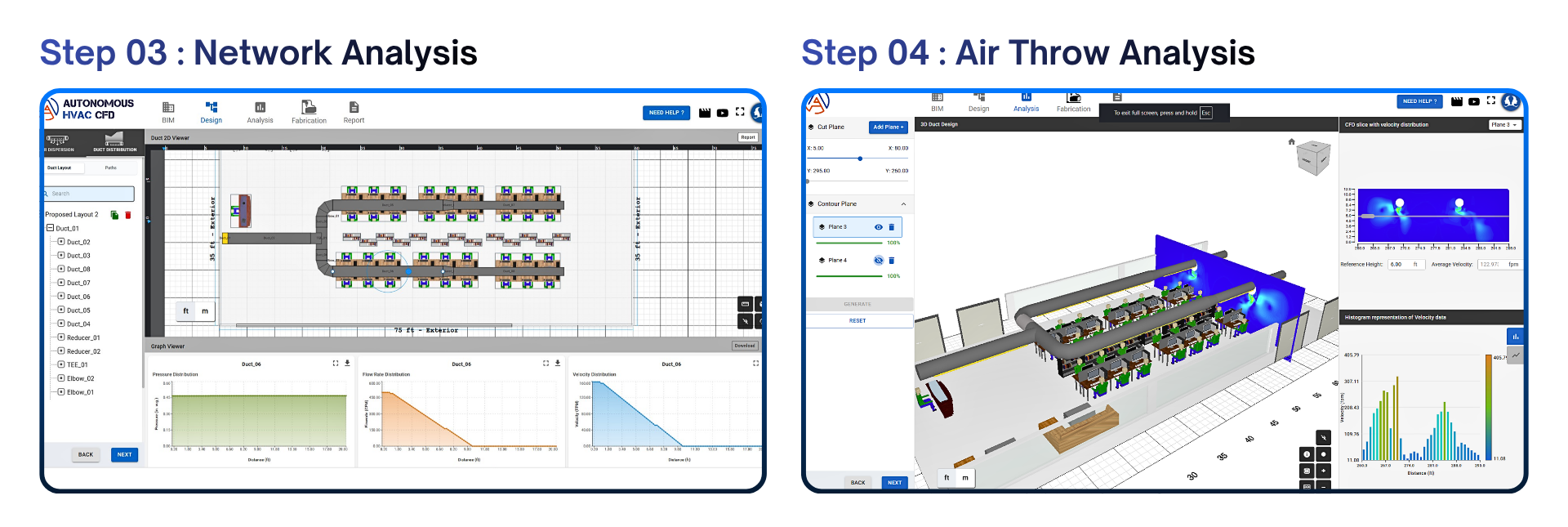
Performance validation is integrated directly into the design process. Alex can evaluate airflow distribution, air throw, and velocity profiles using built-in analysis tools.
• Air Dispersion Design - Definition of airflow behavior based on spatial context, occupancy, and textile properties.
• Network Analysis - Evaluation of system-level airflow performance, including distribution of pressure, flow, and sound inside the fabric duct system.
• Sizing System - Evaluation and design of the complete fabric duct system using an integrated static regain sizing module, enabling efficient airflow distribution while simplifying the designer’s workflow.
• Air Throw Analysis - Assessment and optimization of air reach to ensure effective coverage and occupant comfort
With one-click simulations and interactive controls, he can quickly identify and resolve performance issues. This shifts validation from a late-stage activity to a continuous part of design development.
Chapter 4: The Path to the Factory Floor
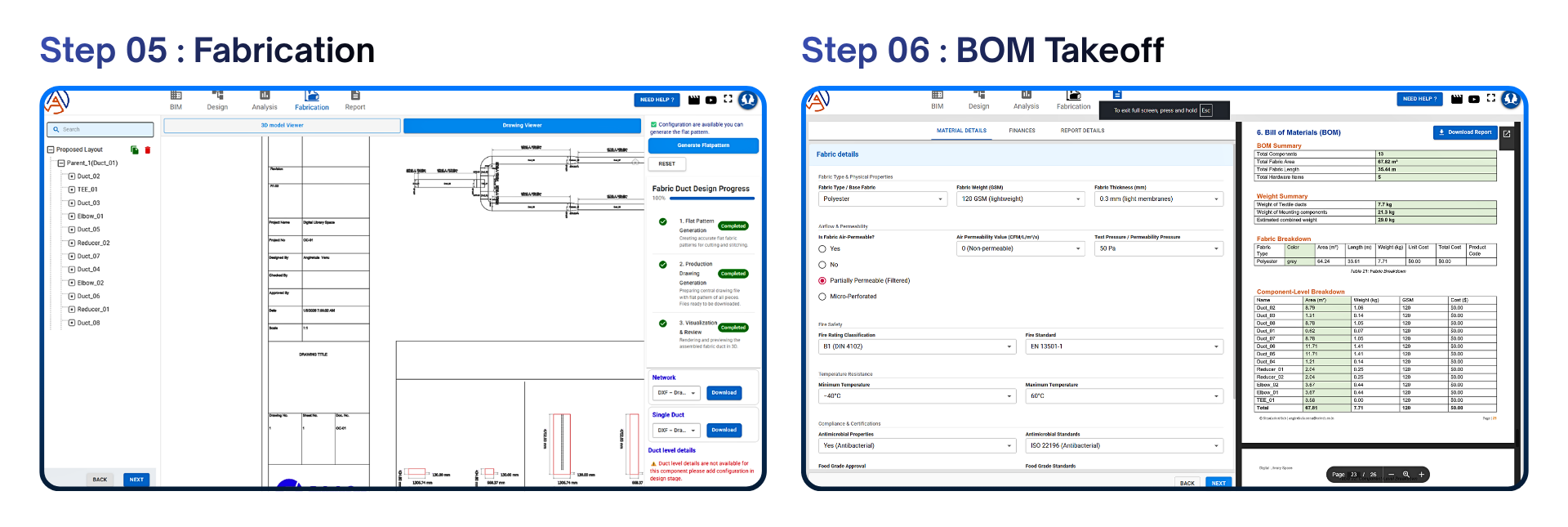
Once the design is finalized, the designer can process this data directly to shop floor, and which can be used to upload to laser cut machines to manufacture the system with ease. This includes flat patterns, production drawings, and billing materials.
• Fabrication - Automated generation of flat patterns and production-ready outputs for manufacturing.
• BOM Takeoff - Instant extraction of bill of materials for costing and project planning.
By connecting design directly to manufacturing, the platform eliminates manual translation and ensures that the final output accurately reflects the validated design.
The Outcome
By the end of the process, Alex is no longer caught in cycles of rework and uncertainty. His workflow becomes streamlined and predictable, where every design decision is validated early and carried through with confidence to the final output.
AHC-Fabric enables this shift by connecting design, performance validation, and fabrication into a single continuous workflow. If you're looking to reduce inefficiencies and bring greater accuracy to your HVAC projects, it’s time to explore a more integrated approach

Comments
Recent posts