Written by Aaditya Ruiker
Tuesday, May 19, 2026
Building Design Stages - And Where Buildings AI Actually Fits
By
Aaditya Ruikar
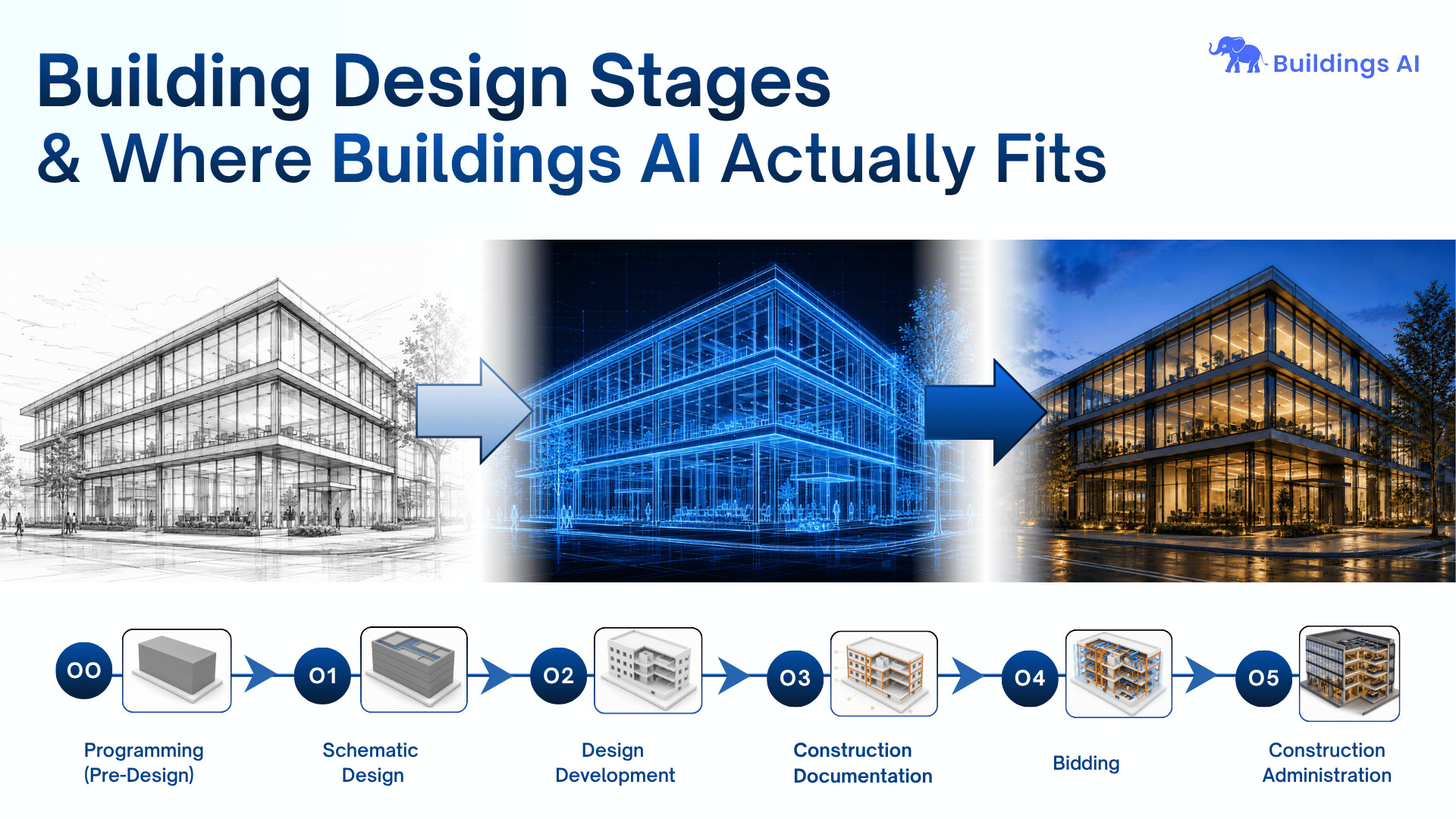

Designing a building isn't a single creative leap. It's a structured journey - and the AIA knows it well.
Designing a building isn't a single creative leap. It's a structured journey — and the AIA defines it clearly.
ASHRAE 209 outlines a structured building performance Design process that guides projects from early concept development through post-occupancy evaluation. Not bureaucracy - but a proven framework that keeps teams aligned with goals, analysis intent, and deliverables at every stage.
The question isn't whether to follow the stages. It's how intelligently you move through them.
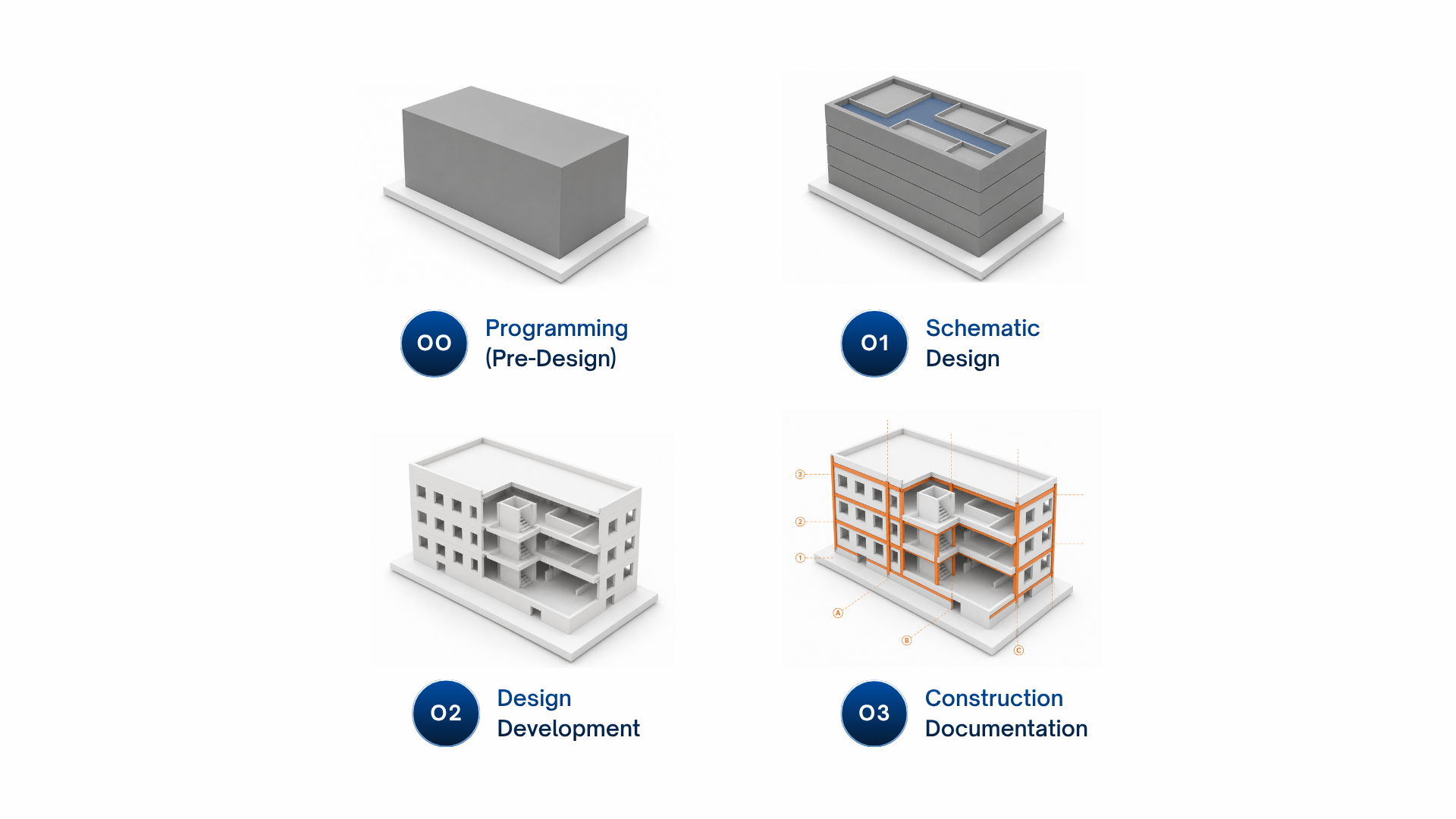
The Four Stages
00 - Conceptual Design: Define project goals, space requirements, budget, and constraints. Everything that follows is built on this foundation.
01 - Schematic Design: Early layouts, massing, and spatial concepts. The most flexible stage — changes are cheap, and direction is everything.
02 - Design Development: Concepts resolved. Materials, systems, and MEP coordination come together. Performance decisions shift from directional to specific.
03 - Construction Documentation: Detailed drawings and specifications for permits and construction. Legal instruments — accuracy is non-negotiable.
From Fragmented Workflows to Connected Decision-Making
Four stages. Clean on paper. Messier in practice.
At every stage of transition, design teams face the same invisible tax: rebuilding context. A schematic massing model built in one tool can't feed directly into an energy simulation engine. An HVAC sizing spreadsheet from Design Development doesn't connect to the Revit model. Construction Document sets don't carry forward the performance intent established while conceptualizing.
Each phase handoff becomes a data reconstruction exercise - not a design exercise.
This is where Buildings AI enters - not to replace the process, but to close the gaps between the stages where information gets lost, rebuilt, and misaligned.
Where It Matters Most
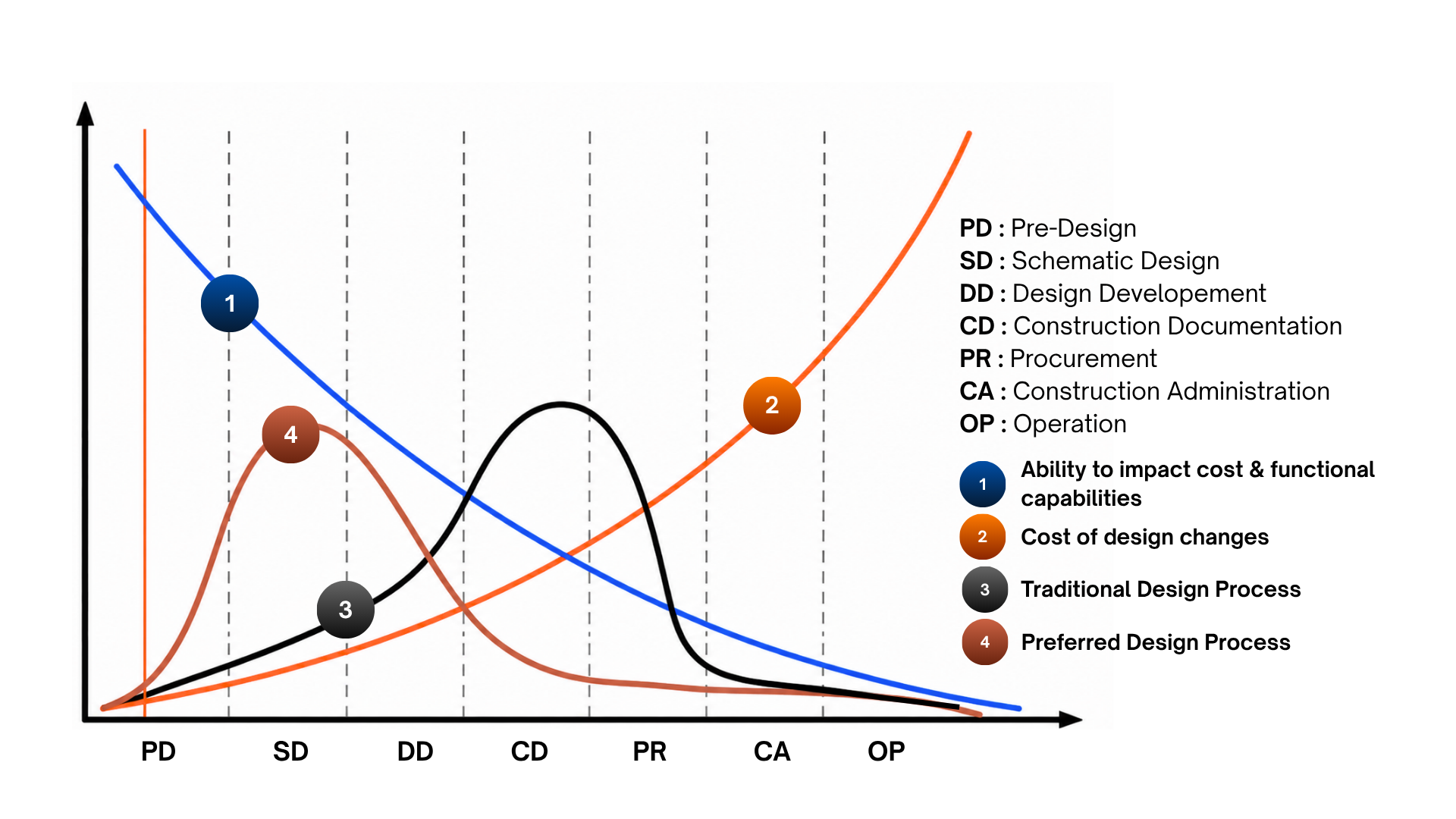
The cost of a design change follows an exponential curve across the ASHRAE 209 Design phases. At Schematic Design, a revised orientation costs an afternoon. At Construction Documents, the same change costs weeks and budget. Buildings AI is most valuable precisely in the window where design flexibility still exists - Stages 0 through 2.
Stage 00 · Conceptual — HVAC Conceptual (Ideal Loads)
A simplified, non-physical, decentralized HVAC model calculates exact heating and cooling loads — no equipment or system details required. Teams use it to compare massing, orientation, and envelope options at the fastest possible pace. Built for early feasibility and concept studies, before any system is selected.
A simplified, non-physical, decentralized HVAC model calculates exact heating and cooling loads — no equipment or system details required. Teams use it to compare massing, orientation, and envelope options at the fastest possible pace. Built for early feasibility and concept studies, before any system is selected.
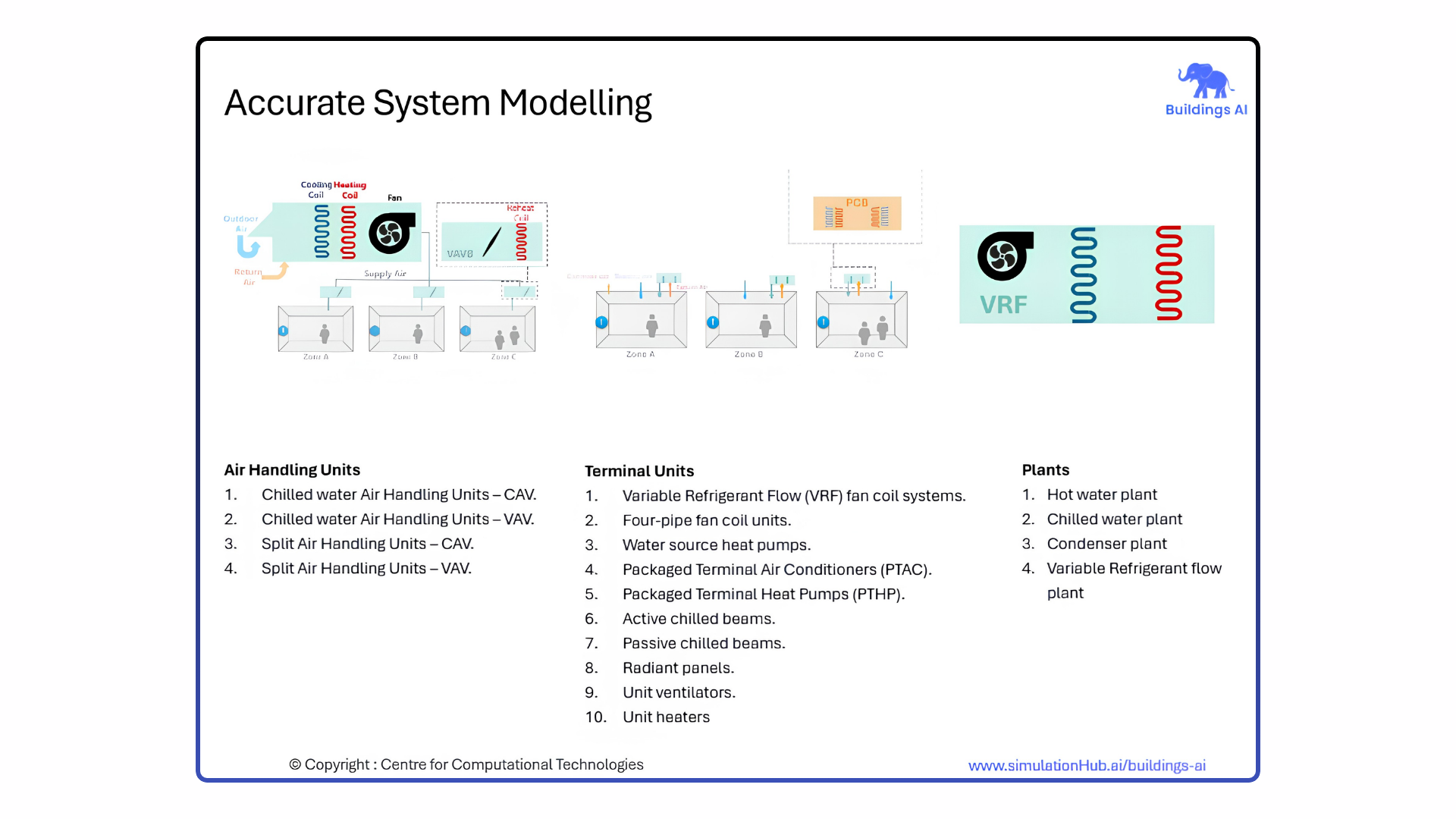
Stage 01 · Schematic Design — HVAC Schematic (Standard Systems)
Pre-configured HVAC templates deploy rapidly against the early model. Minimal inputs, sensible defaults — quick to set up, easy to iterate. Teams run load and energy comparisons across system options during the selection stage, without committing to full component detail yet.
Pre-configured HVAC templates deploy rapidly against the early model. Minimal inputs, sensible defaults — quick to set up, easy to iterate. Teams run load and energy comparisons across system options during the selection stage, without committing to full component detail yet.
Quick Energy Simulation
Runs rapid whole-building energy estimates on basic model geometry. Output: directional EUI benchmarks and envelope sensitivity — enough to make informed schematic decisions without waiting for a full DD model.
Runs rapid whole-building energy estimates on basic model geometry. Output: directional EUI benchmarks and envelope sensitivity — enough to make informed schematic decisions without waiting for a full DD model.
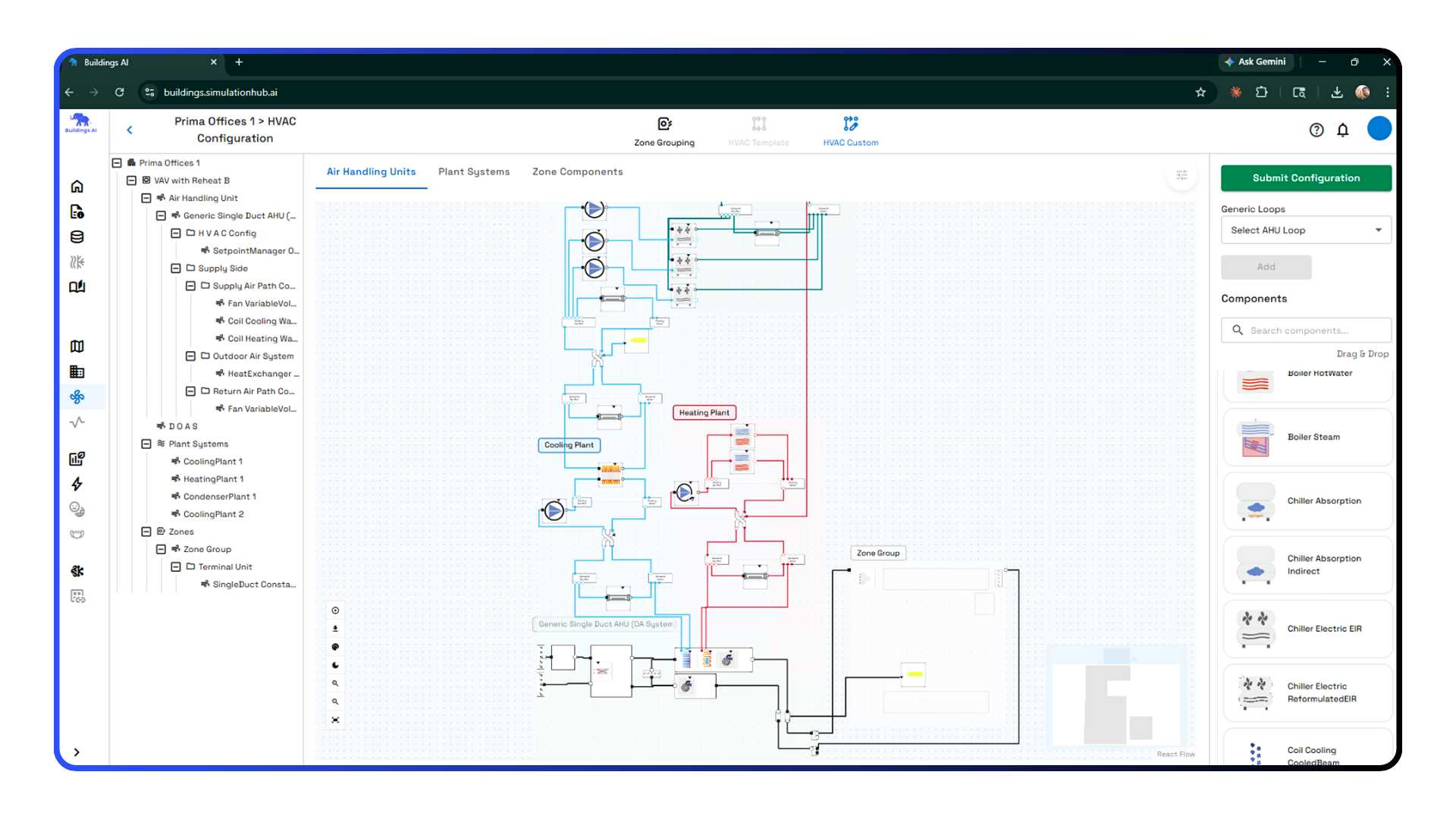
Stage 02 · Design Development — HVAC Detailed (Full Control)
Inside Buildings AI's HVAC Canvas, every aspect of the system is designed with precision - airside, plant-side, controls, and sequences. It is not a system selector. It is an interactive visual workspace where system logic is shaped naturally, supporting both standard configurations and custom modeling needs. High accuracy for performance prediction and detailed documentation.
Inside Buildings AI's HVAC Canvas, every aspect of the system is designed with precision - airside, plant-side, controls, and sequences. It is not a system selector. It is an interactive visual workspace where system logic is shaped naturally, supporting both standard configurations and custom modeling needs. High accuracy for performance prediction and detailed documentation.
Detailed Energy & System Simulation
Full-resolution simulation with material properties, internal load schedules, and configured HVAC systems. Output supports design decisions and early compliance documentation — before the CD phase locks specifications in place.
Full-resolution simulation with material properties, internal load schedules, and configured HVAC systems. Output supports design decisions and early compliance documentation — before the CD phase locks specifications in place.
Stage 03-05 · CDs → Bidding → Construction Administration
Where the quality of early-stage decisions shows up. Well-simulated designs produce cleaner documents, fewer bid RFIs, and fewer field surprises. Buildings AI's value here is in what prevents upstream.
Where the quality of early-stage decisions shows up. Well-simulated designs produce cleaner documents, fewer bid RFIs, and fewer field surprises. Buildings AI's value here is in what prevents upstream.
The Bottom Line
Building stages haven't changed - and they shouldn't. They exist for good reasons. What's changed is how much performance intelligence you can carry into each one, and how smoothly that intelligence moves from phase to phase without getting lost in translation.
Buildings AI doesn't reimagine the design process. It fits inside it - closing the gaps where data gets rebuilt; decisions get made blind, and performance intent gets separated from the model. From a structured Basis of Design in programming, to simulation-ready models at schematic, to fully configured HVAC systems in design development - the right insight, at the right stage, when it still shapes the outcome.
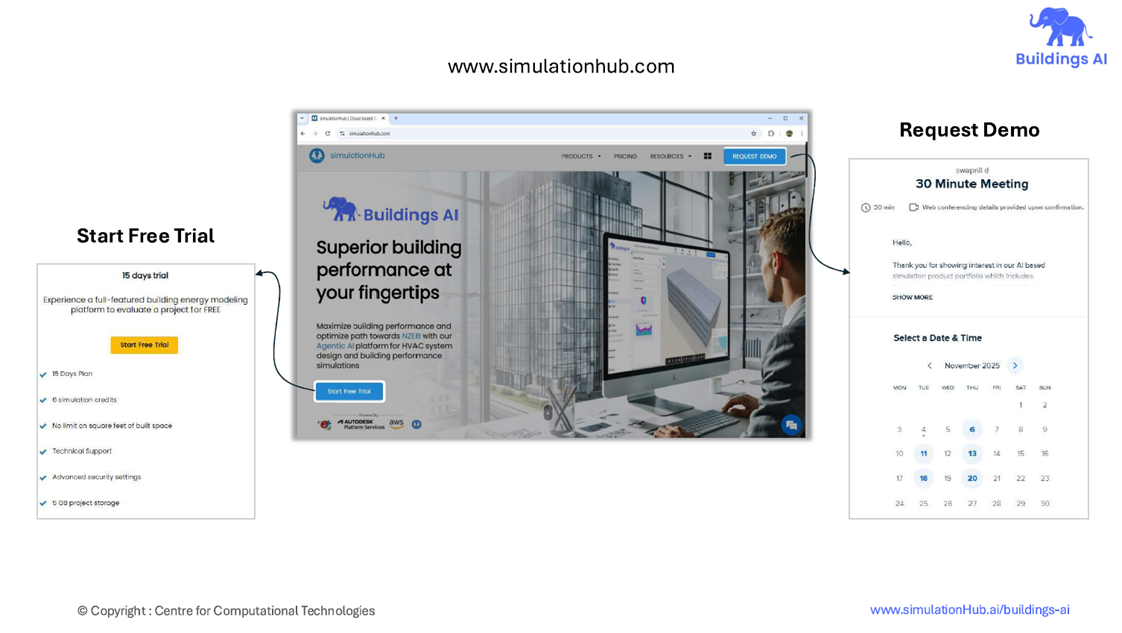
Take the Next Step: Start Your Free Trial or Book a Demo
Comments
Recent posts