Written by Rohit Chavan
Monday, May 04, 2026
From 3 months to 30 minutes: The valve performance data shift no manufacturer can afford to ignore.
By
Rohit Chavan

150+ valve manufacturers across 40 countries have already made this shift. The ones who haven't are responding to RFQs the same way they did three years ago.
There is a moment most valve designers know well.
A customer asks for performance data — Cv curves, cavitation guarantees, certified flow coefficients. And before the answer comes, a quiet calculation happens.
How long will the lab take? Is the prototype ready? Can we hold this customer long enough?
That calculation has a cost. It shows up not in the lab budget - those fees are visible - but in the bids that went to a competitor who arrived with validated data first. In the product lines that took four months to validate when the market moved in two. In the engineers who spent their best hours waiting for results instead of designing the next iteration.
Most of the time, that cost goes unaccounted. It lives in the revenue column rather than the expense column, which makes it easier to set aside.
Three timelines
Physical flow loop testing: 3 to 4 months per design iteration.
Traditional CFD simulation: 3 to 7 days — with a specialist, a licence, and a compute queue.
Autonomous simulation: under 30 minutes. Any designer on the team. No CFD expertise required.
These are the actual timelines valve manufacturers are operating on today - not projections. The gap between the first number and the third is not new. The technology to compress valve performance testing has existed in various forms for years. Computational Fluid Dynamics simulation, when properly configured and validated, produces results within ±5% of physical flow loop measurements, meeting ANSI/ISA-75.02 and IEC 60534 test procedure standards. The accuracy was available. What wasn't available was access.
Why access was the real barrier
Traditional CFD required a specialist to configure each simulation correctly for valve geometry. It required working knowledge of meshing, solver settings, boundary conditions. It required computing infrastructure that most valve design teams of ten or fifteen people could not justify.
The simulation industry built tools for CFD specialists. Valve designers — who think in Cv curves and RFQ windows, not meshing algorithms — looked at those tools and concluded, reasonably, that the technology was built for someone else.
So the timeline stayed where it was. Not because manufacturers didn't want faster validation. Because the path to it required resources and expertise most teams didn't have.
That is the access problem. It is worth naming clearly because the solution to it is not more powerful simulation software. It is simulation software that does not require the user to understand simulation.
What the shift looks like in practice
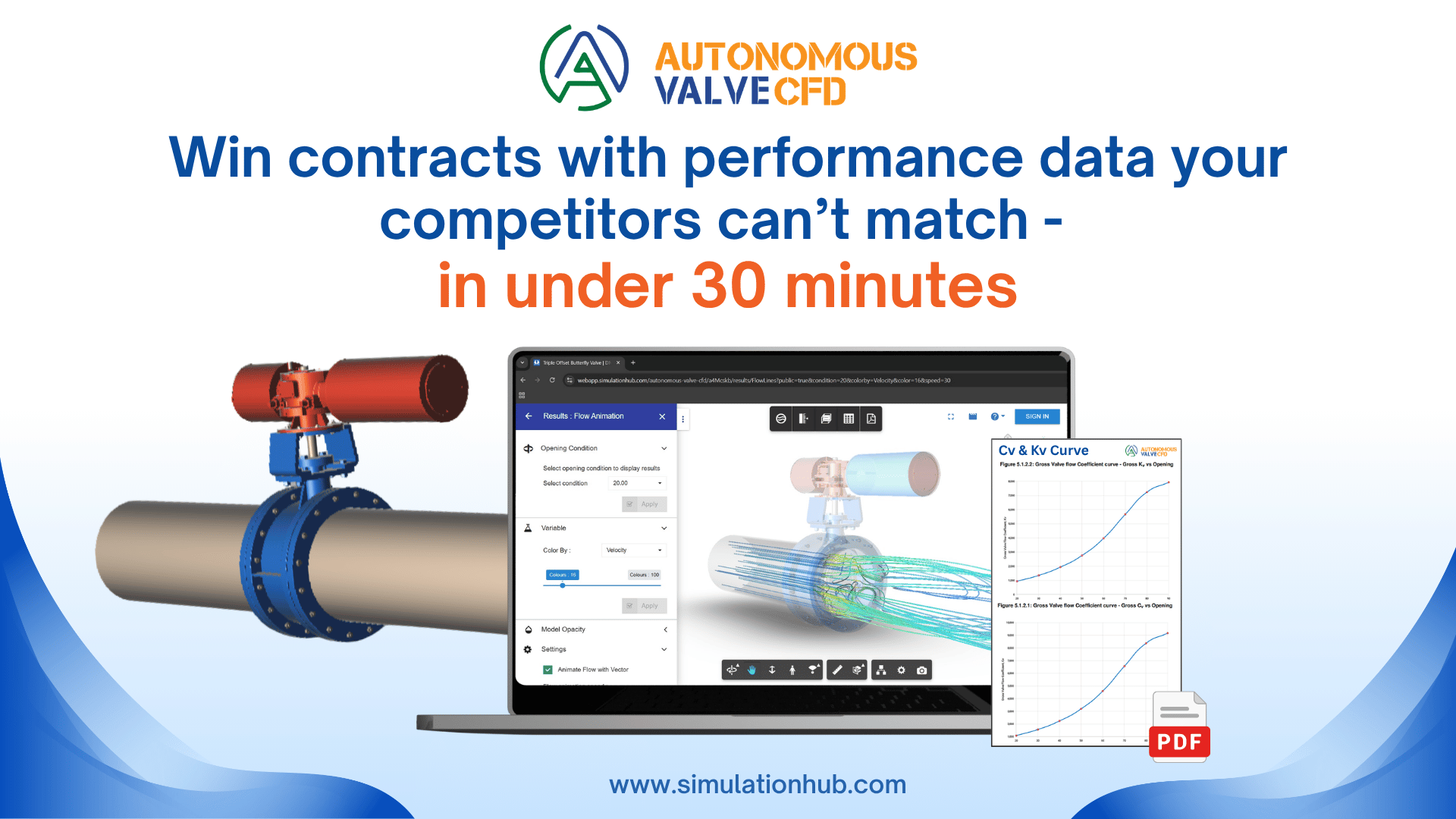
Autonomous simulation platforms built specifically for valve designers remove the specialist dependency. The input is a standard CAD file. The output is certified Cv, Kv, Cdt performance data, cavitation risk assessment, 3D flow visualization, and a ready-to-share PDF technical report.
The pipeline between those two points — CAD cleanup, fluid volume extraction, mesh generation, solver execution, post-processing — runs without human intervention, on cloud infrastructure, in under 30 minute
The consequence is not just speed. It is what speed makes possible.
When a simulation takes 30 minutes and any designer can run it, design iterations that previously required a lab booking or a consultant request can be evaluated the same afternoon they are conceived. Multiple variants can be compared in parallel. RFQs that ask for performance data can be answered the day they arrive.
Across manufacturers who have made this transition, two patterns are consistent.
First, the volume of simulations per design cycle increases significantly — teams that previously ran one or two validation checks per project run ten or fifteen, because the cost of each check is now measured in minutes rather than weeks. Second, the specialist bottleneck dissolves. Senior CFD engineers who were previously occupied with routine valve performance checks refocus on more complex analysis where their expertise is genuinely needed.
Neither of these outcomes requires the technology to be revolutionary. They require it to be accessible.
What the validation looks like
One question that comes up consistently from manufacturers evaluating this shift: does the accuracy hold on our specific valve geometry, not just the geometries in a demo?
The validation basis is documented. Results are independently verified against physical test data from certified flow testing institutions — within ±5% deviation across butterfly, ball, globe, and segmented ball valve types. The methodology follows ASME V&V 20, the international standard for verification and validation in CFD. Standards compliance — ANSI/ISA-75.01, ANSI/ISA-75.02, IEC 60534-2-1, IEC 60534-2-3, AWWA M49 — is built into the platform, not applied manually.
Over 14,000 valve simulations have been completed on the platform across more than ten valve types, from small-bore control valves to large-diameter industrial valves where physical test facility constraints make traditional validation difficult or impractical.
The simulation gallery is publicly accessible — real valve geometries, real performance data, no sign-in required. That is a more useful reference point than any validation document.
Where the specification conversation is heading
This section is an observation, not a prediction.
In the segments where we see the most consistent adoption — process industries, water infrastructure, oil and gas, HVAC — procurement teams and engineering contractors are asking for performance data earlier in the design conversation than they did three or four years ago. Not as a final validation deliverable. As part of the initial evaluation.
Whether this becomes a universal expectation across all valve segments and all geographies is not certain. What is clear is that manufacturers who can provide certified performance data quickly are finding that conversation easier to have. The data removes an objection that would otherwise require weeks to resolve.
That is the commercial case, stated plainly. Not that autonomous simulation wins specifications — that is too simple. But that it removes a friction point that slows down or ends the specification conversation prematurely.
What physical testing still does
A point worth being clear about: physical flow loop testing is not being replaced by this shift. For certain valve types, pressure classes, and regulatory requirements, lab validation remains necessary. The argument here is not that simulation eliminates testing.
The more accurate description is that autonomous simulation changes when physical testing happens in the design cycle. Manufacturers using it consistently arrive at physical validation with a design already refined through multiple simulation iterations.
One lab test instead of four.
One prototype instead of six.
The testing is still there — it just carries less of the iteration burden.
That changes the cost structure and the timeline. Whether it changes them enough to matter depends on the volume of design work and the competitive environment each manufacturer is operating in.
The remaining question
The shift from 3 months to 30 minutes is not a future state for the manufacturers already operating on it. It is their current design process - running right now, on live projects, against competitors who may include yours.
“The timeline cost of staying on the longer cycle is not abstract. It shows up in the RFQ that required three weeks to answer while the customer was still evaluating. In the design iteration that went back to the lab because the first prototype wasn't right. In the bid where your number was competitive but your data wasn't ready.”
None of those situations announce themselves in advance. They simply cost you - quietly, repeatedly, in ways that rarely get traced back to the validation timeline that caused them.
The question worth sitting with is what the next six months look like on your current timeline - and whether the gap between that and 30 minutes is a gap you can afford to keep.
The simulation gallery is publicly accessible through the link button below. Explore real geometries and real performance data — no sign-in required.
Explore the Updated AVC Website
Book a Free Demo
Comments
Recent posts