Written by Praveen Kumar
Tuesday, December 30, 2025
How Accurate Are Autonomous Valve CFD Results?
By
Praveen Kumar
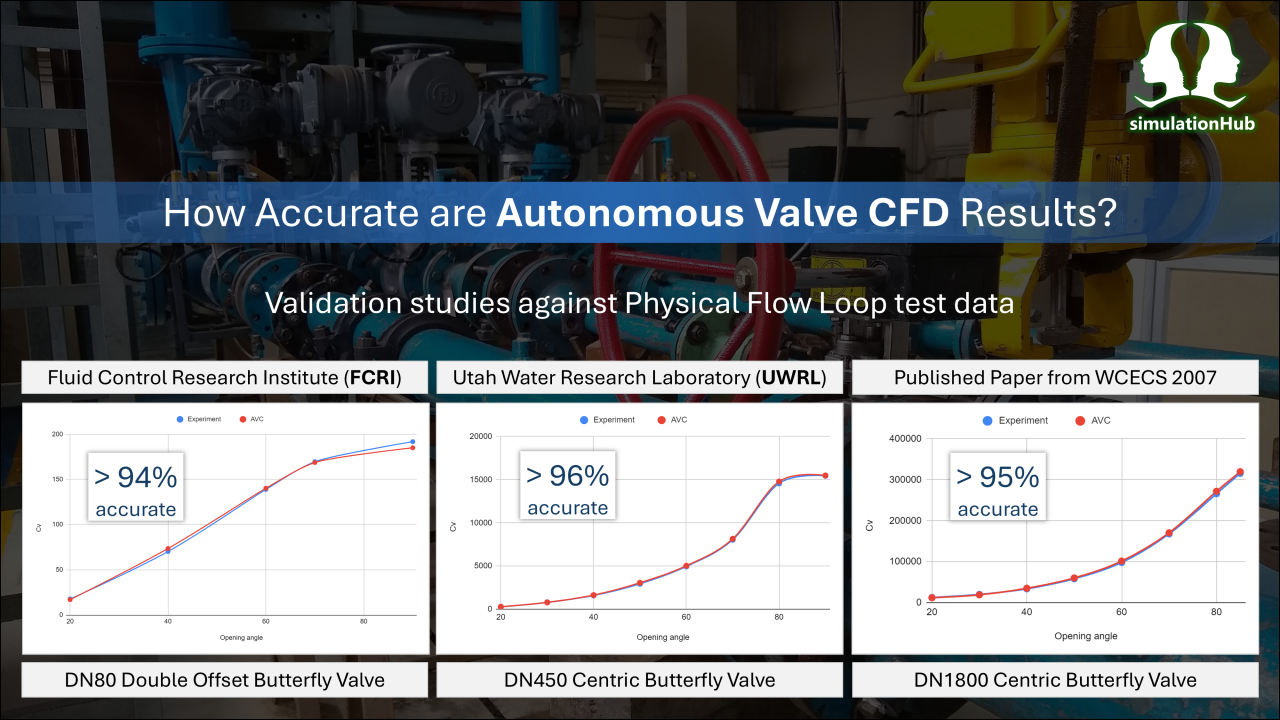

Validation studies against Physical Flow Loop Test
data
For decades, Computational Fluid Dynamics (CFD) has been a powerful tool in the engineer's
arsenal, allowing for the simulation of complex fluid behaviours. However, its power has always
been gated by significant challenges: it is a notoriously complex, time-consuming, and expensive
process that demands deep specialist knowledge to execute correctly.
A new approach promises to change this paradigm: Autonomous Valve CFD - an autonomous system
designed specifically for valve flow simulation. But with any new technology, a critical
question arises: Can an autonomous system deliver the accuracy and reliability of traditional
methods?
This blog provides a formal validation of the performance and accuracy of the simulationHub
Autonomous Valve CFD (AVC) software. The validation is conducted by systematically comparing
simulation results generated by AVC against a range of established industry benchmarks. These
benchmarks include data from experimental laboratory tests, and published academic research.
Credibility Built on Global Standards
The credibility of any simulation software rests on its adherence to industry-accepted standards
and a transparent, repeatable computational process. Its methodology must be grounded in
industry-wide standards to produce results that are trustworthy and comparable. This adherence
to standards ensures users are speaking the same language as the rest of the industry.
Governing Industry Standards
The procedures for testing, simulation, and calculation within the AVC software are governed by a set of internationally recognized standards. The platform's methodology refers to and follows key international standards, including:
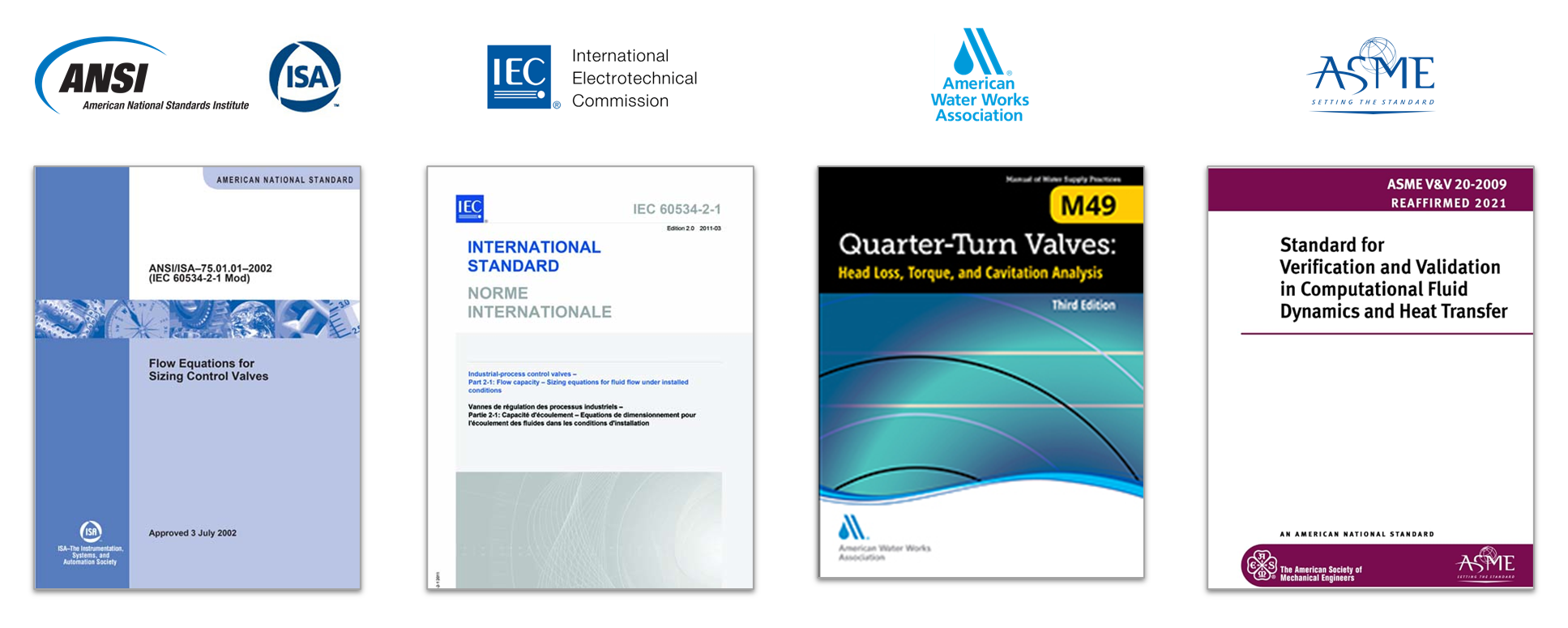
For the user, this foundation provides a crucial layer of trust. The data generated is not just
numerically accurate—it is reliable, consistent, and meaningful within the broader engineering
context.
Computational Fluid Dynamics (CFD) Simulation Process
The "autonomous" aspect of the AVC platform is more than a simple
script. The system is designed to embed the best practices of a human CFD expert directly into
its workflow.
Autonomous Meshing
The software automatically performs a series of sophisticated meshing
operations, effectively mimicking an expert's decision-making process to accurately capture the
complex flow physics inside a valve.
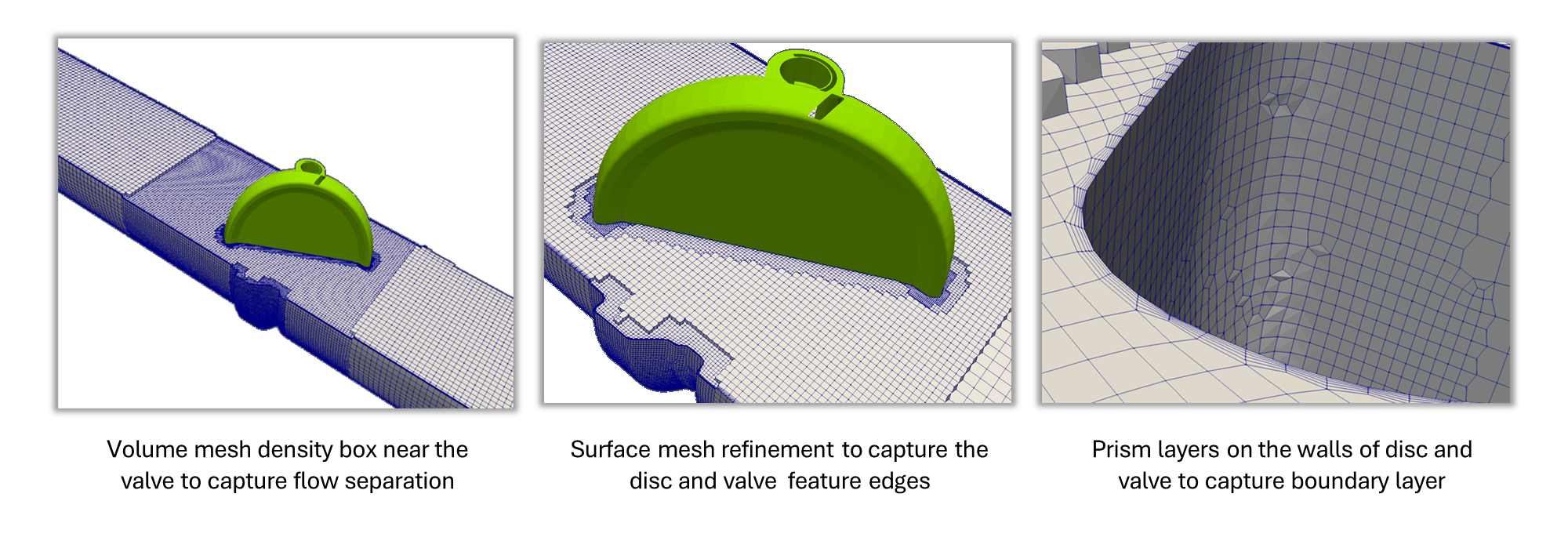
The system also includes automated mesh quality checks for critical
parameters such as nonOrthoFaces, skewFaces, and wrongOrientedFaces. If the initial mesh does
not meet predefined quality criteria, a corrective algorithm automatically refines low-quality
regions to ensure all mesh elements meet stringent quality criteria before proceeding to the
solver.
A special mention to Creative Fields Ltd cfMesh – AVC's meshing
capabilities are powered by cfMesh, which ensures high-quality and accurate meshing for fluid
dynamics simulations.
Solve
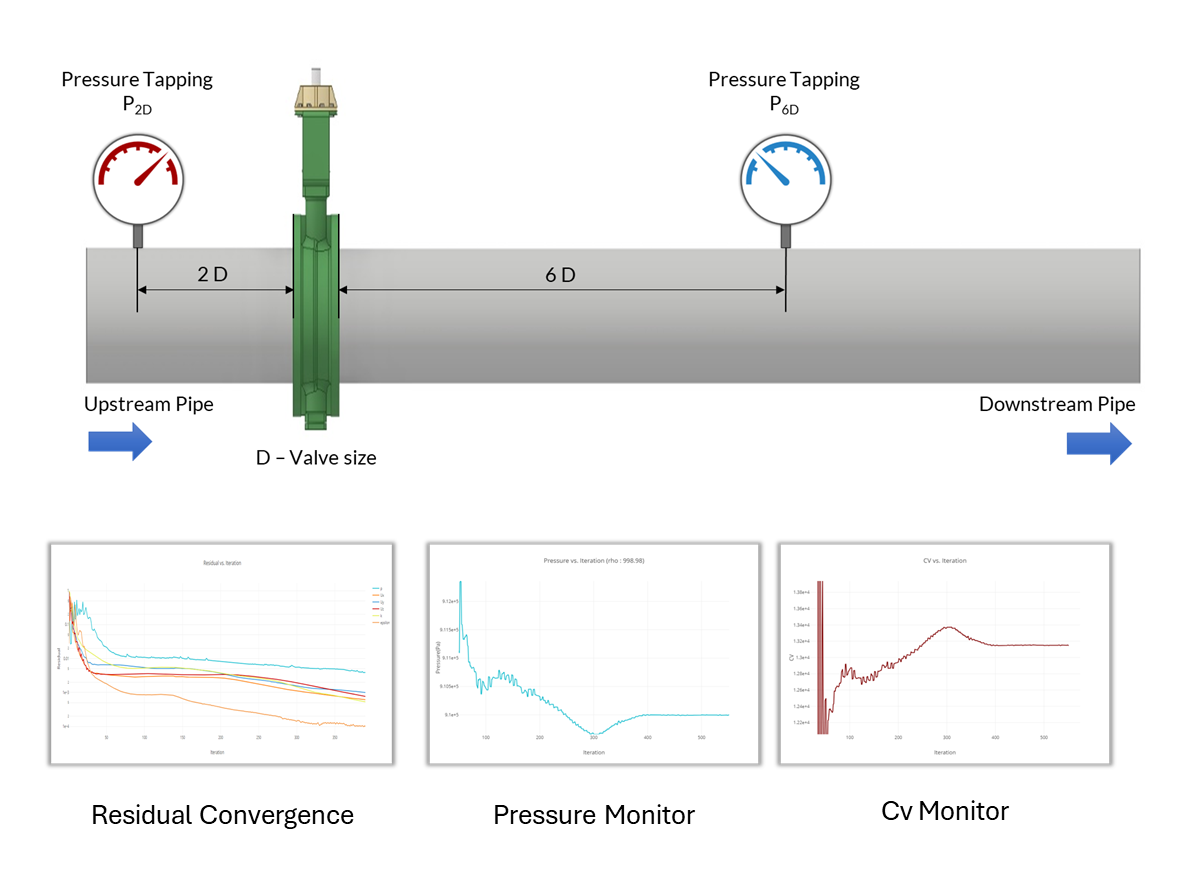
The solver and numerical schemes are configured with the
industry-standard parameters to ensure reliable and consistent simulation outcomes. The flow
conditions and pressure measurement locations are guided by the ANSI/ISA–75.02 standard:
- Flow Conditions: Simulations adhere to a minimum valve Reynolds number of 10^5 and a maximum line velocity of 13.7 m/s (45 ft/s).
- Pressure Measurement: In line with standard test procedures, pressure tapping points are located at 2D (two pipe diameters) upstream and 6D (six pipe diameters) downstream from the valve.
- Inlet Condition: A parabolic velocity profile is applied at the inlet to simulate a fully developed flow, representing realistic pipe flow conditions.
- Residual Monitors: Convergence is achieved when residuals drop below target thresholds: Pressure (1e-03); Velocity (U), Turbulent Kinetic Energy (k), and Turbulent Dissipation Rate (ε) (1e-04).
- Additional Monitors: The simulation also monitors the stability of Pressure and Cv values to ensure a steady-state solution has been reached.
- Quality Alert: A Y+ alert is triggered if more than 20% of the wall-adjacent cells fall within the buffer region of the boundary layer, signalling potential inaccuracies in wall shear prediction.
This structured methodology provides the foundation for the validation studies presented in the next section.
Validation Studies
The performance of the Autonomous Valve CFD software is systematically
benchmarked against multiple independent data sources to quantify its accuracy and reliability.
The results from a wide range of valve types and sizes are compared against physical flow loop
test data and published academic findings.
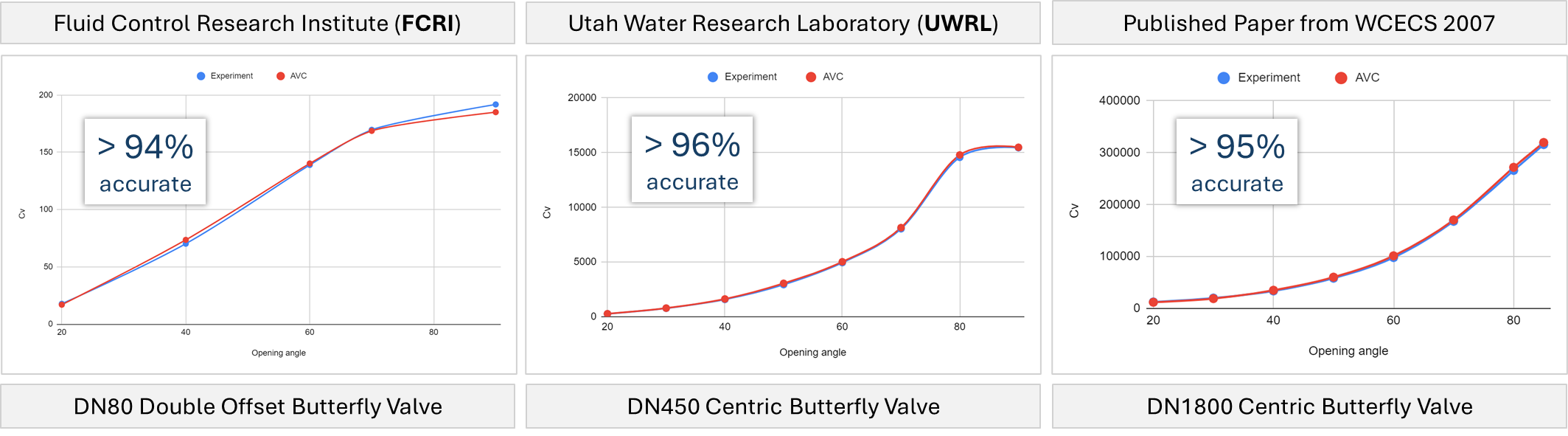
AVC simulation data was benchmarked against experimental results
obtained from two globally recognized facilities: the Utah Water Research Laboratory (UWRL) in
the USA and the Fluid Control Research Institute (FCRI) in Kerala, India. The below graphs show
a detailed validation of different butterfly valve types and sizes with data from different
physical flow loop test sources.
Multiple such validation studies were conducted on a variety of common valve types, including
Centric Butterfly, Double Offset Butterfly, Full Port Ball, Segmented Ball, and Globe Valves. As
illustrated in the comprehensive data summary below, the simulation results demonstrate greater
accuracy with the experimental benchmarks.
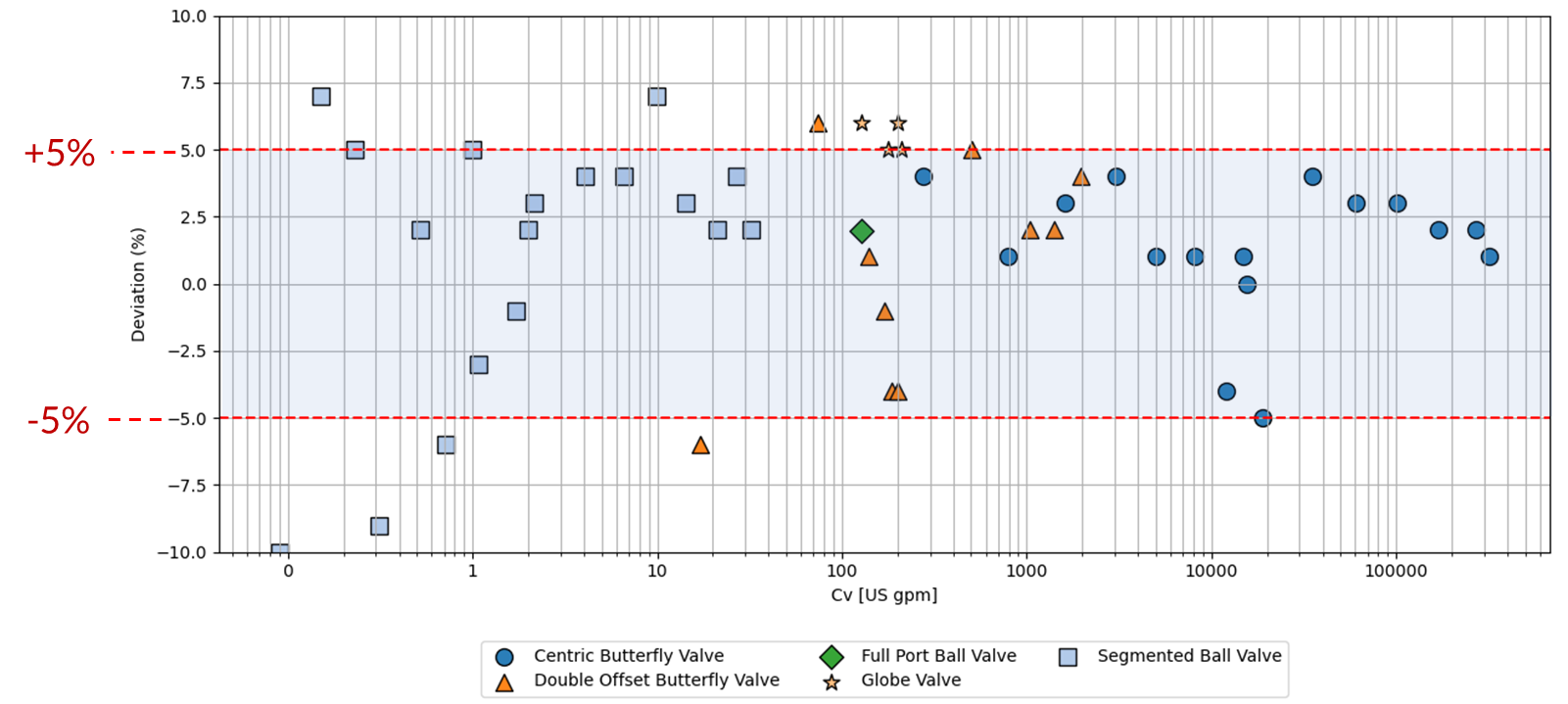
The vast majority of calculated data points fall within a tight +/- 5% deviation band,
indicating a high degree of precision and consistency. This level of agreement across a wide
range of valve types and valve size (Cv values spanning from less than 1 to over 300,000)
demonstrates the robustness and scalability of the AVC’s autonomous simulation method.
Conclusion
The Autonomous Valve CFD (AVC) software has been rigorously tested
against a comprehensive suite of benchmarks to validate its accuracy and reliability. The
findings presented in this report demonstrate that AVC's simulation results consistently
align with experimental data from certified laboratories (UWRL and FCRI), and data from
published academic literature.
This level of validation provides engineers with the confidence
that Autonomous Valve CFD is not just fast and easy to use, but also reliably precise for
making critical design and performance decisions.
To know how AVC can be integrated into your valve design process, schedule a call with our
product expert:
Comments
Recent posts