Search our products, blog, webinars, papers and projects, then see how simulationHub can help.
Tip: describe it in your own words, the way you would ask an engineer, e.g. “How can I predict valve cavitation?” or “I am working on LEED compliance”. We pick out the key words and search everything we have.
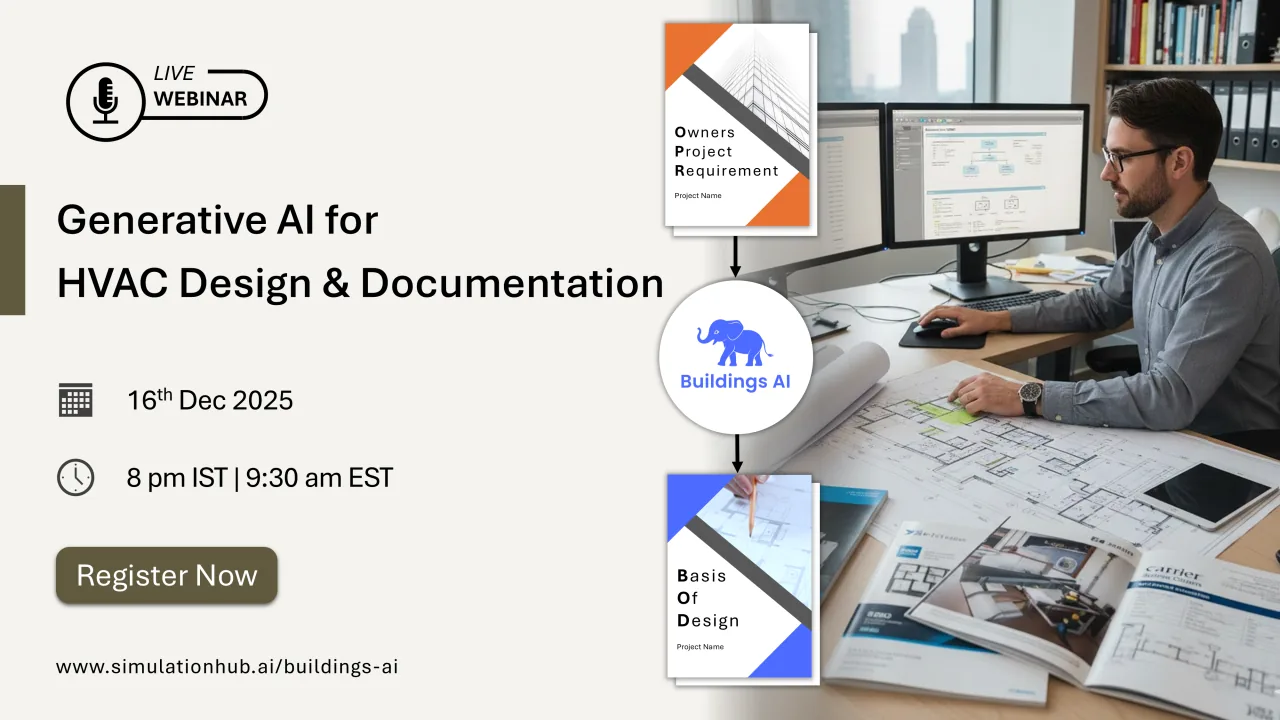
Generative AI is transforming HVAC design by acting as an intelligent assistant throughout the engineering workflow. Instead of replacing designers, AI enhances their capabilities—automating repetitive documentation, interpreting Owner’s Project Requirements, and supporting better, faster design decisions. This webinar explored how AI-driven tools streamline planning, improve coordination across disciplines, and free engineers to focus on high-value analysis and creative problem-solving. Watch it to see how Generative AI is reshaping HVAC workflows with greater accuracy, efficiency, and collaboration.
In today’s fast-paced world, HVAC design is evolving rapidly. Generative AI, often associated with creative text and images, is finding a powerful new role as an intelligent assistant to HVAC designers. It empowers them to optimize every phase of the design lifecycle - from initial planning to final documentation, resulting in greater efficiency, accuracy, and collaboration.
For example, by analysing the Owner’s Project Requirements (OPR), AI can assist in drafting the technical documentation that forms the basis of the engineering plan, ensuring nothing is lost in translation. This integration of AI does not sideline the human expert; it elevates their role. By positioning Generative AI as an "assistant to HVAC designers," the technology automates tedious and time-consuming documentation tasks, allowing the designer to focus on the creative and analytical aspects of the project. The result is a more efficient workflow where the designer orchestrates the project with greater accuracy and insight, guided by an AI assistant that handles the foundational paperwork.
In this webinar, we dived into how Generative AI can assist HVAC professionals in making better design decisions, automating documentation, and improving coordination across disciplines.
Agenda
Introduction: The Evolving Role of the HVAC Designer: Understand how the role of HVAC designers is shifting with AI integration, enabling them to make more informed decisions, handle complex design challenges, and improve workflow efficiency.
Why Documentation and Decision Context Matter: Discover the importance of effective documentation in HVAC design.
The Traditional HVAC Design Process:
Overview of Design Phases: Explore the various stages of HVAC design, including predesign, conceptual, schematic, development, construction, commissioning, and post-occupancy. Learn how Generative AI can assist at each phase.
Documentation at Each Phase: See how AI can enhance key documentation tasks, such as drafting Owner's Project Requirements (OPR), Building Operating Documents (BOD), ensuring code compliance, and supporting commissioning and validation.
Decision Process:Understand how Generative AI helps manage decision-making from initial intent (OPR) to final outcomes, navigating uncertainty, and optimizing iterative design loops.
Demo: Witness a demonstration using the Buildings AI platform, showcasing how Generative AI can streamline the creation of Building Operating Documents (BOD) directly from the Owner's Project Requirements (OPR) for a sample project.
Key Takeaways
Understand the pivotal role of documentation in HVAC design
Learn how Generative AI can streamline decision-making and enhance the quality of design documentation
Witness how Generative AI can automate BOD drafting from OPR, with a demo using Buildings AI
Who Should Watch?
This webinar is ideal for HVAC Designers, MEP Engineers, Energy Consultants, and Professionals involved in building design and performance analysis.
Whether you're new to AI or an experienced designer, this session offers valuable insights into how Generative AI can enhance your work and streamline your processes.
Speakers
Featured speakers
Aaditya RuikarCFD Evangelist, simulationHub
Aaditya Ruikar works As a Product Manager at CCTech, He is involved in developing and delivering high-fidelity technologies for various industries at affordable prices and plays role of domain expert. He also has a vision to make these technologies more accessible and user-friendly for better and efficient design outcomes.His interests lie in researching and simulating real world systems, particularly in the domains of engineering, physics and sustainable development. He likes to tackle challenges and work with others to find innovative solutions.
Transcript
Webinar transcript
Introduction & Context
Okay. Let's start. Good morning, good afternoon, good evening everyone. Welcome to today's webinar on generative AI for HVAC design and documentation. We are thrilled to have you with us for this session. This webinar is ideal for HVAC designers, MEP consultants and professionals involved in HBAC load calculation and building energy analysis. Whether you're new to AI or you're aware, this session will offer valuable insights into how you can leverage generative AI to enhance your work and streamline your work processes.
So let me introduce the speakers like myself privacy I'll be your host today and I'm the product marketing manager at simulationHub with over 16 years of experience in CFD simulations applied to various field especially building hack indothermal comfort simulations and I'm delighted to introduce today's speaker privacy an AI futurist and product manager at simulationHub. He is involved in developing and delivering highfidelity technologies for various industries playing the role of domain expert. He also has a vision to make these technologies more accessible and userfriendly leading to better and more efficient design outcomes. His interest lies in researching and simulating real world systems particularly in the domain of engineering, physics and sustainable development. So moving ahead I'll set the context who we are and what we do and then jump into the topic. That way it will set the right context before you go into the topic. So who we are for those who are new to this series of webinars we are like Buildings AI.
So that is a Buildings AI is a aentic AI platform for hrack load calculations and energy modeling building energy modeling. So it's powered by EnergyPlus engine in the back end and Autodesk platform services for data management and importing you know the gravit model and all stuff AWS it's a cloud-based application and simulation of platform so all the APIs we use are from simulation so what we do is what we saw what we do right like what we do it differently is We develop AI powered human inloop workflows for the whole building energy simulations, whole building performance simulations to make the workflow more efficient. So what I mean is can go ahead next slide. So there are we have introduced AI in the whole workflow you know. So for example PDF to bin. So you have a PDF floor plan PDF.
You don't have to manually retrace to create the to sketch the floor plan and create 3D. So the AI like the algorithm of image processing, computer vision and deep learning is used to detect the walls, windows and doors and you know convert that PDF floor plan into a BIM. And another example I can quote is it has the platform has a complete building the assistant workflow in every stage of the complete simulation workflow. So you can interact with the you can use the assistant to take any help and interact in your natural language and interact with your BIM u and query the details materials and the selection of materials and window to wall ratio anything you can interact with your bin. So another example I could put is it has a report assistant feature. So again you can you know customize your report with the interaction with the application. So we have been conducting yeah in the next slide.
So we have been conducting lot of educational free educational webinar series in the past. So if you have missed so and if whatever I described interests you can go there watch the recordings and things. So from as a continuation of these webinars we have picked today's topic yes one more click so which is generative AI for hrack design and documentation so with this I'll hand it over to privacy please yeah thank you privacy for the introduction and contact setting yes so for the today's webinar I'll start with my topic here.
So today's agenda of the webinar is we'll see evolving role of hrack design engineer. Then documentation how what are the pain points in document what pain points HR designer is currently facing. Then the problem statement that is a key topic of today's webinar how generative AI can help in resolving those pain points demo of the functionality we have developed in house as a P and then how generative can help in different other design workflows. So without going into too much details, I'll directly jump on to the webinar first slide.
Okay.
HVAC Design Engineer Role
So as we can see you all are also experiencing as a hack design engineer. Today the role of HR design engineer is not only like engineer he is like a project coordinator for architect. And then project coordinator for different engineers from different domains like structural, electrical, pump, plumbing. Then he has to be a like expert in or proficient in compliances various codes standard from various government organizations as well as rating agencies. He has to be a risk mitigator for the client he's working with or architect. Then he has to be a business partner with his company and technical expert in and proficient in using different tools for loads, energy calculation, system selections. And these softwares are also very complex and so he has to be like application engineer also. So this is like multifaceted role exciting but it's demanding. So there are some pain points or we are trying to help hack designer to focus on his core qualities and what is his whole core.
Documentation Pain Points
So now first thing we are going with the documentation part. So as the today's topic of the webinar so from the ashray design manual will we are seeing like contract documents are like important part. It's not just paperwork. It's like strategic backbone of entire Hback design life cycle as well as a user manual or like a guide for your client as well as your team members and commissioning those who are going to commission this project. So the documentation should be there should be high quality document documentation needs to be generated but what happens is like as specifi as specified in the document as going through air conditioning system design manual. So most of the time designer may or may not be participated initial conversations while project has been organization has taken this project or in the negotiation of designer's fee or how much is budget allocated for that project and designer have to keep in mind that while doing project while achieving design intent this project should be a profitable for company. If not then it may be problematic for company his organization in meeting those KPIs and or
Sustainable it's not sustainable for his organization. So u so main major part is to generate contract documents. So generating those comp contract document needs large amount of expertise, large amount of times, large amount of meetings. So what generally happens is designers has to balance between what is agreed design fee versus how much documents he is going to generate for that project. But if you keep in mind that if he is not able to provide detailed documentation to his client, his client may not be satisfied or might get low quality of work to him. So how can we resolve this problem? So docu number of documents is like equal to time. So here we'll see how AI can help you.
Then so the first document which you might
OPR & Basis of Design
Be also experiencing that first document that user is starting with is like generating basis of design document. So this is a key problem we have taken for today's webinar as you are starting from here. So owner's project requirement is nothing but what and why of the or wants and needs of the your owner like exceptional energy efficiency or acceptable IP or low maintenance or owner might want to achieve some rating system or might wanted to apply for some tax incentives.
So that he is going to ask for you and then you have to go through various scores standard you have to discuss with your team you have to brainstorm with your team and come up with how part of this how it can be achieved whether it can be achieved or not and then provide this basis of design to your client for approval. So it's like likeou between you and your client also for your design team also it's like guiding document how you are going to proceed for and how you are going to apply design methodologies also while design commissioning this basis of design document will help commissioning engineers whether what is what is committed is achieved or not achieved.
So for validation it is helpful. So we'll see how it can be achieved or we'll see how what are the problems HVAC engineer might face or might be facing in generating bas of design document. So we have talked to various users and what we have realized that in the most of the user stories are something like most of the users are saying like most of the time client is not providing a formal OPR document or they might not be very clear about their goals. They just tell about like make it energy effic efficient or u sometimes u hack engineers are working on international projects might be one hack design designer who is sitting in the South America and working on a project which is from the USA. So there might be the language barrier and he might not be understanding this language of client very well so these are the problems he can face so here we'll see how AI can help us the next thing he's facing like as I say nowadays HAC engineers are like taking international projects various MNC's are taking and international project engineers is sitting in some other country project in some other
Country. So Hback we cannot expect that HVAC engineer might be proficient in every ports and standards followed in every other country. So these ports and standards are varying according to different countries. Not only countries if you can take example of USA you can see this energy efficiency code ash 90.1 the different states are following different versions of ash 90.1 so which to follow so might be expert is not there or might be hback engineer might get confused while working on different projects so then for different applications also there are different codes like for ducting there there's a different code for fire protection there is a different code so we might not expect so here we'll see how AI can be helpful then third thing is u analysis versus design people might confuse between or might be consider analysis is same as a design but not that like if you can consider like heat load calculation or heat load analysis or energy analysis. So analysis is a straightforward logical pro process like with given building model with given HVAC model what will be my heat load heat loads or
How much will be my energy that is like analysis but design is something like you have to work in multiple constraints constraints of like economic constraints like cultural constraints or like owner might want to acostically acostic proof HAX system. So you have to come up with different type of H. There might be different best suitable energy source might be different for that. Maybe you are going with ground sourced pump or project you are working on has a district cooling system or district heating system. So you have to try multiple things. You have to analyze multiple models. U then you will get multiple options or multiple designs and you have to choose best which is best for that contest or for that location.
So you might have to try different design configuration and it will consume large amount of time. So here AI can help you. So yeah after that once that you come up with design you will draft that all these things into your basis of design document and then we'll discuss with client and then you and your team will start working on design process. Now we'll see how AI can help you here.
AI as Design Co‑Pilot
So AI is just for helping purpose. We must be clear that this is a technology and not here to replace engineers. So instead it's it is served as design co-pilot like in aeroplane there is one pilot and there is one another pilot which is co-pilot assisting him. So whole and sole complete ownership and responsibility is towards designer and engineer only. AI just to increase your productivity and efficiency. Yeah, we'll see how it can help. So now generative AI. So there are two kinds of AI. Earlier in earlier webinars we have seen that there are two kinds of AI in the market. One is predictive AI and another is generative AI. So now we are seeing the generative AI part. So this generative AI has cognitive capabilities. Cognitive means it can take decisions. It can understand design intent and it is very it is it can understand our language. Not means understand but it's like it creates u it can it creates a requirement and it can understand your design intent what you are trying to say and it can generate language as well as a output.
So we can see like intelligent OPR synthesis it can help like if you have unstructured data like if your owner might not provided you formal OPR or provided vague OPR or few things are missing it can go and check through all the your email chains you can upload your minutes of the meetings and come up with formal OPR document share with your client and check what he is saying it's correct or ensure all owners project requirements so that you can directly go for basis of design then it can understand design intent. So from the multiple documents like there can be a document like basis of OPR might be different, minutes of the meeting might be different, email change might be different. You might be providing the floor plans because OPR might not have full picture of floor plan. So you are so it can go and understand design intent also. Then it can automate compliances like it can go and map which requirement for which requirement which code should we follow u currently project in which country or which state what is a climate zone and which code needs to be followed and what owner is asking so that mapping it can do
Once AI copilot understand this intent then its next job is to help generate necessary documentation So now this is about understanding part. Now generation part. So now this name itself is generative AI. So now we can see like traditional AI software. Now you might have seen that traditional AI softwares which are in the market can able to provide you reports like heat load calculation report or energy report or PRM report. Those are like hardcoded reports. But basis of design report is like complex report. It changes subjectively form to form, designer to designer, client to client and project to project.
It cannot be generated using traditional hardcoded softwares. So here generative can adapt to various needs and provide you required basis of design document. You can iterate multiple times and come up with what is what suits your requirement. Then it can the flow of basis of design document in traditional software if I provide you then it might be fixed order and for all reports. Here it can be different. Then scope of flexibility for traditional software it can be hardcoded or you might get some check boxes which section to add which section not to add. Here you can actually change weightage that I wanted to provide weightage for this paragraph or this section. I wanted to change scope of some other paragraph or section also. You can change your reports according to your branding as basis of design document is like first interaction of yourself with your client after you won this project. So you might wanted to set brandings in your branding you might wanted to provide branding touch to this report. So you might you using generative way you can ask to change branding colors, fonts, you
Can able to add logos, you can set headers, footer, cover page, you can ask entire reports to be temp customized in your organizational template format. So yeah, so now we so this is about
AI Report Assistant
Introduction what are the capabilities now we'll see the key features what we have developed as a P. So the P what we have developed it can take multiiformat support. So you can provide PDFs, word files or you can provide text files or you can just copy your minutes of the meeting and paste in the chat box. Also it can also able to read images and floor plans. So benefit is you can upload at a single time you can upload OPR your minutes of the meeting floor plan and technical browsers. If you wanted to suggest to your client that go with this manufacturer or wanted to compare the technical HVAC system with different HVAC system, you can upload those document template. You can set document template inside this assistant. You can ask it about cover page, header, footer, customize it. You can ask for branding integration. You can upload your logo company name and you can ask for structure of your basis of design document also which section should come first which section should come next and if you provide this that's fine if not this is a default checklist we have provided that you will get basis of design document according to this checklist. This.
Yeah. Now I'll provide a demo. If you have any question, you can ask in
Report Assistant Demo
The in the chat box and we'll take it last. So yeah. Is my video clear or should I go to full screen? Let me check. Previn is video visible? Yeah, it's clear. Yeah, go ahead. Okay. So now you can see as Prebin had shared we have we are planning to integrate inside a report assistant module of buildings here. So earlier webinar we have shown you how it can help you in heat load calculation report ventilation report from the simulation data and we are planning to come up with bidding support also. So within the scope of this webinar I will go with basis of design document so yeah just ask what it can do what are capabilities of report assistant I'll ask generate report it will ask me to upload necessary documents So first I'll as it asked I'll go to go and configure my basis of design agent like provide system prompts I'll upload logo of my company then the structure and what I want inside the report description and I'll customize it. Now all things set now okay so then you have then I'm going to upload owner's project requirement.
This is the owner's project requirement we have created for our office expansion at the time of office expansion. So it has all the goals budget of what budget we have allocated for HVAC system project then floor plan of a office and ask to generate a report. So within a few minutes it will generate a report. So now you can download that report in word file format. Just go and open the original report. So this is the report generated using the I think your screen sharing is stopped.
Is it visible? Yes. Yes. Okay. So, this is the report it has generated. So, yeah. Names u address of the site company name then it has the I think introduction then thumb rules and beautiful report it has generated Yes. So this is the next version. I have prompted and changed the theme of that report like I want in black and white theme. So Ash 62.1 IQ requirement then VF system it had suggested then comfort criteria. So intentionally our co wanted that as we are coming up with VRF IQ also should be maintained in the conference room in meetings room because it feels dizzy if meetings are long it takes long.
So that's about the demo. You can also if you don't like what is report you generated you can ask it to change or modify any section it can in a few minutes it can generate a new report also it is providing output in a word file format so you can manually download and manually change that report also. Yeah my slides Yes. Yes. Now it's visible.
Agentic vs Traditional AI
So now next question I think might be people mean you might be asking like in a chat boxes also what is the difference between you and chat GPT. So in chat juty also we can upload OPR document and ask for generating basis of design document. Obviously that is the interesting question. So we also thought initially but what is different is we have adopted here agentic workflow that autonomously every agent can go and take decisions for every section of the report. We have a different agent like for weather data collect for the collecting weather data. We have a different agent for research agent for researching through the different codes and standard we have a different agent. We have a different agent for context agent which goes and understand design intent and requirements and then shares that to research agent or weather agent to collect information. We have a HR system expert agent which can go compare between different system drafting agent which can draft all the research and context he has collected in the format user has asked for and at last critic agent which goes and check whatever is drafted
It is correct with respect to OPR with respect to codes and standards. And domain specific. So it's there is not one critic agent there are different critic agent goes and check report from different aspect and provides you tailored report and another power is this report assistant is very tightly integrated with Buildings AI so that as your project progresses you do heat load calculation or energy calculation so we'll see how we can integrate or how we can provide a context or connection between this report assistant with this document so that your basis of design document will be also enriched as bas of design document is it change can be changed as a design progresses so you can make a changes and it can adhere to the entire design process also we have created domain specific knowledge base so that and it has a knowledge of only the specific domains like HVAC, sustainability and ACE industry so that it can efficiently work whether if you go for general tool it has a knowledge base of entire internet so it might not be very efficient it might have a very small context windows it can hallucinate because it is only single agent working or few agents
Working. So yes so our agent is efficient and can help you and in time progress we are going to will improvise all these agents. So yeah it will cater you best possible. So that's about the demo. Now we'll see what are the other design
AI in Other Workflows
Workflows where AI can help. So as we have seen in a pre-esign stage it can help in basis of design. So I'll not go much into detail. So in schematic design it can go and check on the internet and help you in system selection. It can understand space requirement. It can go into various technical browsers. It can understand the dimensions. It can understand dimensions from the floor plan and help you in selecting right HVAC system. It can help you in preliminary heat load calculations. You might not be initially you might not be thinking to go with heat load calculation report.
So on the just area basis or just climate zone or building type basis it can go on a preliminary it can do preliminary Hback load calculation and provide you HVAC system idea which Hback system could be suitable. Next thing is design development. It can go so like earlier HVAX software, heat load calculation softwares. So we are trying to integrate this thing this feature also that in a heat load calculation software you are configuring HVAC system. So practical HWAC system you might have a technical browser you might be you HVAC engineers might need to go through technical browser and enter manually these properties of different HVAC system components. So now you should be able to upload this technical browser and it will understand this technical browser and automatically goes and provides input and creates a new component which you can use for creating hax systems.
Also it can help in contract documentations like creating RFIs creating first functional performance test cases. It can go and check that all the drawings are correct or not. Is there any conflict in terminologies there it can go and check contract specifications. It can also generate BOQS and BOM bill of materials and bill of quantities. So that for contract documentation for contract who are going to bid who are bet betting any bid can have a infor can get can do better with informed decisions.
Then construction documentation it can go and check multiple documents and see whether any anomaly is there. Like if you have a chiller with some dimension and in a floor plan you have some other another dimension. So might not be correct with space requirement. Go and check this construction floor plans and tell that you might you should use some different component or this is not appropriate thing. So for testing also it will be helpful. There might be some rule checker agents also which can check while many organizations have different rules for creating construction documentation. So it can check whether your documentation or drawings are adhering to your organizational rules.
Commissioning agent it can go and check that basis of design document and OPR document design is according to it or not. It can go and check sensor data and check whe whether what is asked by client is actually achieved or not. So it can accelerate this process also. So yeah from all the aspects AI can help here. So in the near progress we will be so if you have any requirements from every design aspect we wanted to connect with you understand more what are your pain points how we can solve this and we'll see how we can cater your needs and how we can use means present AI for your efficiency and productivity.
So that's it from my side. That's the end of the slide. Thanks for coming over. Yes. Yes. Thanks. Thanks privacy for the wonderful demonstration and showcasing the capabilities of you know generative AI. Yeah. So for the audience what's the next step? You can log into like simulationHub.com. You can visit simulationub.com and then you can start a free trial of Buildings AI and explore or experience the u capabilities yourself. We have a 15-day pre-trial period and some limited simulation credits and on the other hand you can if you need some assistance you can schedule a call with our product expert. Maybe you can discuss custom requirements particularly experience some pain points experienced by your team or arrange a demo meeting for your team. So those things can be done. So thanks everyone and then now we can move on to the Q&A session. Aditi can
Q&A Session
Like do you see the list of questions in the Q&A? Let me check. We have few questions from Naden. Yeah. So meanwhile I got some simple questions. Let me take that. So can you have any training for this subject? That's from Narendra. So yes Narendra we do not have a you know like self-paced course or anything yet on the internet but what we do is when you schedule a we can schedule a call and we can do a onboarding session with you or your team. So that can be done so that you know it's it's a handhold for to start the process to get started with the platform. So that can be done in this subject.
Okay. So one question I think Natan has posted for the PDF can it add text or markup to an uploaded PDF based on prompts. For example, upload chilled water diagram with no pipe tax. Indicate the flow through the pipe and request to add pipe size to the PDF at each pipe. Upon some criteria. Okay. So, currently we have a PDF to BIM module in which you can upload your PDF drawings and extract floor plans and convert that into beam. But I think this is an interesting problem.
Maybe nothing let me u I think it can able to do but let me check with our development team. Yeah I think we can set up a meeting or just over the email you can try we can try connecting and understand your requirement so that I can check. Yes. So as I just wanted to add on few things. So already the software has the capability to understand the PDF the elements of PDF. So here we are talking about some more customization problem. So adding the text and markups on the PDF existing PDF. So that is that should be easily possible. We just need to connect once and understand the requirement exactly and we can we'll be able to provide or add that feature in the application or you know develop it custom development for your team. Yeah.
Thanks. Thanks for posting that question. Yes sir. Omar Birdar is asking what criteria and processes do agent follow to identify and apply appropriate standards considering that regulatory and technical requirements vary by project scope and regional regulations. So this is a like so generative way I can understand design intent like in owner's project requirement owner has asked about indoor air quality requirement that I want that sufficient fresh air should be provided for the office space so it can able to understand for fresh air ash 62.1 standard is applicable and I have to go for office space based on the LLM capabilities. LLM is not nothing like next word predictor. Yes, it is a next word predictor but now you can also able to see its capabilities. It can understand and process information.
Yes. So and as you asked it can for different technical needs and regional regulations also in your OPR is if it has mentioned that location of your project it can go and search in on the internet that which code or compliance is applicable in your region and select from that. Yeah. Can we generate an energy audit report for HVAC system in building? Sunil Sud I think ring let get back to you Sunil. So I think I wanted to understand more about your requirements. Yeah our team will get back to you.
So itella Narendra so privacy Itella Narendra is asking can you have any training for this subject? Yes I answered it at the start like while you are going through the questions here. So just to re revisit again we do provide personal onboarding training separately but we are already working on launching some training materials and courses kind of things but it'll be launching soon. Right now we can schedule a call with the product team and then we'll be happy to help you know some do some handholding at the start to get started with the platform. Yeah.
Yeah. So, Harharan is asking if I have architect layout for a project how effectively can it extract data from drawing and where and all it the data is used for the heat load calculations. So, yes, so it can extract data from the floor plan. It can understand the names of the spaces. It can understand dimensions and calculate areas. But yes we haven't integrated with heat load calculation. Thanks for this requirement. So we have another privacy I guess the thing is like the extracted data how it is used in the heat load calculation. So as you already answered like the space name once it understands the space name the space type is assigned based on the name. So the data is used for setting up the the BIM model for heat load calculations kind of no made that connection currently for preliminary heat load calculation in basis of design it is doing but we haven't connected that with our heat load calculation solver.
Okay. Okay. Sure. So Nadan is saying we'll schedule a demo. Very curious. Thanks. Thanks privacy for that showing that interest. We'll definitely get back to you, connect with you and take it forward here. Okay. What about security and privacy? I think that is a general FAQ. How safe is our data when using AI tools especially when dealing with sensitive building information? Haring privacy, over to you. So, so this data security is you know kind of industry grade security and the AI whatever we have trained that information you are sharing with the AI assistant that is not used for the training purpose or anything. So that data is completely private and so you can you know AWS has its own security codes and pro like you know protocols. So on top of that you know multiple layers of security protocols are followed. So that is not a that should not be an issue. Yeah. Yeah.
So another FAQ is can generative AI handles large scale projects or it is better suited for smaller designs. So I'll say so we have made agentic workflow. So it can work for large scale projects because it can understand information and extract what is valuable information from that. But still we are experimenting and we need we are experimenting this and checking that how much context for how much context window we can set this and how much how big project we can support but yes so we are trying to increase our context window as well as if there are more and more agents are there we'll be able to cater larger projects as yes somebody I guess he also wants to contact yes we'll get in touch with you after the webinar in this week we'll get in touch with you and schedule a call or something like I think there are few more questions but we are towards the end we already over spilled by 10 minutes so thanks for showing interest and staying till the end of the webinar you can write to us go to the website like simulation.com and use the chat window to connect with us request a demo with to schedule a call with us. So there are multiple ways you can write to us and we'll be happy
To help and thanks privacy for bringing us this topic and another note I wanted to say. Yeah. Yeah. Sure. Sure. Yeah. Okay. Besides this pro product division, if you have any custom requirements or wanted to develop any AI workflows for your firm only for your firm, so we are open and our consultants you can reach our to me or privacy and we can connect with our consultancy department. privacy you are not sorry it happens often so I'm sharing my email id in the chat window so you can reach out to me reach out to me and we happy to help you. So thanks again thanks privacy for this topic and presenting this topic and we'll be bringing some more interesting topics in the future. Every month we have this webinar. So stay tuned look out at our social media handles. We'll you'll get updates on upcoming webinars.
Thanks. Thanks everyone. Thanks everybody.
Read the full transcript6000+ words, 10 chapters. Tell us who you are, and the transcript and the recording open.
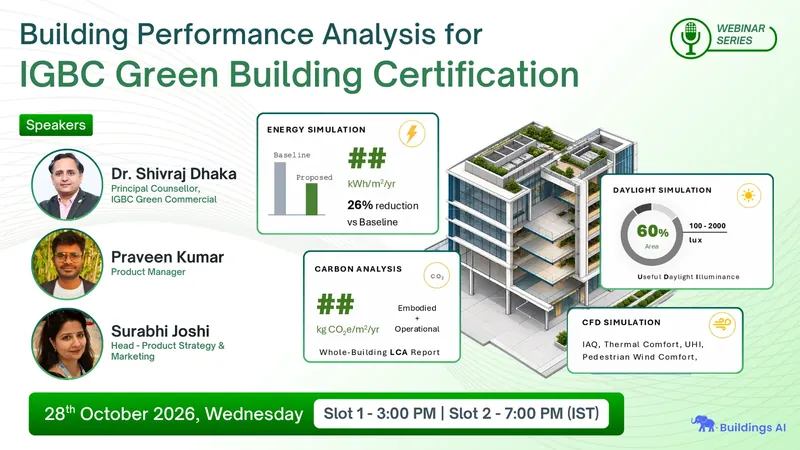
Watch this webinar to learn how building performance analysis contributes to achieving IGBC Green Building certification and optimizing sustainable design strategies.Watch the recording
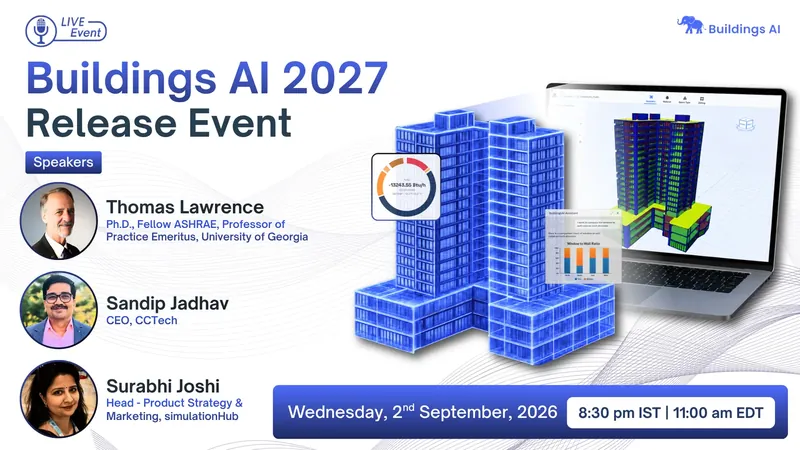
Watch the recording of the Buildings AI 2027 Release Event as we unveil the latest capabilities, demonstrate new workflows, and explore how engineering teams can build models faster, reduce repetitive work, and create more connected building energy workflows.Watch the recording
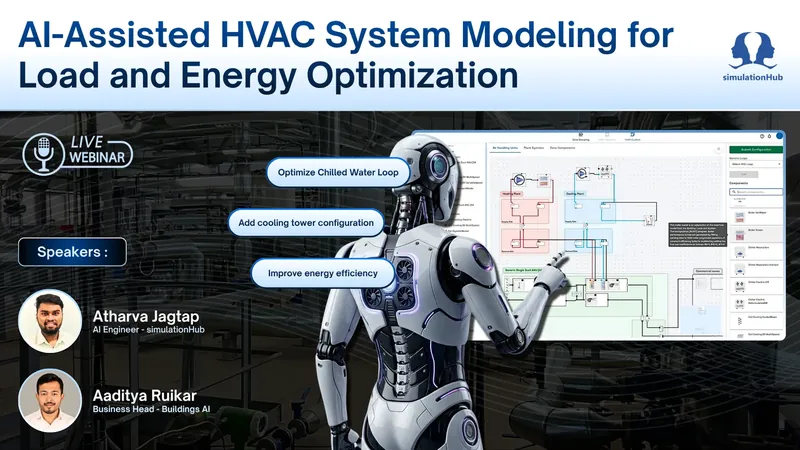
Watch this webinar to learn how the HVAC Canvas AI Assistant in Buildings AI enables automated HVAC network modeling through a conversational, agentic workflow — eliminating manual configuration and delivering faster, more efficient system design without the complexity of traditional tools.Watch the recording
We value your privacy
We use cookies to make our website work. With your consent, we also use analytics cookies to understand how the website is used, and marketing cookies to measure our campaigns. See our Privacy Notice and Cookie Policy.