<?xml version="1.0" encoding="utf-8"?><feed xmlns="http://www.w3.org/2005/Atom" ><generator uri="https://jekyllrb.com/" version="4.4.1">Jekyll</generator><link href="https://www.simulationhub.com/feed.xml" rel="self" type="application/atom+xml" /><link href="https://www.simulationhub.com/" rel="alternate" type="text/html" /><updated>2026-05-07T03:51:24+00:00</updated><id>https://www.simulationhub.com/feed.xml</id><title type="html">simulationHub | Cloud based CFD simulation apps for designer</title><subtitle>simulationHub is easy-to-use cloud based CFD apps for designers and works from mobile, tablets and desktop devices.</subtitle><entry><title type="html">Understanding and Mitigating Hydrodynamic Noise in Valves Using Autonomous Valve CFD</title><link href="https://www.simulationhub.com/blog/mitigating_noise_using_avc" rel="alternate" type="text/html" title="Understanding and Mitigating Hydrodynamic Noise in Valves Using Autonomous Valve CFD" /><published>2026-04-21T22:51:54+00:00</published><updated>2026-04-21T22:51:54+00:00</updated><id>https://www.simulationhub.com/blog/mitigating_noise_using_avc</id><content type="html" xml:base="https://www.simulationhub.com/blog/mitigating_noise_using_avc"><![CDATA[<div class="shbg-pallet white ui segment stackable grid no-border no-padding no-margin no-radius no-shadow">
    <div class="row no-margin no-padding">
        <div class="sixteen wide mobile sixteen wide tablet sixteen wide computer column no-margin no-padding">
            <div class="container-fluid responsive-padding padding-large" style="padding-bottom: 0rem !important">
                <div class="content-block vertical-align-top">
                    <div
                        class="inner-content custom-section-width sixteen-wide position-center container-limit max-width-boxed-layout">
                        <div
                            class="shbg-pallet white ui segment stackable grid no-border no-padding no-margin no-radius no-shadow">
                            <div class="row no-margin no-padding">
                                <div
                                    class="sixteen wide mobile eight wide tablet eight wide computer column no-margin no-padding">
                                    <div class="container-fluid">
                                        <div class="content-block vertical-align-middle">
                                            <div class="inner-content custom-section-width sixteen-wide">
                                                <div class="sh-services-title">
    <div class="top-aligned image" style="width: 70px;">
        <img class="ui fluid circular image image-border size-mini color-teal" src="https://static.simulationhub.com/prod/images/common/team-members/joel_mammen.jpg" alt="Blog Author - Joel Mammen">
    </div>
    <div class="content">
        <div class="ui small header no-margin">
            Written by <span class="font-weight-bold text teal">Joel Mammen</span>
        </div>
        <div class="ui small header custom-link color-blue font-weight-bold no-margin">
            <a href="https://www.linkedin.com/in/joel-mammen-3737b4232/" target="_blank">
                @JoelMammen
            </a>
        </div>
    </div>
</div>
                                            </div>
                                        </div>
                                    </div>
                                </div>
                                <div
                                    class="sixteen wide mobile eight wide tablet eight wide computer column no-margin no-padding hide-on-mobile">
                                    <div class="container-fluid">
                                        <div class="content-block vertical-align-middle">
                                            <div class="inner-content position-right text-align-right">
                                                <div class="ui small header no-margin">
                                                    Approximately
                                                </div>
                                                <div class="ui small teal header font-weight-bold no-margin">
                                                    5 Minutes Reading
                                                </div>
                                            </div>
                                        </div>
                                    </div>
                                </div>
                                <div
                                    class="sixteen wide mobile eight wide tablet eight wide computer column no-margin no-padding hide-on-tablet hide-on-computer">
                                    <div class="container-fluid">
                                        <div class="content-block vertical-align-middle">
                                            <div class="inner-content">
                                                <div class="ui small header no-margin">
                                                    Approximately
                                                </div>
                                                <div class="ui small teal header font-weight-bold no-margin">
                                                    5 Minutes Reading
                                                </div>
                                            </div>
                                        </div>
                                    </div>
                                </div>
                            </div>
                        </div>
                    </div>
                </div>
            </div>
        </div>
    </div>
</div>
<div class="shbg-pallet white ui segment stackable grid no-border no-padding no-margin no-radius no-shadow">
    <div class="row no-margin no-padding">
        <div class="sixteen wide mobile sixteen wide tablet sixteen wide computer column no-margin no-padding">
            <div class="container-fluid responsive-padding padding-large">
                <div class="content-block vertical-align-middle">
                    <div class="header small ui">Industrial control valves now operate under higher flow rates and pressure drops as energy demand rises in water, power, chemical, and process industries. Pushed closer to their limits, valve noise generation has become unavoidable rather than incidental.</div>
                    <div class="header large ui">
                        <strong>Why is noise in valves becoming an issue?</strong>
                    </div>
                    <div class="header small ui">Valve noise is an unavoidable result of energy dissipation, as flow energy converted across control valves generates acoustic energy. With plants operating continuously at higher loads, valve - generated noise is now a critical design constraint.</div>
                    <div class="header small ui">Stricter safety regulations, higher maintenance costs, and growing reliability expectations make early valve noise control essential in modern plant design.</div>
                    <div class="sixteen wide mobile sixteen wide tablet eight wide computer column min-width-50" style="width: 100%;">
                        <img class="ui huge centered rounded image"
                        src="https://static.simulationhub.com/prod/images/pages/blogs/2026/22-April/noise_issue.png"/>
                    </div>
                    <div class="header large ui">
                        <strong>Consequences of noise generation and Why we care</strong>
                    </div>
                    <div class="header small ui">Valve noise is not just an environmental or comfort issue — it has direct technical and economic consequences. Excessive noise often indicates adverse flow conditions such as cavitation or flashing. </div>
                    <div class="header small ui"><strong>High valve noise can lead to:</strong>
                        <ul>
                            <li>Hearing damage to plant operators</li>
                            <li>Excessive vibration and piping fatigue </li>
                            <li>Accelerated erosion of valve trims </li>
                            <li>Non - compliance with OSHA and international noise regulations </li>
                        </ul>
                        In many plants, control valves contribute significantly to the overall plant noise, making their acoustic performance a critical factor during valve selection and operations.
                    </div>
                    <div class="sixteen wide mobile sixteen wide tablet eight wide computer column min-width-50" style="width: 100%;">
                        <img class="ui large centered rounded image"
                        src="https://static.simulationhub.com/prod/images/pages/blogs/2026/22-April/noise_levels.png"/>
                    </div>
                    <div class="header large ui">
                        <strong>Types of noise generated in valves</strong>
                    </div>
                    <div class="header small ui"><strong>Noise generation in control valves is commonly classified into three types:</strong>
                        <ul>
                            <li><strong>Mechanical noise</strong> – caused by vibration of valve components </li>
                            <li><strong>Aerodynamic noise</strong> – predominant in gas or vapor flows </li>
                            <li><strong>Hydrodynamic noise</strong> – predominant in liquid flow </li>
                        </ul>
                        Among these, <strong>hydrodynamic noise</strong> is the most common and damaging in liquid service control valves, making it a primary concern in valve design and application.
                    </div>
                    <div class="sixteen wide mobile sixteen wide tablet eight wide computer column min-width-50" style="width: 100%;">
                        <img class="ui large centered rounded image"
                        src="https://static.simulationhub.com/prod/images/pages/blogs/2026/22-April/valve_noise.png"/>
                    </div>
                    <div class="header large ui">
                        <strong>Sources of hydrodynamic noise in valves</strong>
                    </div>
                    <div class="header small ui"><strong>Hydrodynamic noise in valves primarily arises from the following mechanisms:</strong>
                        <ul>
                            <li>Turbulent flow</li>
                            <li>Cavitation</li>
                            <li>Flashing</li>
                            <li>Flow‑induced mechanical vibration</li>
                        </ul>
                        Among these, <strong>cavitation</strong> is the dominant source of excessive noise and vibration in liquid service control valves, often leading to performance degradation and accelerated component damage.
                    </div>
                    <div class="header large ui">
                        <strong>Methods to predict hydrodynamic noise in valves</strong>
                    </div>
                    <div class="header small ui">Traditional hydrodynamic noise prediction methods rely on empirical correlations derived from experimental testing and standardized procedures.</div>
                    <div class="header small ui"><strong>- VDMA 24422</strong></div>
                    <div class="header small ui">The standard provides separate formulations for cavitating and non-cavitating flow conditions and is used to calculate the Acoustic Power (LA) using the following inputs:</div>
                    <div class="sixteen wide mobile sixteen wide tablet eight wide computer column min-width-50" style="width: 100%;">
                        <img class="ui large centered rounded image"
                        src="https://static.simulationhub.com/prod/images/pages/blogs/2026/22-April/acoustic_power.png"/>
                    </div>
                    <div class="header small ui"><strong>- IEC 60534-8-4</strong></div>
                    <div class="header small ui">IEC 60534-8-4 predicts the external A-weighted sound pressure level, typically measured 1m downstream of the valve, using the following inputs:</div>
                    <div class="sixteen wide mobile sixteen wide tablet eight wide computer column min-width-50" style="width: 100%;">
                        <img class="ui large centered rounded image"
                        src="https://static.simulationhub.com/prod/images/pages/blogs/2026/22-April/sound_pressure_level.png"/>
                    </div>
                    <div class="header small ui">While both methods are well established, they provide limited visibility into the actual noise generation mechanisms within the valve, offering little insight into which internal flow regions dominate acoustic emission.</div>
                    <div class="header large ui">
                        <strong>Using CFD to predict hydrodynamic noise in valves</strong>
                    </div>
                    <div class="header small ui">Computational Fluid Dynamics (CFD) offers a physics‑based approach to predicting hydrodynamic noise by resolving pressure, velocity, and turbulence fields within control valves. Unlike empirical methods, CFD enables direct correlation between noise generation and internal flow phenomena. Multiple acoustic modeling techniques can be coupled with CFD to estimate valve noise and identify dominant noise‑producing regions.</div>
                    <div class="header large ui">
                        <strong>CFD-based acoustic modelling approaches</strong>
                    </div>
                    <div class="header small ui"><strong>Broadly, CFD‑based acoustic prediction methods fall into three categories.</strong></div>
                    <div class="header small ui">Integral acoustic analogy methods, such as the Ffowcs Williams–Hawkings (FW-H), Curle’s analogy and Lighthill’s acoustic analogy, compute sound pressure by integrating pressure fluctuations over source surfaces, while CAA methods resolve acoustic wave propagation explicitly. Though accurate, these methods require highly resolved transient simulations and significant computational resources </div>
                    <div class="sixteen wide mobile sixteen wide tablet eight wide computer column min-width-50" style="width: 100%;">
                        <img class="ui large centered rounded image"
                        src="https://static.simulationhub.com/prod/images/pages/blogs/2026/22-April/proudman_model.jpg"/>
                    </div>
                    <div class="header large ui">
                        <strong>Proudman model – a practical approach for valve noise prediction</strong>
                    </div>
                    <div class="header small ui">For engineering applications, broadband noise models strike an effective balance between prediction accuracy and computational efficiency. Among these, the Proudman model is widely used for estimating hydrodynamic noise in control valves.</div>
                    <div class="header small ui">The Proudman model computes acoustic power directly from turbulence quantities, making it well suited for liquid service valves where noise is primarily turbulence‑driven—particularly near the vena contracta and cavitating regions. As a result, it effectively identifies zones of high noise generation within the valve.</div>
                    <div class="sixteen wide mobile sixteen wide tablet eight wide computer column min-width-50" style="width: 100%;">
                        <img class="ui big centered rounded image"
                        src="https://static.simulationhub.com/prod/images/pages/blogs/2026/22-April/proudman_zones.png"/>
                    </div>
                    <div class="header large ui">
                        <strong>Advancing Valve Design with Confidence</strong>
                    </div>
                    <div class="header small ui">This CFD‑based approach enables engineers to visualize noise hot spots, compare operating conditions, and assess design modifications virtually, significantly reducing the need for early‑stage physical testing. </div>
                    <div class="header small ui">At simulationHub, we help valve engineers bridge the gap between design and real‑world performance. Our Autonomous Valve CFD (AVC) app is the industry benchmark for automated, high‑accuracy Cv, Kv, and Cdt curve generation. Beyond standard performance analysis, simulationHub also offers in‑house expertise for custom acoustic CFD studies, enabling valve designs optimized for maximum performance and minimum noise.</div>
                    <div class="header small ui">To explore this topic further, watch our webinar recording: <strong>Predict Valve Hydrodynamic Noise Using Autonomous Valve CFD</strong>.</div>
                    <div class="sixteen wide mobile sixteen wide tablet eight wide computer column min-width-50" style="width: 100%;">
                        <img class="ui large centered rounded image"
                        src="https://www.simulationhub.com/assets/images/og-images/webinars/2026/15-jan/Predict_valve_hydronamic_noise.png"/>
                    </div>
                    <div class="header small ui">Contact the simulationHub team to advance your valve designs with confidence.</div>
                    <a class="left-align-text ui right labeled icon large primary button uppercase" href="https://www.simulationhub.com/webinars/recorded/predict-valve-hydrodynamic-noise" target="_blank">
                        <i class="right chevron icon"></i>Watch the Webinar Recording
                    </a>
                    <a class="left-align-text ui right labeled icon large primary button uppercase" href="https://www.simulationhub.com/contact-us?tab=autonomous-valve-cfd" target="_blank" style="margin-top: 10px;">
                        <i class="right chevron icon"></i>Book a Free Demo
                    </a>
                </div>
            </div>
        </div>
    </div>
    <!-- BLOG AUTHOR -->
    <div class="shbg-grey-pallet hundred ui segment stackable grid no-border no-padding no-margin no-radius no-shadow">
        <div class="row no-margin no-padding">
            <div class="sixteen wide mobile sixteen wide tablet sixteen wide computer column no-margin no-padding">
                <div class="container-fluid responsive-padding padding-large">
                    <div class="content-block vertical-align-top">
                        <div
                            class="inner-content custom-section-width sixteen-wide position-center container-limit max-width-boxed-layout">
                            <div class=" hide-on-tablet hide-on-computer">
    <img class="ui small circular centered image image-border size-small color-teal" src="https://static.simulationhub.com/prod/images/common/team-members/joel_mammen.jpg" alt="Blog Author - Joel Mammen">
    <div class="ui medium teal centered header font-weight-bold">
        Joel Mammen
    </div>
    <div class="spaced" style="text-align: center">
        <a class="ui linkedin small icon button" target="_blank" href="https://www.linkedin.com/in/joel-mammen-3737b4232/">
            <i class="linkedin icon"></i>
        </a>
    </div>
    <div class="ui small header">
        Joel Mammen is a CFD support Engineer at Centre for Computational Technologies Private Limited (CCTech), Pune. He loves to work in fields physics and mathematics. Skilled in OpenFOAM, Fluent, C, MATLAB, CAD Modelling. He has completed his M.Tech in Thermal and Fluids Engineering from (Dr. BATU), Lonere, Raigad. His areas of interest are Heat Transfer, Fluid Mechanics, Computational Fluid Dynamics, Numerical Methods, Operation Research modeling. Driving and traveling, playing cricket and chess are his hobbies and he likes to explore historical places.
    </div>
</div>
<div class="sh-services-title hide-on-mobile">
    <div class="top-aligned image" style="width:200px;">
        <img class="ui fluid circular image image-border size-small color-teal" src="https://static.simulationhub.com/prod/images/common/team-members/joel_mammen.jpg" alt="Blog Author - Joel Mammen">
    </div>
    <div class="content">
        <div class="ui medium teal header font-weight-bold">
            Joel Mammen
        </div>
        <div class="ui small header">
            Joel is a Customer Success CFD Engineer at simulationHub, with hands-on experience in Computational Fluid Dynamics (CFD) across a variety of engineering applications, particularly in valves. With an Undergraduate Degree in Mechanical Engineering from VIT Chennai and formal training in CFD through ANSYS certification, Joel brings both technical depth and practical problem-solving skills to his role. He has also contributed to aerodynamics and CFD-focused work, including a research engagement with IIT Bombay, and is actively involved in delivering customer-centric CFD solutions. His experience enables him to effectively translate complex simulation problems, helping customers achieve reliable and optimized outcomes.
        </div>
        <div class="spaced">
            <a class="ui linkedin small icon button" target="_blank" href="https://www.linkedin.com/in/joel-mammen-3737b4232/">
                <i class="linkedin icon"></i>
            </a>
        </div>
    </div>
</div>
                        </div>
                    </div>
                </div>
            </div>
        </div>
    </div>
</div>]]></content><author><name>https://www.linkedin.com/in/joel-mammen-3737b4232/</name></author><category term="simulationHub" /><category term="Autonomous Valve CFD" /><category term="CFD" /><category term="Cavitation" /><category term="Valve Design" /><category term="simulationHub" /><category term="Autonomous Valve CFD" /><category term="CFD" /><category term="Design software" /><category term="Valve Engineers" /><summary type="html"><![CDATA[Discover hydrodynamic noise in control valves using Autonomous Valve CFD to predict, analyze, and reduce noise through physics-driven insights.]]></summary></entry><entry><title type="html">From Sketch to Stitch with the Fabric Duct Design Suite</title><link href="https://www.simulationhub.com/blog/fabric-duct-workflow" rel="alternate" type="text/html" title="From Sketch to Stitch with the Fabric Duct Design Suite" /><published>2026-04-19T22:51:54+00:00</published><updated>2026-04-19T22:51:54+00:00</updated><id>https://www.simulationhub.com/blog/fabric-duct-workflow</id><content type="html" xml:base="https://www.simulationhub.com/blog/fabric-duct-workflow"><![CDATA[<div class="shbg-pallet white ui segment stackable grid no-border no-padding no-margin no-radius no-shadow">
    <div class="row no-margin no-padding">
        <div class="sixteen wide mobile sixteen wide tablet sixteen wide computer column no-margin no-padding">
            <div class="container-fluid responsive-padding padding-large" style="padding-bottom: 0rem !important">
                <div class="content-block vertical-align-top">
                    <div
                        class="inner-content custom-section-width sixteen-wide position-center container-limit max-width-boxed-layout">
                        <div
                            class="shbg-pallet white ui segment stackable grid no-border no-padding no-margin no-radius no-shadow">
                            <div class="row no-margin no-padding">
                                <div
                                    class="sixteen wide mobile eight wide tablet eight wide computer column no-margin no-padding">
                                    <div class="container-fluid">
                                        <div class="content-block vertical-align-middle">
                                            <div class="inner-content custom-section-width sixteen-wide">
                                                <div class="sh-services-title">
    <div class="top-aligned image" style="width: 70px;">
        <img class="ui fluid circular image image-border size-mini color-teal" src="https://static.simulationhub.com/prod/images/common/team-members/Angirekula-Venu.png" alt="Blog Author -Angirekula Venu">
    </div>
    <div class="content">
        <div class="ui small header no-margin">
            Written by <span class="font-weight-bold text teal">Angirekula Venu</span>
        </div>
        <div class="ui small header custom-link color-blue font-weight-bold no-margin">
            <a href="https://www.linkedin.com/in/angirekula-venu" target="_blank">
                @AngirekulaVenu
            </a>
        </div>
    </div>
</div>
                                            </div>
                                        </div>
                                    </div>
                                </div>
                                <div
                                    class="sixteen wide mobile eight wide tablet eight wide computer column no-margin no-padding hide-on-mobile">
                                    <div class="container-fluid">
                                        <div class="content-block vertical-align-middle">
                                            <div class="inner-content position-right text-align-right">
                                                <div class="ui small header no-margin">
                                                    Approximately
                                                </div>
                                                <div class="ui small teal header font-weight-bold no-margin">
                                                    2 Minutes Reading
                                                </div>
                                            </div>
                                        </div>
                                    </div>
                                </div>
                                <div
                                    class="sixteen wide mobile eight wide tablet eight wide computer column no-margin no-padding hide-on-tablet hide-on-computer">
                                    <div class="container-fluid">
                                        <div class="content-block vertical-align-middle">
                                            <div class="inner-content">
                                                <div class="ui small header no-margin">
                                                    Approximately
                                                </div>
                                                <div class="ui small teal header font-weight-bold no-margin">
                                                    2 Minutes Reading
                                                </div>
                                            </div>
                                        </div>
                                    </div>
                                </div>
                            </div>
                        </div>
                    </div>
                </div>
            </div>
        </div>
    </div>
</div>
<div class="shbg-pallet white ui segment stackable grid no-border no-padding no-margin no-radius no-shadow">
    <div class="row no-margin no-padding">
        <div class="sixteen wide mobile sixteen wide tablet sixteen wide computer column no-margin no-padding">
            <div class="container-fluid responsive-padding padding-large">
                <div class="content-block vertical-align-middle">
                    <div class="header small ui">Designing high-performance Fabric/Textile duct HVAC systems today still involves fragmented workflows. Consultants handle calculations separately; layouts are created in CAD tools, and fabrication details are developed downstream. This disconnect introduces inefficiencies, repeated effort, and design uncertainty.</div>
                    <div class="header small ui">Consider Alex, an HVAC consultant. His workflow starts with spreadsheets for duct sizing and airflow calculations, followed by manual drafting in CAD. When architectural layouts change, the process often restarts - requiring recalculation and redrawing. This iterative loop is time-consuming and prone to errors.</div>
                    <div class="header small ui">The <a href="https://www.simulationhub.com/fabric-duct" target="_blank">AHC-Fabric Duct Design Suite</a> is designed to address this fragmentation by connecting the entire fabric duct project workflow within a single platform. </div>
                    <div class="header large ui">
                        <strong>Chapter 1: The Contextual Blueprint</strong>
                    </div>
                    <div class="header small ui">Alex begins within a 2D workspace that is purpose-built for HVAC design. Instead of working with abstract geometry, he defines the actual design context - walls, windows, occupancy, and furniture - along with textile properties that influence airflow behavior. This ensures that system design is aligned with spatial and environmental conditions from the start, reducing the need for downstream corrections.</div>
                    <div class="header large ui">
                        <strong>Chapter 2: From Layout to 3D Intelligence</strong>
                    </div>
                    <div class="header small ui">Using a library of prebuilt components, Alex assembles the duct system directly within the 2D environment. Automated snapping ensures accurate connections between elements, while parametric controls allow precise adjustments.</div>
                    <div class="header small ui"><strong>• 3D Duct Modeling</strong> - Creation of accurate, connected duct geometry with automated 3D generation from 2D layouts.</div>
                    <div class="header small ui">From this layout, the platform generates a true-to-scale 3D model instantly. This enables early visualization, improves coordination with architects, and removes the need for separate 3D modeling workflows</div>
                    <div class="sixteen wide mobile sixteen wide tablet eight wide computer column min-width-50" style="width: 100%;">
                        <img class="ui huge centered rounded image"
                        src="https://static.simulationhub.com/prod/images/pages/blogs/2026/20-April/FB-Step1-2.png"/>
                    </div>
                    <div class="header large ui">
                        <strong>Chapter 3: CFD-Driven Performance Insights</strong>
                    </div>
                    <div class="header small ui">Performance validation is integrated directly into the design process. Alex can evaluate airflow distribution, air throw, and velocity profiles using built-in analysis tools.</div>
                    <div class="header small ui"><strong>• Air Dispersion Design</strong> - Definition of airflow behavior based on spatial context, occupancy, and textile properties. </div>
                    <div class="header small ui"><strong>• Network Analysis</strong> - Evaluation of system-level airflow performance, including distribution of pressure, flow, and sound inside the fabric duct system.</div>
                    <div class="header small ui"><strong>• Sizing System</strong> - Evaluation and design of the complete fabric duct system using an integrated static regain sizing module, enabling efficient airflow distribution while simplifying the designer’s workflow.</div>
                    <div class="header small ui"><strong>• Air Throw Analysis</strong> - Assessment and optimization of air reach to ensure effective coverage and occupant comfort</div>
                    <div class="header small ui">With one-click simulations and interactive controls, he can quickly identify and resolve performance issues. This shifts validation from a late-stage activity to a continuous part of design development.</div>
                    <div class="sixteen wide mobile sixteen wide tablet eight wide computer column min-width-50" style="width: 100%;">
                        <img class="ui huge centered rounded image"
                        src="https://static.simulationhub.com/prod/images/pages/blogs/2026/20-April/FB-Step3-4.png"/>
                    </div>
                    <div class="header large ui">
                        <strong>Chapter 4: The Path to the Factory Floor</strong>
                    </div>
                    <div class="header small ui">Once the design is finalized, the designer can process this data directly to shop floor, and which can be used to upload to laser cut machines to manufacture the system with ease. This includes flat patterns, production drawings, and billing materials.</div>
                    <div class="header small ui"><strong>• Fabrication</strong> - Automated generation of flat patterns and production-ready outputs for manufacturing.</div>
                    <div class="header small ui"><strong>• BOM Takeoff</strong> - Instant extraction of bill of materials for costing and project planning.</div>
                    <div class="header small ui">By connecting design directly to manufacturing, the platform eliminates manual translation and ensures that the final output accurately reflects the validated design.</div>
                    <div class="sixteen wide mobile sixteen wide tablet eight wide computer column min-width-50" style="width: 100%;">
                        <img class="ui huge centered rounded image"
                        src="https://static.simulationhub.com/prod/images/pages/blogs/2026/20-April/FB-Sep5-6.png"/>
                    </div>
                    <div class="header large ui">
                        <strong>The Outcome</strong>
                    </div>
                    <div class="header small ui">By the end of the process, Alex is no longer caught in cycles of rework and uncertainty. His workflow becomes streamlined and predictable, where every design decision is validated early and carried through with confidence to the final output. </div>
                    <div class="header small ui"><a href="https://www.simulationhub.com/fabric-duct" target="_blank">AHC-Fabric</a> enables this shift by connecting design, performance validation, and fabrication into a single continuous workflow. If you're looking to reduce inefficiencies and bring greater accuracy to your HVAC projects, it’s time to explore a more integrated approach</div>
                    <div class="sixteen wide mobile sixteen wide tablet eight wide computer column min-width-50" style="width: 100%;">
                        <img class="ui huge centered rounded image"
                        src="https://static.simulationhub.com/prod/images/pages/blogs/2026/20-April/FB_is_now_live.gif"/>
                    </div>
                    <a class="left-align-text ui right labeled icon large primary button uppercase" href="https://www.simulationhub.com/fabric-duct" target="_blank">
                        <i class="right chevron icon"></i>Explore the Fabric Duct Design Suite
                    </a>
                    <a class="left-align-text ui right labeled icon large primary button uppercase" href="https://www.simulationhub.com/contact-us?tab=fabric-duct" target="_blank" style="margin-top: 10px;">
                        <i class="right chevron icon"></i>Book a Free Demo
                    </a>
                </div>
            </div>
        </div>
    </div>
    <!-- BLOG AUTHOR -->
    <div class="shbg-grey-pallet hundred ui segment stackable grid no-border no-padding no-margin no-radius no-shadow">
        <div class="row no-margin no-padding">
            <div class="sixteen wide mobile sixteen wide tablet sixteen wide computer column no-margin no-padding">
                <div class="container-fluid responsive-padding padding-large">
                    <div class="content-block vertical-align-top">
                        <div
                            class="inner-content custom-section-width sixteen-wide position-center container-limit max-width-boxed-layout">
                            <div class=" hide-on-tablet hide-on-computer">
    <img class="ui small circular centered image image-border size-small color-teal" src="https://static.simulationhub.com/prod/images/common/team-members/Angirekula-Venu.png" alt="Blog Author - Angirekula Venu">
    <div class="ui medium teal centered header font-weight-bold">
        Angirekula Venu
    </div>
    <div class="spaced" style="text-align: center">
        <a class="ui linkedin small icon button" target="_blank" href="https://www.linkedin.com/in/angirekula-venu">
            <i class="linkedin icon"></i>
        </a>
    </div>
    <div class="ui small header">
        Venu is a Team lead in simulationHub, a flagship CFD platform for Centre for Computational Technologies Private Limited (CCTech), Pune. He enjoys working on real-world problems and finding solutions for them using CFD. He is skilled with OpenFOAM, ANSYS Fluent, MATLAB, and python. He got his M.Tech in Chemical engineering from IIT Guwahati, with thesis work focusing on the numerical modeling of Multiphase flows in the microchannels.
    </div>
</div>
<div class="sh-services-title hide-on-mobile">
    <div class="top-aligned image" style="width:200px;">
        <img class="ui fluid circular image image-border size-small color-teal" src="https://static.simulationhub.com/prod/images/common/team-members/Angirekula-Venu.png" alt="Blog Author - Angirekula Venu">
    </div>
    <div class="content">
        <div class="ui medium teal header font-weight-bold">
            Angirekula Venu
        </div>
        <div class="ui small header">
            Venu is the Team lead for the Solver Development team in simulationHub, a flagship CFD platform for Centre for Computational Technologies Private Limited (CCTech), Pune. He enjoys working on real-world problems and finding solutions for them using CFD. He is skilled with OpenFOAM, ANSYS Fluent, MATLAB, and python. He got his M.Tech in Chemical engineering from IIT Guwahati, with thesis work focusing on the numerical modeling of Multiphase flows in the microchannels.
        </div>
        <div class="spaced">
            <a class="ui linkedin small icon button" target="_blank" href="https://www.linkedin.com/in/angirekula-venu">
                <i class="linkedin icon"></i>
            </a>
        </div>
    </div>
</div>
                        </div>
                    </div>
                </div>
            </div>
        </div>
    </div>
</div>]]></content><author><name>https://www.linkedin.com/in/angirekula-venu/</name></author><category term="simulationHub" /><category term="Autonomous HVAC CFD" /><category term="CFD" /><category term="HVAC Engineers" /><category term="Design software" /><category term="simulationHub" /><category term="Autonomous HVAC CFD" /><category term="CFD" /><category term="Design software" /><category term="HVAC Engineers" /><summary type="html"><![CDATA[HVAC design workflows are often fragmented, causing inefficiencies and rework. This blog highlights these challenges and introduces the AHC-Fabric Duct Design Suite—a unified platform for faster, more reliable system design.]]></summary></entry><entry><title type="html">Detailed and Flexible HVAC Modeling Workflow in Buildings AI</title><link href="https://www.simulationhub.com/blog/detailed_hvac_canvas" rel="alternate" type="text/html" title="Detailed and Flexible HVAC Modeling Workflow in Buildings AI" /><published>2026-04-14T22:51:54+00:00</published><updated>2026-04-14T22:51:54+00:00</updated><id>https://www.simulationhub.com/blog/detailed_hvac_canvas</id><content type="html" xml:base="https://www.simulationhub.com/blog/detailed_hvac_canvas"><![CDATA[<div class="shbg-pallet white ui segment stackable grid no-border no-padding no-margin no-radius no-shadow">
    <div class="row no-margin no-padding">
        <div class="sixteen wide mobile sixteen wide tablet sixteen wide computer column no-margin no-padding">
            <div class="container-fluid responsive-padding padding-large" style="padding-bottom: 0rem !important">
                <div class="content-block vertical-align-top">
                    <div
                        class="inner-content custom-section-width sixteen-wide position-center container-limit max-width-boxed-layout">
                        <div
                            class="shbg-pallet white ui segment stackable grid no-border no-padding no-margin no-radius no-shadow">
                            <div class="row no-margin no-padding">
                                <div
                                    class="sixteen wide mobile eight wide tablet eight wide computer column no-margin no-padding">
                                    <div class="container-fluid">
                                        <div class="content-block vertical-align-middle">
                                            <div class="inner-content custom-section-width sixteen-wide">
                                                <div class="inner-content custom-section-width sixteen-wide">
    <div class="sh-services-title">
        <div class="top-aligned image" style="width: 70px;">
            <img class="ui fluid circular image image-border size-mini color-teal" src="https://static.simulationhub.com/prod/images/common/team-members/aaditya_ruiker.jpg" alt="Blog Author - Aaditya Ruiker">
        </div>
        <div class="content">
            <div class="ui small header no-margin">
                Written by <span class="font-weight-bold text teal">Aaditya Ruiker</span>
            </div>
            <div class="ui small header custom-link color-blue font-weight-bold no-margin">
                <a href="https://twitter.com/AadityaRuikar" target="_blank">
                    @AadityaRuikar
                </a>
            </div>
        </div>
    </div>
</div>
                                            </div>
                                        </div>
                                    </div>
                                </div>
                                <div
                                    class="sixteen wide mobile eight wide tablet eight wide computer column no-margin no-padding hide-on-mobile">
                                    <div class="container-fluid">
                                        <div class="content-block vertical-align-middle">
                                            <div class="inner-content position-right text-align-right">
                                                <div class="ui small header no-margin">
                                                    Approximately
                                                </div>
                                                <div class="ui small teal header font-weight-bold no-margin">
                                                    5 Minutes Reading
                                                </div>
                                            </div>
                                        </div>
                                    </div>
                                </div>
                                <div
                                    class="sixteen wide mobile eight wide tablet eight wide computer column no-margin no-padding hide-on-tablet hide-on-computer">
                                    <div class="container-fluid">
                                        <div class="content-block vertical-align-middle">
                                            <div class="inner-content">
                                                <div class="ui small header no-margin">
                                                    Approximately
                                                </div>
                                                <div class="ui small teal header font-weight-bold no-margin">
                                                    5 Minutes Reading
                                                </div>
                                            </div>
                                        </div>
                                    </div>
                                </div>
                            </div>
                        </div>
                    </div>
                </div>
            </div>
        </div>
    </div>
</div>
<div class="shbg-pallet white ui segment stackable grid no-border no-padding no-margin no-radius no-shadow">
    <div class="row no-margin no-padding">
        <div class="sixteen wide mobile sixteen wide tablet sixteen wide computer column no-margin no-padding">
            <div class="container-fluid responsive-padding padding-large">
                <div class="content-block vertical-align-middle">
                    <div class="header large ui">
                        <strong>HVAC System Modeling Should Not Feel Outdated </strong>
                    </div>
                    <div class="header small ui">In modern building design, HVAC systems directly impact energy performance, occupant comfort, and operational efficiency. Yet, modeling these systems often feels disconnected from how engineers actually work.</div>
                    <div class="header small ui">Traditional workflows are still tied to rigid system definitions, desktop-heavy tools, and interfaces that prioritize setup over usability. As systems become more diverse and projects need more nuanced, these limitations become harder to ignore. What engineers need today is not just more capability—but a better way to use it. Modern HVAC modeling should be visual, flexible, and aligned with real workflows. </div>
                    <div class="header large ui">
                        <strong>The Problem with Conventional HVAC Workflows</strong>
                    </div>
                    <div class="header small ui">Creating HVAC systems is challenging in itself; doing so efficiently and transparently makes it even more challenging. Many tools struggle beyond predefined structures. Templates help early on but lack flexibility, while fully custom setups become complex and hard to interpret. This creates a gap between speed and control.</div>
                    <div class="header small ui">As systems grow, understanding what has been modeled becomes difficult. Logic is often buried in layered inputs, making review and validation harder. Combined with repetitive setup and desktop-style interfaces, these workflows slow down decisions and reduce adaptability. The challenge is not just building systems—but building them in a way that stays clear, flexible, and efficient. </div>
                    <div class="header large ui">
                        <strong>Introducing HVAC Canvas in <a href="https://www.simulationhub.com/buildings-ai" target="_blank">Buildings AI</a></strong>
                    </div>
                    <div class="header small ui">HVAC Canvas rethinks how HVAC systems are created and understood. Built within <a href="https://www.simulationhub.com/buildings-ai" target="_blank">Buildings AI</a>, it offers a visual environment to design, configure, and explore systems more intuitively.</div>
                    <div class="header small ui">Instead of relying only on static templates, it provides an interactive workspace where system logic can be shaped naturally. It supports both standard configurations and custom modeling needs across project stages. This is not just a system selector—it is a workspace combining flexibility and visual clarity in one workflow.</div>
                    <div class="inner-content position-center text-align-center" style="  position: relative;overflow: hidden;width: 100%;padding-top: 56.25%; ">
                            <iframe
                                style=" position: absolute;top: 0;left: 0;bottom: 0; right: 0; width: 100%;height: 100%;border: none;"
                                src="https://www.youtube.com/embed/TvQnAuVRx5I" title="HVAC Canvas Demo Video" frameborder="0"
                                allow="accelerometer; autoplay; clipboard-write; encrypted-media; gyroscope; picture-in-picture"
                                allowfullscreen>
                            </iframe>
                    </div>
                    <div class="header large ui">
                        <strong>Go Beyond Templates with Flexible System Creation</strong>
                    </div>
                    <div class="header small ui">While templates provide speed, real projects need flexibility. HVAC Canvas allows users to adapt and refine systems beyond predefined types.</div>
                    <div class="header small ui">This capability empowers users to move beyond fixed templates and build highly customized, bespoke HVAC systems that closely reflect real-world design intent. From standard setups to complex, project-specific configurations, the workflow supports a wide spectrum of system possibilities.</div>
                    <div class="sixteen wide mobile sixteen wide tablet eight wide computer column min-width-50" style="width: 100%;">
                        <img class="ui huge centered rounded image"
                        src="https://static.simulationhub.com/prod/images/pages/blogs/2026/14-April/hvac_canvas_modes.png"/>
                    </div>
                    <div class="header large ui">
                        <strong>Start Fast with Templates</strong>
                    </div>
                    <div class="header small ui">A strong starting point makes modeling efficient. HVAC Canvas includes templates inspired by ASHRAE-based configurations, allowing users to quickly set up common systems without starting from scratch.</div>
                    <div class="header small ui">This reduces setup time and improves consistency, especially for early-stage modeling and baseline creation. For users who prefer structure, templates provide a reliable and approachable foundation.</div>
                    <div class="header large ui">
                        <strong>Visual Clarity and Easier Review</strong>
                    </div>
                    <div class="header small ui">A major limitation of traditional workflows is poor visibility into system structure. HVAC Canvas introduces a visual approach where users can clearly see how components and system elements connect.</div>
                    <div class="header small ui">This replaces fragmented inputs with a more transparent view and improves system understanding, ease of review, and confidence in the model. For both creators and reviewers, a visual workflow reduces ambiguity and minimizes hidden errors. When systems are easier to see, they are easier to trust.</div>
                    <div class="sixteen wide mobile sixteen wide tablet eight wide computer column min-width-50" style="width: 100%;">
                        <img class="ui huge centered rounded image"
                        src="https://static.simulationhub.com/prod/images/pages/blogs/2026/14-April/hvac_canvas_window.png"/>
                    </div>
                    <div class="header large ui">
                        <strong>A Modern Web-Based Modeling Experience</strong>
                    </div>
                    <div class="header small ui">Expectations from engineering tools are evolving. Teams now look for software that is intuitive, accessible, and aligned with modern workflows.</div>
                    <div class="header small ui">Desktop-first tools often introduce friction in usability and onboarding. As part of a web-based platform, HVAC Canvas reflects a more modern experience with a cleaner interface, reduced reliance on legacy patterns, and easier onboarding. The focus is not just functionality—but making modeling more accessible and efficient.</div>
                    <div class="header large ui">
                        <strong>Expanding the Workflow with Component Libraries</strong>
                    </div>
                    <div class="header small ui">HVAC Canvas is strengthened by <a href="https://www.simulationhub.com/buildings-ai" target="_blank">Buildings AI</a>’s growing ecosystem. The platform includes expanding libraries for HVAC components, building elements, and internal loads. </div>
                    <div class="header small ui">These reduce repetitive input and improve consistency across projects. Instead of redefining components, users can rely on structured, reusable elements. Together, the canvas and libraries create a more scalable and complete modeling environment.</div>
                    <div class="sixteen wide mobile sixteen wide tablet eight wide computer column min-width-50" style="width: 100%;">
                        <img class="ui huge centered rounded image"
                        src="https://static.simulationhub.com/prod/images/pages/blogs/2026/14-April/hvac_canvas_library.png"/>
                    </div>
                    <div class="header large ui">
                        <strong>Why It Matters for Engineers and Modelers</strong>
                    </div>
                    <div class="header small ui">HVAC Canvas goes beyond interface improvements—it directly enhances how teams work. For energy modelers, it enables faster setup and clearer system definitions. For mechanical engineers, it offers greater flexibility to shape systems around real project intent without rigid constraints.</div>
                    <div class="header small ui">The workflow also scales naturally. Teams can start with standard system foundations, bring in components and loads, and refine systems as needed. This makes HVAC Canvas suitable for both quick starting points and advanced customization—supporting different levels of modeling maturity within one environment.</div>
                    <div class="header large ui">
                        <strong>A More Modern Foundation for HVAC Modeling</strong>
                    </div>
                    <div class="header small ui">HVAC modeling is evolving toward more flexible and connected workflows. HVAC Canvas reflects this shift by combining structured templates, flexible system creation, and a visual interface within a modern web environment.</div>
                    <div class="header small ui">Supported by reusable libraries, it delivers a more transparent and adaptable modeling experience. As systems grow more complex, tools that balance usability with engineering depth become essential. HVAC Canvas in <a href="https://www.simulationhub.com/buildings-ai" target="_blank">Buildings AI</a> moves in that direction—bringing clarity, flexibility, and efficiency into a single workflow. </div>
                    <div class="header medium ui"><strong>Join our webinar to explore a smarter, more flexible approach to HVAC system design with HVAC Canvas in <a href="https://www.simulationhub.com/buildings-ai" target="_blank">Buildings AI</a>—combining visual modeling, structured workflows, and engineering precision in one platform.</strong></div>
                    <div class="sixteen wide mobile sixteen wide tablet eight wide computer column min-width-50" style="width: 100%;">
                        <a href="https://www.simulationhub.com/webinars/hvac_canvas_2026" target="_blank">
                            <img class="ui huge centered rounded image" style="margin-bottom: 10px;"
                            src="https://static.simulationhub.com/prod/images/pages/webinars/2026/30-April/hvac_canvas_OG.png"/>
                        </a>
                    </div>
                    <a class="left-align-text ui right labeled icon large primary button uppercase" href="https://www.simulationhub.com/webinars/hvac_canvas_2026" target="_blank">
                        <i class="right chevron icon"></i>Register for the Webinar
                    </a>
                    <a class="left-align-text ui right labeled icon large primary button uppercase" href="https://www.simulationhub.com/contact-us?tab=buildings-ai" target="_blank" style="margin-top: 10px;">
                        <i class="right chevron icon"></i>Book a Free Demo
                    </a>
                </div>
            </div>
        </div>
    </div>
    <!-- BLOG AUTHOR -->
    <div class="shbg-grey-pallet hundred ui segment stackable grid no-border no-padding no-margin no-radius no-shadow">
        <div class="row no-margin no-padding">
            <div class="sixteen wide mobile sixteen wide tablet sixteen wide computer column no-margin no-padding">
                <div class="container-fluid responsive-padding padding-large">
                    <div class="content-block vertical-align-top">
                        <div
                            class="inner-content custom-section-width sixteen-wide position-center container-limit max-width-boxed-layout">
                            <div class=" hide-on-tablet hide-on-computer">
    <img class="ui small circular centered image image-border size-small color-teal" src="https://static.simulationhub.com/prod/images/common/team-members/aaditya_ruiker.jpg" alt="Blog Author - Aaditya Ruiker">
    <div class="ui medium teal centered header font-weight-bold">
        Aaditya Ruiker
    </div>
    <div class="spaced" style="text-align: center">
        <a class="ui facebook small icon button" target="_blank" href="https://www.facebook.com/Aaditya.Ruikar">
            <i class="facebook f icon"></i>
        </a>
        <a class="ui twitter small icon button" target="_blank" href="https://twitter.com/AadityaRuikar">
            <i class="twitter icon"></i>
        </a>
        <a class="ui linkedin small icon button" target="_blank" href="https://www.linkedin.com/in/aaditya-ruiker">
            <i class="linkedin icon"></i>
        </a>
    </div>
    <div class="ui small header">
        Aaditya Ruiker is a CFD support Engineer at Centre for Computational Technologies Private Limited (CCTech), Pune. He loves to work in fields physics and mathematics. Skilled in OpenFOAM, Fluent, C, MATLAB, CAD Modelling. He has completed his M.Tech in Thermal and Fluids Engineering from (Dr. BATU), Lonere, Raigad. His areas of interest are Heat Transfer, Fluid Mechanics, Computational Fluid Dynamics, Numerical Methods, Operation Research modeling. Driving and traveling, playing cricket and chess are his hobbies and he likes to explore historical places.
    </div>
</div>
<div class="sh-services-title hide-on-mobile">
    <div class="top-aligned image" style="width:200px;">
        <img class="ui fluid circular image image-border size-small color-teal" src="https://static.simulationhub.com/prod/images/common/team-members/aaditya_ruiker.jpg" alt="Blog Author - Aaditya Ruiker">
    </div>
    <div class="content">
        <div class="ui medium teal header font-weight-bold">
            Aaditya Ruiker
        </div>
        <div class="ui small header">
            Aaditya Ruikar works As a Product Manager at CCTech, He is involved in developing and delivering high-fidelity technologies for various industries at affordable prices and plays role of domain expert. He also has a vision to make these technologies more accessible and user-friendly for better and efficient design outcomes.His interests lie in researching and simulating real world systems, particularly in the domains of engineering, physics and sustainable development. He likes to tackle challenges and work with others to find innovative solutions.
        </div>
        <div class="spaced">
            <a class="ui facebook small icon button" target="_blank" href="https://www.facebook.com/Aaditya.Ruikar">
                <i class="facebook f icon"></i>
            </a>
            <a class="ui twitter small icon button" target="_blank" href="https://twitter.com/AadityaRuikar">
                <i class="twitter icon"></i>
            </a>
            <a class="ui linkedin small icon button" target="_blank" href="https://www.linkedin.com/in/aaditya-ruiker">
                <i class="linkedin icon"></i>
            </a>
        </div>
    </div>
</div>
                        </div>
                    </div>
                </div>
            </div>
        </div>
    </div>
</div>]]></content><author><name>https://www.linkedin.com/in/aaditya-ruiker/</name></author><category term="Buildings AI" /><category term="simulationHub" /><category term="Agentic AI" /><category term="Building Performance Simulation" /><category term="simulationHub" /><category term="Energy Analysis" /><category term="Building Performance Simulation" /><category term="simulationHub" /><category term="Buildings AI" /><summary type="html"><![CDATA[Learn how Buildings AI simplifies HVAC design with unified configuration, simulation, and performance insights to improve accuracy and efficiency.]]></summary></entry><entry><title type="html">simulationHub announces the launch of Fabric Duct Design Suite in Autonomous HVAC CFD</title><link href="https://www.simulationhub.com/blog/fabric-duct-launch" rel="alternate" type="text/html" title="simulationHub announces the launch of Fabric Duct Design Suite in Autonomous HVAC CFD" /><published>2026-03-25T22:51:54+00:00</published><updated>2026-03-25T22:51:54+00:00</updated><id>https://www.simulationhub.com/blog/fabric-duct-launch</id><content type="html" xml:base="https://www.simulationhub.com/blog/fabric-duct-launch"><![CDATA[<div class="shbg-pallet white ui segment stackable grid no-border no-padding no-margin no-radius no-shadow">
    <div class="row no-margin no-padding">
        <div class="sixteen wide mobile sixteen wide tablet sixteen wide computer column no-margin no-padding">
            <div class="container-fluid responsive-padding padding-large" style="padding-bottom: 0rem !important">
                <div class="content-block vertical-align-top">
                    <div
                        class="inner-content custom-section-width sixteen-wide position-center container-limit max-width-boxed-layout">
                        <div
                            class="shbg-pallet white ui segment stackable grid no-border no-padding no-margin no-radius no-shadow">
                            <div class="row no-margin no-padding">
                                <div
                                    class="sixteen wide mobile eight wide tablet eight wide computer column no-margin no-padding">
                                    <div class="container-fluid">
                                        <div class="content-block vertical-align-middle">
                                            <div class="inner-content custom-section-width sixteen-wide">
                                                <div class="sh-services-title">
    <div class="top-aligned image" style="width: 70px;">
        <img class="ui fluid circular image image-border size-mini color-teal" src="https://static.simulationhub.com/prod/images/common/team-members/praveen_kumar.jpg" alt="Blog Author - Praveen Kumar">
    </div>
    <div class="content">
        <div class="ui small header no-margin">
            Written by <span class="font-weight-bold text teal">Praveen Kumar</span>
        </div>
        <div class="ui small header custom-link color-blue font-weight-bold no-margin">
            <a href="https://twitter.com/Praveen06816" target="_blank">
                @Praveen06816
            </a>
        </div>
    </div>
</div>
                                            </div>
                                        </div>
                                    </div>
                                </div>
                                <div
                                    class="sixteen wide mobile eight wide tablet eight wide computer column no-margin no-padding hide-on-mobile">
                                    <div class="container-fluid">
                                        <div class="content-block vertical-align-middle">
                                            <div class="inner-content position-right text-align-right">
                                                <div class="ui small header no-margin">
                                                    Approximately
                                                </div>
                                                <div class="ui small teal header font-weight-bold no-margin">
                                                    2 Minutes Reading
                                                </div>
                                            </div>
                                        </div>
                                    </div>
                                </div>
                                <div
                                    class="sixteen wide mobile eight wide tablet eight wide computer column no-margin no-padding hide-on-tablet hide-on-computer">
                                    <div class="container-fluid">
                                        <div class="content-block vertical-align-middle">
                                            <div class="inner-content">
                                                <div class="ui small header no-margin">
                                                    Approximately
                                                </div>
                                                <div class="ui small teal header font-weight-bold no-margin">
                                                    2 Minutes Reading
                                                </div>
                                            </div>
                                        </div>
                                    </div>
                                </div>
                            </div>
                        </div>
                    </div>
                </div>
            </div>
        </div>
    </div>
</div>
<div class="shbg-pallet white ui segment stackable grid no-border no-padding no-margin no-radius no-shadow">
    <div class="row no-margin no-padding">
        <div class="sixteen wide mobile sixteen wide tablet sixteen wide computer column no-margin no-padding">
            <div class="container-fluid responsive-padding padding-large">
                <div class="content-block vertical-align-middle">
                    <div class="header small ui">simulationHub today announced the commercial launch of <a href="https://www.simulationhub.com/fabric-duct" rel="noopener noreferrer" target="_blank">Fabric Duct Design Suite</a>, a cloud-based platform purpose-built for fabric and textile HVAC duct manufacturers. The solution connects design, performance validation, and fabrication into a single workflow, eliminating fragmented tools and manual dependencies.</div>
                    <div class="header small ui">Fabric duct manufacturing typically involves multiple steps, from layout creation and sizing to airflow estimation and fabrication detailing. These are often handled across disconnected tools and manual calculations, with performance validation occurring late in the process. This leads to design uncertainty, rework, material wastage, and delays. </div>
                    <div class="sixteen wide mobile sixteen wide tablet eight wide computer column min-width-50" style="width: 100%;">
                        <img class="ui huge centered rounded image"
                        src="https://static.simulationhub.com/prod/images/pages/blogs/2026/26-March/fabric-duct-features.png"
                        alt="Fabric Duct Design Suite - Workflow Visualization" />
                    </div>
                    <div class="header small ui"><a href="https://www.simulationhub.com/fabric-duct" rel="noopener noreferrer" target="_blank">Fabric Duct Design Suite</a> unifies this workflow within a single platform. It enables accurate 2D duct layouts with automated sizing, integrates CFD-based analysis to validate pressure drop and air throw before fabrication, and generates flat patterns, bill of materials, and production-ready outputs. This connected approach not only simplifies fabric duct workflows but also reflects a broader shift toward integrated design-to-manufacturing processes across HVAC systems, including GI duct applications.</div>
                    <div class="header small ui">One of our early adopters, <strong>Rohit Sarwade</strong> from <strong>Fabrisox</strong>, a leading Indian manufacturer of textile-based air dispersion ducts - shares his experience about the platform: </div>
                    <div class="sixteen wide mobile sixteen wide tablet eight wide computer column min-width-50" style="width: 100%;">
                        <img class="ui huge centered rounded image"
                        src="https://static.simulationhub.com/prod/images/pages/blogs/2026/26-March/rohit-sarawade-quote.png"
                        alt="Rohit Sarwade - Testimonial" />
                    </div>
                    <div class="header small ui">By reducing manual dependencies and enabling early validation, the platform helps achieve up to 30–40% reduction in design iterations, faster bid turnaround, and lower material wastage, while supporting standardized and scalable project execution. simulationHub further extends this capability through custom-built workflow solutions tailored to specific industry and enterprise requirements.</div>
                    <div class="header small ui">“With fabric duct systems, understanding airflow and pressure behavior early is no longer optional,” said <strong>Rohit Chavan - Business Unit Head, simulationHub.</strong> <a href="https://www.simulationhub.com/fabric-duct" rel="noopener noreferrer" target="_blank">Fabric Duct Design Suite</a> is now available globally via subscription, with enterprise customization options. </div>
                    <div class="header small ui">For more information, </div>
                    <a class="left-align-text ui right labeled icon large primary button uppercase" href="https://www.simulationhub.com/fabric-duct">
                        <i class="right chevron icon"></i>Visit Fabric Duct Design Suite
                    </a>
                </div>
            </div>
        </div>
    </div>
    <!-- BLOG AUTHOR -->
    <div class="shbg-grey-pallet hundred ui segment stackable grid no-border no-padding no-margin no-radius no-shadow">
        <div class="row no-margin no-padding">
            <div class="sixteen wide mobile sixteen wide tablet sixteen wide computer column no-margin no-padding">
                <div class="container-fluid responsive-padding padding-large">
                    <div class="content-block vertical-align-top">
                        <div
                            class="inner-content custom-section-width sixteen-wide position-center container-limit max-width-boxed-layout">
                            <div class=" hide-on-tablet hide-on-computer">
    <img class="ui small circular centered image image-border size-small color-teal" src="https://static.simulationhub.com/prod/images/common/team-members/praveen_kumar.jpg" alt="Blog Author - Praveen Kumar">
    <div class="ui medium teal centered header font-weight-bold">
        Praveen Kumar
    </div>
    <div class="spaced" style="text-align: center">
        <a class="ui facebook small icon button" target="_blank" href="https://www.facebook.com/praveenkumar.r.1422">
            <i class="facebook f icon"></i>
        </a>
        <a class="ui twitter small icon button" target="_blank" href="https://twitter.com/Praveen06816">
            <i class="twitter icon"></i>
        </a>
        <a class="ui linkedin small icon button" target="_blank" href="https://www.linkedin.com/pub/praveen-kumar/4/ba3/560">
            <i class="linkedin icon"></i>
        </a>
    </div>
    <div class="ui small header">
        Praveen is a seasoned Product Marketing Manager at simulationHub, with over 15 years of experience in the field of Computational Fluid Dynamics (CFD). His expertise spans a wide range of applications, including Valves, HVAC, and more. As a Mechanical Engineer, Praveen has a solid technical foundation, complemented by a Post Graduate Certification in Product Management from IIM Indore. His extensive background allows him to bridge the gap between technical intricacies and market needs, helping businesses drive innovation and deliver impactful solutions.
    </div>
</div>
<div class="sh-services-title hide-on-mobile">
    <div class="top-aligned image" style="width:200px;">
        <img class="ui fluid circular image image-border size-small color-teal" src="https://static.simulationhub.com/prod/images/common/team-members/praveen_kumar.jpg" alt="Blog Author - Praveen Kumar">
    </div>
    <div class="content">
        <div class="ui medium teal header font-weight-bold">
            Praveen Kumar
        </div>
        <div class="ui small header">
            Praveen is a seasoned Product Marketing Manager at simulationHub, with over 15 years of experience in the field of Computational Fluid Dynamics (CFD). His expertise spans a wide range of applications, including Valves, HVAC, and more. As a Mechanical Engineer, Praveen has a solid technical foundation, complemented by a Post Graduate Certification in Product Management from IIM Indore. His extensive background allows him to bridge the gap between technical intricacies and market needs, helping businesses drive innovation and deliver impactful solutions.
        </div>
        <div class="spaced">
            <a class="ui facebook small icon button" target="_blank" href="https://www.facebook.com/praveenkumar.r.1422">
                <i class="facebook f icon"></i>
            </a>
            <a class="ui twitter small icon button" target="_blank" href="https://twitter.com/Praveen06816">
                <i class="twitter icon"></i>
            </a>
            <a class="ui linkedin small icon button" target="_blank" href="https://www.linkedin.com/pub/praveen-kumar/4/ba3/560">
                <i class="linkedin icon"></i>
            </a>
        </div>
    </div>
</div>
                        </div>
                    </div>
                </div>
            </div>
        </div>
    </div>
</div>]]></content><author><name>https://www.linkedin.com/in/praveen-r-kumar/</name></author><category term="simulationHub" /><category term="Autonomous HVAC CFD" /><category term="CFD" /><category term="HVAC Engineers" /><category term="Design software" /><category term="simulationHub" /><category term="Autonomous HVAC CFD" /><category term="CFD" /><category term="Design software" /><summary type="html"><![CDATA[Discover Fabric Duct Design Suite, An end-to-end design, verification, and manufacturing platform for fabric duct manufacturers, unifying design, CFD validation, and manufacturing to reduce rework, cost, and lead time.]]></summary></entry><entry><title type="html">Microfinish Valves accelerates valve design with Autonomous Valve CFD</title><link href="https://www.simulationhub.com/blog/microfinish-valves-partners-with-avc" rel="alternate" type="text/html" title="Microfinish Valves accelerates valve design with Autonomous Valve CFD" /><published>2026-03-24T04:30:00+00:00</published><updated>2026-03-24T04:30:00+00:00</updated><id>https://www.simulationhub.com/blog/microfinish-valves-partners-with-avc</id><content type="html" xml:base="https://www.simulationhub.com/blog/microfinish-valves-partners-with-avc"><![CDATA[<div class="shbg-pallet white ui segment stackable grid no-border no-padding no-margin no-radius no-shadow">
    <div class="row no-margin no-padding">
        <div class="sixteen wide mobile sixteen wide tablet sixteen wide computer column no-margin no-padding">
            <div class="container-fluid responsive-padding padding-large" style="padding-bottom: 0rem !important">
                <div class="content-block vertical-align-top">
                    <div
                        class="inner-content custom-section-width sixteen-wide position-center container-limit max-width-boxed-layout">
                        <div
                            class="shbg-pallet white ui segment stackable grid no-border no-padding no-margin no-radius no-shadow">
                            <div class="row no-margin no-padding">
                                <div
                                    class="sixteen wide mobile eight wide tablet eight wide computer column no-margin no-padding">
                                    <div class="container-fluid">
                                        <div class="content-block vertical-align-middle">
                                            <div class="inner-content custom-section-width sixteen-wide">
                                                <div class="sh-services-title">
    <div class="top-aligned image" style="width: 70px;">
        <img class="ui fluid circular image image-border size-mini color-teal" src="https://static.simulationhub.com/prod/images/common/team-members/praveen_kumar.jpg" alt="Blog Author - Praveen Kumar">
    </div>
    <div class="content">
        <div class="ui small header no-margin">
            Written by <span class="font-weight-bold text teal">Praveen Kumar</span>
        </div>
        <div class="ui small header custom-link color-blue font-weight-bold no-margin">
            <a href="https://twitter.com/Praveen06816" target="_blank">
                @Praveen06816
            </a>
        </div>
    </div>
</div>
                                            </div>
                                        </div>
                                    </div>
                                </div>
                                <div
                                    class="sixteen wide mobile eight wide tablet eight wide computer column no-margin no-padding hide-on-mobile">
                                    <div class="container-fluid">
                                        <div class="content-block vertical-align-middle">
                                            <div class="inner-content position-right text-align-right">
                                                <div class="ui small header no-margin">
                                                    Approximately
                                                </div>
                                                <div class="ui small teal header font-weight-bold no-margin">
                                                    5 Minutes Reading
                                                </div>
                                            </div>
                                        </div>
                                    </div>
                                </div>
                                <div
                                    class="sixteen wide mobile eight wide tablet eight wide computer column no-margin no-padding hide-on-tablet hide-on-computer">
                                    <div class="container-fluid">
                                        <div class="content-block vertical-align-middle">
                                            <div class="inner-content">
                                                <div class="ui small header no-margin">
                                                    Approximately
                                                </div>
                                                <div class="ui small teal header font-weight-bold no-margin">
                                                    5 Minutes Reading
                                                </div>
                                            </div>
                                        </div>
                                    </div>
                                </div>
                            </div>
                        </div>
                    </div>
                </div>
            </div>
        </div>
    </div>
</div>
<div class="shbg-pallet white ui segment stackable grid no-border no-padding no-margin no-radius no-shadow">
    <div class="row no-margin no-padding">
        <div class="sixteen wide mobile sixteen wide tablet sixteen wide computer column no-margin no-padding">
            <div class="container-fluid responsive-padding padding-large">
                <div class="content-block vertical-align-middle">
                    <div class="header small ui">This partnership marks an important step in transforming how Microfinish designs, analyzes, and validates valve performance — with greater accuracy, speed, and confidence. </div>
                    <div class="header small ui"><strong>About Microfinish Valves</strong></div>
                    <div class="header small ui">Established in 1971, Microfinish Valves has become a trusted name in the global valve manufacturing and automation industry. With decades of engineering excellence, the company is widely recognized for delivering high-quality ball valves, bellows sealed globe valves, process pumps, gate, globe and check valves, along with pneumatic actuators and automated valve systems to industries worldwide. Microfinish is renowned for its product reliability, strong R&D capabilities, and consistent service to customers across international markets, including oil & gas, energy, chemical, and process sectors. </div>
                    <div class="header small ui">Over the years, Microfinish has achieved several key quality and compliance milestones, including ISO 9001 certification in 1994, API 6D certification in 1999, PED certification for the European market in 2002, SIL 3 compliance in 2009, and advanced fugitive-emission certifications such as TA-Luft, ISO 15848-1, and API 641. With growing demand for high-performance and low-emission valve solutions, Microfinish continues to invest in advanced design and validation technologies to streamline development, improve performance prediction, and accelerate time-to-market. This is where Autonomous Valve CFD plays a critical role.</div>
                    <div class="header small ui"><strong>About simulationHub and Autonomous Valve CFD</strong></div>
                    <div class="header small ui">simulationHub is a cloud-based simulation platform developed to make CFD simulations accessible to engineers and designers worldwide.</div>
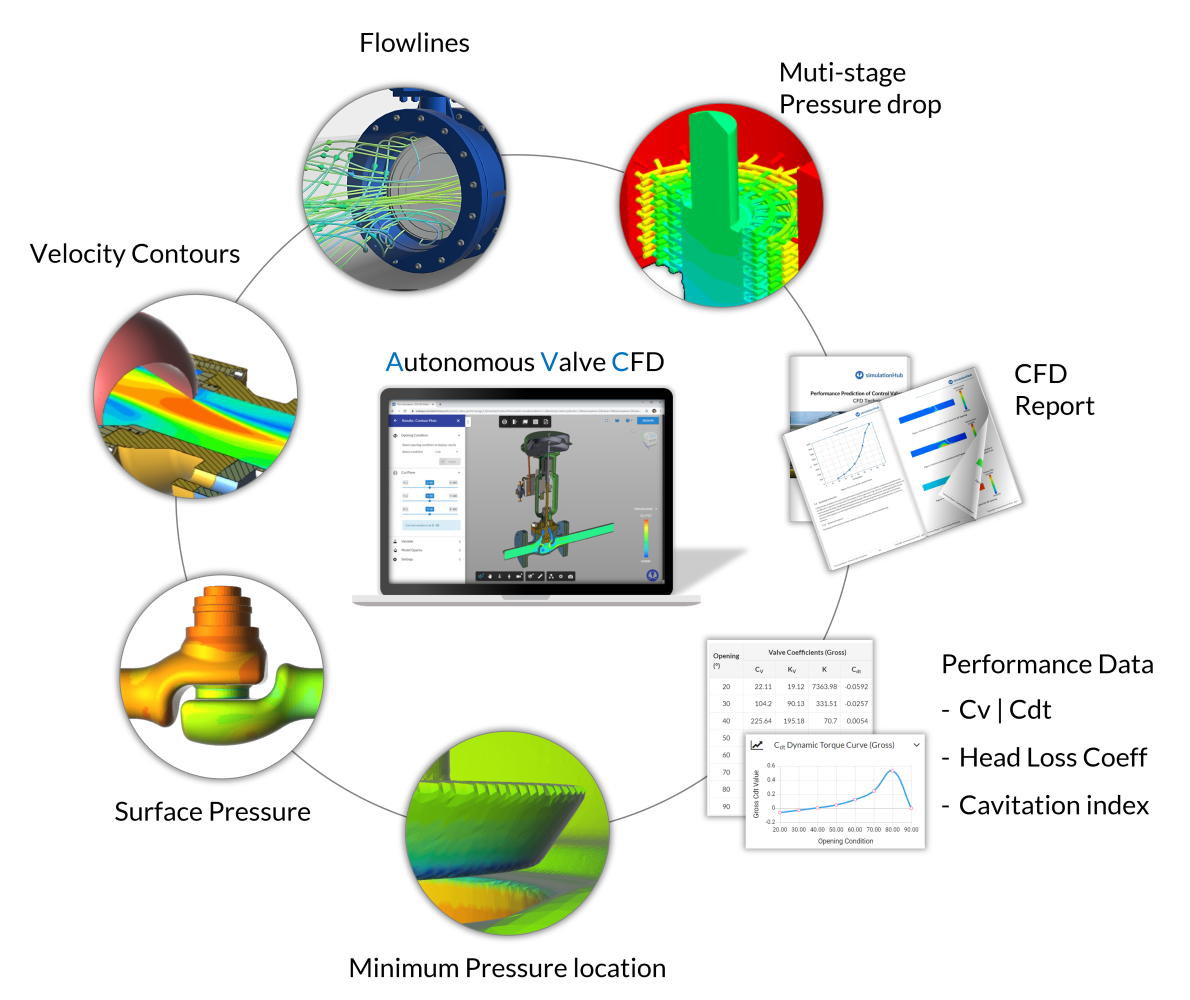
                    <div class="header small ui">Autonomous Valve CFD (AVC) is an AI-powered virtual flow loop testing app developed by simulationHub to accurately predict the valve flow performance parameters: Cv, Cdt, K, and σ at the design stage.</div>
                    <!--Image-->
                    <div class="sixteen wide mobile sixteen wide tablet eight wide computer column min-width-50"
                    style="width: 100%;">
                      <img class="ui centered rounded image" src="https://static.simulationhub.com/prod/images/pages/blogs/2025/17-July/avc.png"
                        alt="Autonomous Valve CFD Application" />
                        <div style="color: #888; font-size: 0.7em; text-align: center; margin-top: 0.3em;">
                            Autonomous Valve CFD
                         </div>
                    </div>
                    <div class="header small ui"><strong>Why Microfinish chose Autonomous Valve CFD</strong></div>
                    <div class="header small ui">In today’s competitive market, Microfinish needed strong technical support to enhance engineering innovation and reduce product development time and costs. Conventional testing and simulation methods are time-consuming, expensive, and demand specialized expertise, making scalability difficult.</div>
                    <div class="header small ui">With Autonomous Valve CFD, Microfinish can now generate detailed performance reports for its specialized valves in just minutes. The ability to test multiple design variations quickly and cost-effectively will allow Microfinish to enhance the quality of its products while reducing lead times.</div>
                    <div class="header small ui">With the support of simulationHub’s cloud-based simulation platform, Microfinish Valves is now able to: </div>
                    <ul lass="header small ui">
                        <li>Accelerate design iterations through fast, cloud-native flow simulations—eliminating delays from physical testing and complex in-house setups. </li>
                        <li>Improve design accuracy with high-fidelity, data-driven insights that closely reflect real-world valve performance and help avoid costly redesigns. </li>
                        <li>Enable engineers to run reliable CFD studies without needing deep simulation expertise, making advanced flow analysis accessible across the design team. </li>
                        <li>Shorten development cycles and bring new valve products to market faster with a smooth, end-to-end digital workflow. </li>
                    </ul>
                    <div class="header small ui">With simulationHub, Microfinish is transforming its engineering process, delivering precision, speed, scalability, and measurable business value. </div>
                    <div class="header small ui"><strong>Looking Ahead</strong></div>
                    <div class="header small ui">As Microfinish Valves continues to expand its global presence, simulationHub will play a strategic role in supporting its ongoing digital transformation journey. We are proud to enable Microfinish with advanced simulation technology and engineering expertise and look forward to the significant impact they will achieve through this collaboration</div>
                    <div class="header small ui">Welcome aboard, Microfinish!</div>
                    <div class="header small ui"><strong>Join the AVC Revolution!</strong></div>
                    <div class="header small ui">If you're looking to optimize your valve designs with the power of CFD but don't have the expertise, Autonomous Valve CFD is here to help. Join the growing list of customers like Entech Controls who are leveraging Autonomous Valve CFD to take their valve design processes to the next level.</div>
                    <div class="header small ui">Contact us today to discover how Autonomous Valve CFD can benefit your organization.</div>
                    <a class="left-align-text ui right labeled teal icon large button" href="https://www.simulationhub.ai/autonomous-valve-cfd">
                        <i class="right chevron icon"></i>Learn More About Autonomous Valve CFD
                    </a><br/>
                    <div class="ui hidden divider"></div>
                    <a class="left-align-text ui right labeled teal icon large button" href="https://www.simulationhub.ai/request-demo">
                        <i class="right chevron icon"></i>Get in Touch
                    </a>
                </div>
            </div>
        </div>
    </div>

    <!-- BLOG AUTHOR -->
    <div class="shbg-grey-pallet hundred ui segment stackable grid no-border no-padding no-margin no-radius no-shadow">
        <div class="row no-margin no-padding">
            <div class="sixteen wide mobile sixteen wide tablet sixteen wide computer column no-margin no-padding">
                <div class="container-fluid responsive-padding padding-large">
                    <div class="content-block vertical-align-top">
                        <div
                            class="inner-content custom-section-width sixteen-wide position-center container-limit max-width-boxed-layout">
                            <div class=" hide-on-tablet hide-on-computer">
    <img class="ui small circular centered image image-border size-small color-teal" src="https://static.simulationhub.com/prod/images/common/team-members/praveen_kumar.jpg" alt="Blog Author - Praveen Kumar">
    <div class="ui medium teal centered header font-weight-bold">
        Praveen Kumar
    </div>
    <div class="spaced" style="text-align: center">
        <a class="ui facebook small icon button" target="_blank" href="https://www.facebook.com/praveenkumar.r.1422">
            <i class="facebook f icon"></i>
        </a>
        <a class="ui twitter small icon button" target="_blank" href="https://twitter.com/Praveen06816">
            <i class="twitter icon"></i>
        </a>
        <a class="ui linkedin small icon button" target="_blank" href="https://www.linkedin.com/pub/praveen-kumar/4/ba3/560">
            <i class="linkedin icon"></i>
        </a>
    </div>
    <div class="ui small header">
        Praveen is a seasoned Product Marketing Manager at simulationHub, with over 15 years of experience in the field of Computational Fluid Dynamics (CFD). His expertise spans a wide range of applications, including Valves, HVAC, and more. As a Mechanical Engineer, Praveen has a solid technical foundation, complemented by a Post Graduate Certification in Product Management from IIM Indore. His extensive background allows him to bridge the gap between technical intricacies and market needs, helping businesses drive innovation and deliver impactful solutions.
    </div>
</div>
<div class="sh-services-title hide-on-mobile">
    <div class="top-aligned image" style="width:200px;">
        <img class="ui fluid circular image image-border size-small color-teal" src="https://static.simulationhub.com/prod/images/common/team-members/praveen_kumar.jpg" alt="Blog Author - Praveen Kumar">
    </div>
    <div class="content">
        <div class="ui medium teal header font-weight-bold">
            Praveen Kumar
        </div>
        <div class="ui small header">
            Praveen is a seasoned Product Marketing Manager at simulationHub, with over 15 years of experience in the field of Computational Fluid Dynamics (CFD). His expertise spans a wide range of applications, including Valves, HVAC, and more. As a Mechanical Engineer, Praveen has a solid technical foundation, complemented by a Post Graduate Certification in Product Management from IIM Indore. His extensive background allows him to bridge the gap between technical intricacies and market needs, helping businesses drive innovation and deliver impactful solutions.
        </div>
        <div class="spaced">
            <a class="ui facebook small icon button" target="_blank" href="https://www.facebook.com/praveenkumar.r.1422">
                <i class="facebook f icon"></i>
            </a>
            <a class="ui twitter small icon button" target="_blank" href="https://twitter.com/Praveen06816">
                <i class="twitter icon"></i>
            </a>
            <a class="ui linkedin small icon button" target="_blank" href="https://www.linkedin.com/pub/praveen-kumar/4/ba3/560">
                <i class="linkedin icon"></i>
            </a>
        </div>
    </div>
</div>
                        </div>
                    </div>
                </div>
            </div>
        </div>
    </div>
</div>]]></content><author><name>https://www.linkedin.com/in/praveen-kumar/</name></author><category term="simulationHub" /><category term="Autonomous Valve CFD" /><category term="simulationHub" /><category term="Autonomous Valve CFD" /><summary type="html"><![CDATA[At SimulationHub, we’re pleased to announce our new collaboration with Microfinish Valves, a globally recognized manufacturer of high-performance valves and flow-control solutions.]]></summary></entry><entry><title type="html">Meet SimulationHub at ACREX India 2026: Showcasing Buildings AI and the AHC Fabric Duct Design Suite</title><link href="https://www.simulationhub.com/blog/simulationhub-at-acrex-2026" rel="alternate" type="text/html" title="Meet SimulationHub at ACREX India 2026: Showcasing Buildings AI and the AHC Fabric Duct Design Suite" /><published>2026-03-02T22:51:54+00:00</published><updated>2026-03-02T22:51:54+00:00</updated><id>https://www.simulationhub.com/blog/simulationhub-at-acrex-2026</id><content type="html" xml:base="https://www.simulationhub.com/blog/simulationhub-at-acrex-2026"><![CDATA[<div class="shbg-pallet white ui segment stackable grid no-border no-padding no-margin no-radius no-shadow">
    <div class="row no-margin no-padding">
        <div class="sixteen wide mobile sixteen wide tablet sixteen wide computer column no-margin no-padding">
            <div class="container-fluid responsive-padding padding-large" style="padding-bottom: 0rem !important">
                <div class="content-block vertical-align-top">
                    <div
                        class="inner-content custom-section-width sixteen-wide position-center container-limit max-width-boxed-layout">
                        <div
                            class="shbg-pallet white ui segment stackable grid no-border no-padding no-margin no-radius no-shadow">
                            <div class="row no-margin no-padding">
                                <div
                                    class="sixteen wide mobile eight wide tablet eight wide computer column no-margin no-padding">
                                    <div class="container-fluid">
                                        <div class="content-block vertical-align-middle">
                                            <div class="inner-content custom-section-width sixteen-wide">
                                                <div class="sh-services-title">
    <div class="top-aligned image" style="width: 70px;">
        <img class="ui fluid circular image image-border size-mini color-teal" src="https://static.simulationhub.com/prod/images/common/team-members/praveen_kumar.jpg" alt="Blog Author - Praveen Kumar">
    </div>
    <div class="content">
        <div class="ui small header no-margin">
            Written by <span class="font-weight-bold text teal">Praveen Kumar</span>
        </div>
        <div class="ui small header custom-link color-blue font-weight-bold no-margin">
            <a href="https://twitter.com/Praveen06816" target="_blank">
                @Praveen06816
            </a>
        </div>
    </div>
</div>
                                            </div>
                                        </div>
                                    </div>
                                </div>
                                <div
                                    class="sixteen wide mobile eight wide tablet eight wide computer column no-margin no-padding hide-on-mobile">
                                    <div class="container-fluid">
                                        <div class="content-block vertical-align-middle">
                                            <div class="inner-content position-right text-align-right">
                                                <div class="ui small header no-margin">
                                                    Approximately
                                                </div>
                                                <div class="ui small teal header font-weight-bold no-margin">
                                                    2 Minutes Reading
                                                </div>
                                            </div>
                                        </div>
                                    </div>
                                </div>
                                <div
                                    class="sixteen wide mobile eight wide tablet eight wide computer column no-margin no-padding hide-on-tablet hide-on-computer">
                                    <div class="container-fluid">
                                        <div class="content-block vertical-align-middle">
                                            <div class="inner-content">
                                                <div class="ui small header no-margin">
                                                    Approximately
                                                </div>
                                                <div class="ui small teal header font-weight-bold no-margin">
                                                    2 Minutes Reading
                                                </div>
                                            </div>
                                        </div>
                                    </div>
                                </div>
                            </div>
                        </div>
                    </div>
                </div>
            </div>
        </div>
    </div>
</div>
<div class="shbg-pallet white ui segment stackable grid no-border no-padding no-margin no-radius no-shadow">
    <div class="row no-margin no-padding">
        <div class="sixteen wide mobile sixteen wide tablet sixteen wide computer column no-margin no-padding">
            <div class="container-fluid responsive-padding padding-large">
                <div class="content-block vertical-align-middle">
                    <div class="inner-content custom-section-width sixteen-wide position-center container-limit max-width-boxed-layout"
                            style="font-size:17px">
                            <div class="font-weight-bold aligned center ui header large">
                                <b> Discover the Future of HVAC Design and Building Energy Simulations at ACREX India 2026 - Hall 2 | IM07 (Imperial Hall)</b>
                            </div>
                        </div>
                    <div class="header small ui">The future of HVAC design and building performance modeling continues to evolve with the power of simulation and AI. At <a href="https://acrex.in/">ACREX India 2026</a>, <a href="https://www.simulationhub.com/">SimulationHub</a> will present its latest technologies aimed at helping engineers, architects, and consultants design smarter and more efficient buildings. </div>
                    <div class="header small ui">Visitors will get an opportunity to explore the newest capabilities of <a href="https://www.simulationhub.com/buildings-ai">Buildings AI</a>, our Agentic AI platform for building performance simulations on cloud. In addition, SimulationHub will introduce the <a href="https://www.simulationhub.com/fabric-duct">AHC Fabric Duct Design Suite</a>, a new solution designed to streamline the design and validation of fabric-based HVAC duct systems.</div>
                    <div class="header small ui">Join us at Hall 2, Booth IM07 (Imperial Hall) to see how simulation intelligence can accelerate HVAC design workflows and enable more efficient building systems. </div>
                    <div class="header small ui">
                        <strong>1. Buildings AI: Agentic AI-Powered Building Performance Modeling </strong>
                    </div>
                    <div class="header small ui"><a href="https://www.simulationhub.com/buildings-ai">Buildings AI</a> enables architects, engineers, and energy consultants to evaluate building performance through intelligent simulation workflows powered by the EnergyPlus engine. The platform supports HVAC load and energy simulations, LEED and ECSBC compliance workflows, and thermal comfort analysis. It also simplifies ASHRAE baseline creation and data center cooling optimization, helping professionals assess building performance quickly and with greater confidence.</div>
                    <div class="header small ui">
                        <strong>2. Introducing the AHC Fabric Duct Design Suite </strong>
                    </div>
                    <div class="header small ui">SimulationHub will also unveil the <a href="https://www.simulationhub.com/fabric-duct">AHC Fabric Duct Design Suite</a>, a unified platform built to simplify the design and manufacturing workflow for textile-based HVAC duct systems. The AHC Fabric Duct Design Suite addresses this challenge by bringing the workflow into a single environment. Designers can create 2D layouts that automatically generate BIM-ready 3D models, validate airflow performance during the design stage, and generate manufacturing-ready outputs such as DXF flat patterns and bills of materials. This integrated approach helps teams move efficiently from concept to production with fewer iterations and greater accuracy.</div>
                    <div class="sixteen wide mobile sixteen wide tablet eight wide computer column min-width-50" style="width: 100%;">
                        <img class="ui huge centered rounded image"
                        src="https://static.simulationhub.com/prod/images/pages/blogs/2026/03-March/sh-software-feature.png"
                        alt="SimulationHub Software Feature Image" />
                    </div>
                    <div class="header small ui">
                        <strong>Event Details at a Glance</strong>
                    </div>
                    <ul class="ui list">
                        <li><strong>Date:</strong> March 12-14, 2026</li>
                        <li><strong>Location:</strong> <a href="https://www.google.com/maps/place/Bombay+Exhibition+Centre,+NESCO,+Goregaon+East,+Mumbai,+Maharashtra+400063/@19.1505066,72.8510039,17z/data=!3m1!4b1!4m6!3m5!1s0x3be7b7ca86e01c89:0xa987fb34838933c4!8m2!3d19.1505016!4d72.8535788!16s%2Fg%2F1pv60r4t5?entry=ttu&g_ep=EgoyMDI2MDMwNC4xIKXMDSoASAFQAw%3D%3D">Bombay Exhibition Centre</a>, Mumbai, India</li>
                        <li><strong>Booth:</strong> Hall 2, Booth IM07 (Imperial Hall)</li>
                    </ul>
                    <div class="sixteen wide mobile sixteen wide tablet eight wide computer column min-width-50" style="width: 100%;">
                        <img class="ui huge centered rounded image"
                        src="https://static.simulationhub.com/prod/images/pages/blogs/2026/03-March/meet-us-here.png"
                        alt="ACREX2026 - Meet Us Here" />
                    </div>
                    <div class="header small ui">
                        <strong>Why Attend ACREX India 2026?</strong>
                    </div>
                    <div class="header small ui"><a href="https://acrex.in/">ACREX India</a> is one of South Asia’s most prominent exhibitions for HVAC, refrigeration, and intelligent building technologies. The event gathers global manufacturers, innovators, consultants, and industry professionals to explore emerging technologies and sustainable building solutions. From product launches and technology showcases to networking opportunities and expert discussions, ACREX India offers a unique platform to learn about the latest advancements shaping the HVAC industry. If you are involved in HVAC design, building performance engineering, or sustainable architecture, this is your chance to discover how simulation-powered intelligence can enable faster and more informed design decisions. </div>
                    <div class="header small ui">Join us at ACREX India 2026 in Mumbai and see how <a href="https://www.simulationhub.com/">SimulationHub</a> is helping professionals build smarter, more efficient buildings. </div>
                    <div class="header small ui">
                    <div style="display:flex; flex-direction:column; align-items:flex-start; gap:12px;">
                        <a class="left-align-text ui right labeled icon large primary button uppercase" href="https://www.viablesoft.co/ACREX2026MarMumVD/registrationpage.aspx?rid=ACV26" style="padding:16px 32px; display:block; margin-bottom:12px;">
                        <i class="right chevron icon"></i>Register & Visit Us at ACREX India 2026
                    </a>
                    <a class="left-align-text ui right labeled icon large primary button uppercase" href="https://www.simulationhub.com/contact-us" style="padding:16px 32px; display:block;">
                        <i class="right chevron icon"></i>Schedule a Demo Call
                    </a></div>
                </div>
            </div>
        </div>
    </div>
    <!-- BLOG AUTHOR -->
    <div class="shbg-grey-pallet hundred ui segment stackable grid no-border no-padding no-margin no-radius no-shadow">
        <div class="row no-margin no-padding">
            <div class="sixteen wide mobile sixteen wide tablet sixteen wide computer column no-margin no-padding">
                <div class="container-fluid responsive-padding padding-large">
                    <div class="content-block vertical-align-top">
                        <div
                            class="inner-content custom-section-width sixteen-wide position-center container-limit max-width-boxed-layout">
                            <div class=" hide-on-tablet hide-on-computer">
    <img class="ui small circular centered image image-border size-small color-teal" src="https://static.simulationhub.com/prod/images/common/team-members/praveen_kumar.jpg" alt="Blog Author - Praveen Kumar">
    <div class="ui medium teal centered header font-weight-bold">
        Praveen Kumar
    </div>
    <div class="spaced" style="text-align: center">
        <a class="ui facebook small icon button" target="_blank" href="https://www.facebook.com/praveenkumar.r.1422">
            <i class="facebook f icon"></i>
        </a>
        <a class="ui twitter small icon button" target="_blank" href="https://twitter.com/Praveen06816">
            <i class="twitter icon"></i>
        </a>
        <a class="ui linkedin small icon button" target="_blank" href="https://www.linkedin.com/pub/praveen-kumar/4/ba3/560">
            <i class="linkedin icon"></i>
        </a>
    </div>
    <div class="ui small header">
        Praveen is a seasoned Product Marketing Manager at simulationHub, with over 15 years of experience in the field of Computational Fluid Dynamics (CFD). His expertise spans a wide range of applications, including Valves, HVAC, and more. As a Mechanical Engineer, Praveen has a solid technical foundation, complemented by a Post Graduate Certification in Product Management from IIM Indore. His extensive background allows him to bridge the gap between technical intricacies and market needs, helping businesses drive innovation and deliver impactful solutions.
    </div>
</div>
<div class="sh-services-title hide-on-mobile">
    <div class="top-aligned image" style="width:200px;">
        <img class="ui fluid circular image image-border size-small color-teal" src="https://static.simulationhub.com/prod/images/common/team-members/praveen_kumar.jpg" alt="Blog Author - Praveen Kumar">
    </div>
    <div class="content">
        <div class="ui medium teal header font-weight-bold">
            Praveen Kumar
        </div>
        <div class="ui small header">
            Praveen is a seasoned Product Marketing Manager at simulationHub, with over 15 years of experience in the field of Computational Fluid Dynamics (CFD). His expertise spans a wide range of applications, including Valves, HVAC, and more. As a Mechanical Engineer, Praveen has a solid technical foundation, complemented by a Post Graduate Certification in Product Management from IIM Indore. His extensive background allows him to bridge the gap between technical intricacies and market needs, helping businesses drive innovation and deliver impactful solutions.
        </div>
        <div class="spaced">
            <a class="ui facebook small icon button" target="_blank" href="https://www.facebook.com/praveenkumar.r.1422">
                <i class="facebook f icon"></i>
            </a>
            <a class="ui twitter small icon button" target="_blank" href="https://twitter.com/Praveen06816">
                <i class="twitter icon"></i>
            </a>
            <a class="ui linkedin small icon button" target="_blank" href="https://www.linkedin.com/pub/praveen-kumar/4/ba3/560">
                <i class="linkedin icon"></i>
            </a>
        </div>
    </div>
</div>
                        </div>
                    </div>
                </div>
            </div>
        </div>
    </div>
</div>]]></content><author><name>https://www.linkedin.com/in/praveen-r-kumar/</name></author><category term="ASHRAE 90.1 Compliance" /><category term="Load Calculation" /><category term="Energy Analysis" /><category term="ASHRAE 55 Compliance" /><category term="Buildings AI" /><category term="simulationHub" /><category term="Agentic AI" /><category term="Building Performance Simulation" /><category term="Buildings AI" /><category term="BIM Model" /><category term="Building Performance Simulation" /><category term="Design Software" /><category term="simulationHub" /><category term="Autonomous HVAC CFD" /><category term="CFD" /><category term="Design software" /><summary type="html"><![CDATA[Visit SimulationHub at ACREX India 2026 to explore Buildings AI and the new AHC Fabric Duct Design Suite. Discover how simulation-driven intelligence is accelerating HVAC design and building performance modeling.]]></summary></entry><entry><title type="html">Meet Autonomous Valve CFD at IEW 2026 (Exclusive Offers Inside)</title><link href="https://www.simulationhub.com/blog/meet-avc-at-iew-2026" rel="alternate" type="text/html" title="Meet Autonomous Valve CFD at IEW 2026 (Exclusive Offers Inside)" /><published>2026-03-01T04:30:00+00:00</published><updated>2026-03-01T04:30:00+00:00</updated><id>https://www.simulationhub.com/blog/meet-avc-at-iew-2026</id><content type="html" xml:base="https://www.simulationhub.com/blog/meet-avc-at-iew-2026"><![CDATA[<div class="shbg-pallet white ui segment stackable grid no-border no-padding no-margin no-radius no-shadow">
    <div class="row no-margin no-padding">
        <div class="sixteen wide mobile sixteen wide tablet sixteen wide computer column no-margin no-padding">
            <div class="container-fluid responsive-padding padding-large" style="padding-bottom: 0rem !important">
                <div class="content-block vertical-align-top">
                    <div
                        class="inner-content custom-section-width sixteen-wide position-center container-limit max-width-boxed-layout">
                        <div
                            class="shbg-pallet white ui segment stackable grid no-border no-padding no-margin no-radius no-shadow">
                            <div class="row no-margin no-padding">
                                <div
                                    class="sixteen wide mobile eight wide tablet eight wide computer column no-margin no-padding">
                                    <div class="container-fluid">
                                        <div class="content-block vertical-align-middle">
                                            <div class="inner-content custom-section-width sixteen-wide">
                                                <div class="sh-services-title">
    <div class="top-aligned image" style="width: 70px;">
        <img class="ui fluid circular image image-border size-mini color-teal" src="https://static.simulationhub.com/prod/images/common/team-members/praveen_kumar.jpg" alt="Blog Author - Praveen Kumar">
    </div>
    <div class="content">
        <div class="ui small header no-margin">
            Written by <span class="font-weight-bold text teal">Praveen Kumar</span>
        </div>
        <div class="ui small header custom-link color-blue font-weight-bold no-margin">
            <a href="https://twitter.com/Praveen06816" target="_blank">
                @Praveen06816
            </a>
        </div>
    </div>
</div>
                                            </div>
                                        </div>
                                    </div>
                                </div>
                                <div
                                    class="sixteen wide mobile eight wide tablet eight wide computer column no-margin no-padding hide-on-mobile">
                                    <div class="container-fluid">
                                        <div class="content-block vertical-align-middle">
                                            <div class="inner-content position-right text-align-right">
                                                <div class="ui small header no-margin">
                                                    Approximately
                                                </div>
                                                <div class="ui small teal header font-weight-bold no-margin">
                                                    5 Minutes Reading
                                                </div>
                                            </div>
                                        </div>
                                    </div>
                                </div>
                                <div
                                    class="sixteen wide mobile eight wide tablet eight wide computer column no-margin no-padding hide-on-tablet hide-on-computer">
                                    <div class="container-fluid">
                                        <div class="content-block vertical-align-middle">
                                            <div class="inner-content">
                                                <div class="ui small header no-margin">
                                                    Approximately
                                                </div>
                                                <div class="ui small teal header font-weight-bold no-margin">
                                                    5 Minutes Reading
                                                </div>
                                            </div>
                                        </div>
                                    </div>
                                </div>
                            </div>
                        </div>
                    </div>
                </div>
            </div>
        </div>
    </div>
</div>
<div class="shbg-pallet white ui segment stackable grid no-border no-padding no-margin no-radius no-shadow">
    <div class="row no-margin no-padding">
        <div class="sixteen wide mobile sixteen wide tablet sixteen wide computer column no-margin no-padding">
            <div class="container-fluid responsive-padding padding-large">
                <div class="content-block vertical-align-middle">
                    <div class="header small ui"><strong>Furqan Khatri from Autonomous Valve CFD (AVC) Attending IEW 2026</strong></div>
                    <div class="header small ui">Furqan Khatri, Technical Sales Manager at Autonomous Valve CFD (AVC), will be attending the 4th edition of India Energy Week (IEW 2026) from 27–30 January at the ONGC – Advanced Training Institute, Goa.</div>
                    <div class="header small ui">IEW is the premier event where global energy innovators and leaders connect, and simulationHub’s AVC is proud to be part of this forward-thinking platform.</div>
                    <div class="header small ui"><strong>How simulationHub’s AVC is Redifining Valve Design at IEW 2026</strong></div>
                    <div class="header small ui">At IEW 2026, Furqan will showcase how simulationHub’s Autonomous Valve CFD (AVC) is transforming valve design and validation. Leveraging advanced CFD technology, AVC empowers engineering teams to push valve performance boundaries with faster, more accurate simulations—cutting redesign costs and speeding up go-to-market timelines. It’s a breakthrough for energy and manufacturing sectors focused on precision and efficiency.</div>
                    <!--Image-->
                    <div class="sixteen wide mobile sixteen wide tablet eight wide computer column min-width-50"
                    style="width: 100%;">
                      <img class="ui centered rounded image" src="https://static.simulationhub.com/prod/images/pages/blogs/2026/29-Febuary/furqan-at-iew.png"
                        alt="Autonomous Valve CFD Application" />
                        <div style="color: #888; font-size: 0.7em; text-align: center; margin-top: 0.3em;">
                            Autonomous Valve CFD
                         </div>
                    </div>
                    <div class="header small ui"><strong>Attending IEW? Connect with Furqan to Explore AVC</strong></div>
                    <div class="header small ui">If you’re attending India Energy Week 2026, don’t miss the chance to meet Furqan and discover how simulationHub’s AVC can elevate your valve design process. Furqan will share insights on the latest CFD innovations, valve optimization techniques, and digital transformation in energy systems—showcasing how AVC and simulationHub enable smarter, more efficient engineering.</div>
                    <div class="header small ui">Plus, IEW attendees get access to an exclusive offers - available only through direct connection with Furqan at the event.</div>
                    <div class="header small ui"><strong>Exclusive AVC Offers for IEW Attendees</strong></div>
                    <div class="header small ui">To celebrate IEW 2026, simulationHub is offering exclusive event-only deals on Autonomous Valve CFD (AVC).</div>
                    <div class="header small ui">Use code ( IEW-SH-2026 ) when you connect with Furqan or schedule a call to unlock special offers available only to IEW attendees.</div>
                    <!--Image-->
                    <div class="sixteen wide mobile sixteen wide tablet eight wide computer column min-width-50"
                    style="width: 100%;">
                      <img class="ui centered rounded image" src="https://static.simulationhub.com/prod/images/pages/blogs/2026/29-Febuary/iew-26-offer.png"
                        alt="Autonomous Valve CFD Application" />
                        <div style="color: #888; font-size: 0.7em; text-align: center; margin-top: 0.3em;">
                            Autonomous Valve CFD
                         </div>
                    </div>
                    <div class="header small ui"><strong>Contact Furqan Khatri : </strong><a href="mailto:furqan.khatri@cctech.co.in" target="_blank">furqan.khatri@cctech.co.in</a> / +91-8655805155</div>
                    <a class="left-align-text ui right labeled teal icon large button" href="https://www.simulationhub.ai/request-demo">
                        <i class="right chevron icon"></i>Get in Touch
                    </a>
                </div>
            </div>
        </div>
    </div>

    <!-- BLOG AUTHOR -->
    <div class="shbg-grey-pallet hundred ui segment stackable grid no-border no-padding no-margin no-radius no-shadow">
        <div class="row no-margin no-padding">
            <div class="sixteen wide mobile sixteen wide tablet sixteen wide computer column no-margin no-padding">
                <div class="container-fluid responsive-padding padding-large">
                    <div class="content-block vertical-align-top">
                        <div
                            class="inner-content custom-section-width sixteen-wide position-center container-limit max-width-boxed-layout">
                            <div class=" hide-on-tablet hide-on-computer">
    <img class="ui small circular centered image image-border size-small color-teal" src="https://static.simulationhub.com/prod/images/common/team-members/praveen_kumar.jpg" alt="Blog Author - Praveen Kumar">
    <div class="ui medium teal centered header font-weight-bold">
        Praveen Kumar
    </div>
    <div class="spaced" style="text-align: center">
        <a class="ui facebook small icon button" target="_blank" href="https://www.facebook.com/praveenkumar.r.1422">
            <i class="facebook f icon"></i>
        </a>
        <a class="ui twitter small icon button" target="_blank" href="https://twitter.com/Praveen06816">
            <i class="twitter icon"></i>
        </a>
        <a class="ui linkedin small icon button" target="_blank" href="https://www.linkedin.com/pub/praveen-kumar/4/ba3/560">
            <i class="linkedin icon"></i>
        </a>
    </div>
    <div class="ui small header">
        Praveen is a seasoned Product Marketing Manager at simulationHub, with over 15 years of experience in the field of Computational Fluid Dynamics (CFD). His expertise spans a wide range of applications, including Valves, HVAC, and more. As a Mechanical Engineer, Praveen has a solid technical foundation, complemented by a Post Graduate Certification in Product Management from IIM Indore. His extensive background allows him to bridge the gap between technical intricacies and market needs, helping businesses drive innovation and deliver impactful solutions.
    </div>
</div>
<div class="sh-services-title hide-on-mobile">
    <div class="top-aligned image" style="width:200px;">
        <img class="ui fluid circular image image-border size-small color-teal" src="https://static.simulationhub.com/prod/images/common/team-members/praveen_kumar.jpg" alt="Blog Author - Praveen Kumar">
    </div>
    <div class="content">
        <div class="ui medium teal header font-weight-bold">
            Praveen Kumar
        </div>
        <div class="ui small header">
            Praveen is a seasoned Product Marketing Manager at simulationHub, with over 15 years of experience in the field of Computational Fluid Dynamics (CFD). His expertise spans a wide range of applications, including Valves, HVAC, and more. As a Mechanical Engineer, Praveen has a solid technical foundation, complemented by a Post Graduate Certification in Product Management from IIM Indore. His extensive background allows him to bridge the gap between technical intricacies and market needs, helping businesses drive innovation and deliver impactful solutions.
        </div>
        <div class="spaced">
            <a class="ui facebook small icon button" target="_blank" href="https://www.facebook.com/praveenkumar.r.1422">
                <i class="facebook f icon"></i>
            </a>
            <a class="ui twitter small icon button" target="_blank" href="https://twitter.com/Praveen06816">
                <i class="twitter icon"></i>
            </a>
            <a class="ui linkedin small icon button" target="_blank" href="https://www.linkedin.com/pub/praveen-kumar/4/ba3/560">
                <i class="linkedin icon"></i>
            </a>
        </div>
    </div>
</div>
                        </div>
                    </div>
                </div>
            </div>
        </div>
    </div>
</div>]]></content><author><name>https://www.linkedin.com/in/praveen-kumar/</name></author><category term="simulationHub" /><category term="Autonomous Valve CFD" /><category term="simulationHub" /><category term="Autonomous Valve CFD" /><summary type="html"><![CDATA[Meet us at India Energy Week 2026 (IEW) in Goa. Furqan Khatri will be showcasing simulationHub’s Autonomous Valve CFD (AVC) and how it’s transforming valve design and validation.]]></summary></entry><entry><title type="html">Join Buildings AI Journey of Shaping the Future of Built Environments with Intelligent Simulation Technology</title><link href="https://www.simulationhub.com/blog/join-buildingsai-journey" rel="alternate" type="text/html" title="Join Buildings AI Journey of Shaping the Future of Built Environments with Intelligent Simulation Technology" /><published>2026-02-19T22:51:54+00:00</published><updated>2026-02-19T22:51:54+00:00</updated><id>https://www.simulationhub.com/blog/join-buildingsai-journey</id><content type="html" xml:base="https://www.simulationhub.com/blog/join-buildingsai-journey"><![CDATA[<div class="shbg-pallet white ui segment stackable grid no-border no-padding no-margin no-radius no-shadow">
    <div class="row no-margin no-padding">
        <div class="sixteen wide mobile sixteen wide tablet sixteen wide computer column no-margin no-padding">
            <div class="container-fluid responsive-padding padding-large" style="padding-bottom: 0rem !important">
                <div class="content-block vertical-align-top">
                    <div
                        class="inner-content custom-section-width sixteen-wide position-center container-limit max-width-boxed-layout">
                        <div
                            class="shbg-pallet white ui segment stackable grid no-border no-padding no-margin no-radius no-shadow">
                            <div class="row no-margin no-padding">
                                <div
                                    class="sixteen wide mobile eight wide tablet eight wide computer column no-margin no-padding">
                                    <div class="container-fluid">
                                        <div class="content-block vertical-align-middle">
                                            <div class="inner-content custom-section-width sixteen-wide">
                                                <div class="inner-content custom-section-width sixteen-wide">
    <div class="sh-services-title">
        <div class="top-aligned image" style="width: 70px;">
            <img class="ui fluid circular image image-border size-mini color-teal" src="https://static.simulationhub.com/prod/images/common/team-members/aaditya_ruiker.jpg" alt="Blog Author - Aaditya Ruiker">
        </div>
        <div class="content">
            <div class="ui small header no-margin">
                Written by <span class="font-weight-bold text teal">Aaditya Ruiker</span>
            </div>
            <div class="ui small header custom-link color-blue font-weight-bold no-margin">
                <a href="https://twitter.com/AadityaRuikar" target="_blank">
                    @AadityaRuikar
                </a>
            </div>
        </div>
    </div>
</div>
                                            </div>
                                        </div>
                                    </div>
                                </div>
                                <div
                                    class="sixteen wide mobile eight wide tablet eight wide computer column no-margin no-padding hide-on-mobile">
                                    <div class="container-fluid">
                                        <div class="content-block vertical-align-middle">
                                            <div class="inner-content position-right text-align-right">
                                                <div class="ui small header no-margin">
                                                    Approximately
                                                </div>
                                                <div class="ui small teal header font-weight-bold no-margin">
                                                    2 Minutes Reading
                                                </div>
                                            </div>
                                        </div>
                                    </div>
                                </div>
                                <div
                                    class="sixteen wide mobile eight wide tablet eight wide computer column no-margin no-padding hide-on-tablet hide-on-computer">
                                    <div class="container-fluid">
                                        <div class="content-block vertical-align-middle">
                                            <div class="inner-content">
                                                <div class="ui small header no-margin">
                                                    Approximately
                                                </div>
                                                <div class="ui small teal header font-weight-bold no-margin">
                                                    2 Minutes Reading
                                                </div>
                                            </div>
                                        </div>
                                    </div>
                                </div>
                            </div>
                        </div>
                    </div>
                </div>
            </div>
        </div>
    </div>
</div>
<div class="shbg-pallet white ui segment stackable grid no-border no-padding no-margin no-radius no-shadow">
    <div class="row no-margin no-padding">
        <div class="sixteen wide mobile sixteen wide tablet sixteen wide computer column no-margin no-padding">
            <div class="container-fluid responsive-padding padding-large">
                <div class="content-block vertical-align-middle">
                    <div class="inner-content custom-section-width sixteen-wide position-center container-limit max-width-boxed-layout"
                            style="font-size:17px">
                            <div class="font-weight-bold aligned center ui header large">
                                <b>Introducing <a href="https://www.simulationhub.com/buildings-ai" target="_blank">Buildings AI</a>: Intelligent Simulation in Your Browser</b>
                            </div>
                        </div>
                    <div class="header small ui"><a href="https://www.simulationhub.com/buildings-ai" target="_blank">Buildings AI</a> is a cloud-based whole building performance software that's reimagining how we design sustainable buildings. Running entirely in your web browser, it combines powerful energy simulation with AI-driven insights to accelerate the path to high-performance buildings.</div>
                    <div class="ui medium header">
                        <strong>What Makes <a href="https://www.simulationhub.com/buildings-ai" target="_blank">Buildings AI</a> Different</strong>
                    </div>
                    <div class="ui small header">
                        <strong>1. Seamless Integration with Your Workflow</strong>
                    </div>
                    <div class="sixteen wide mobile sixteen wide tablet eight wide computer column min-width-50" style="width: 100%;">
                        <img class="ui huge centered rounded image"
                        src="https://static.simulationhub.com/prod/images/pages/blogs/2026/15-March/Buildings_AI_seamless_interopereability.png"
                        alt="Platform Used - Buildings AI - simulationHub" />
                    </div>
                    <div class="header small ui"><a href="https://www.simulationhub.com/buildings-ai" target="_blank">Buildings AI</a> connects directly with the tools you already use. Effortlessly import architectural models into precise building energy models, ensuring smooth integration into your existing workflow. Create error free 3D building models from various sources, including Revit, AutoCAD Architecture, PDFs, FloorSpaceJS, or even from scratch using an intuitive sketcher tool.</div>
                    <div class="ui small header">
                        <strong>2. Comprehensive Building Configuration</strong>
                    </div>
                    <div class="header small ui">
                        <p class="header small ui">The Build module transforms imported geometry into simulation-ready models with:</p>
                        <ul>
                            <li>Interactive 3D visualization with Autodesk platform viewer integration </li>
                            <li>600+ predefined construction material assemblies </li>
                            <li>150+ space types across 16+ building categories </li>
                            <li>Flexible zoning tools for HVAC load optimization</li>
                            <li>Real-time property editing and assignment </li>
                        </ul>
                    </div>
                    <div class="ui small header">
                        <strong>3. Sophisticated HVAC System Design</strong>
                    </div>
                    <div class="header small ui">
                        <p class="header small ui">The HVAC module provides extensive system selection capabilities:</p>
                        <ul>
                            <li>Chilled water and split air handling units (CAV and VAV)</li>
                            <li>Multiple terminal unit options: VRF, fan coil units, water source heat pumps, PTAC/PTHP</li>
                            <li>Advanced systems: active/passive chilled beams, radiant panels, unit ventilators </li>
                            <li>Comprehensive plant configurations for chilled water, hot water, condenser water, and VRF </li>
                        </ul>
                    </div>
                    <div class="sixteen wide mobile sixteen wide tablet eight wide computer column min-width-50" style="width: 100%;">
                        <img class="ui huge centered rounded image"
                        src="https://static.simulationhub.com/prod/images/pages/blogs/2026/15-March/BuildingsAI_HVAC_Canvas.png"
                        alt="Platform Used - Buildings AI - simulationHub" />
                    </div>
                    <div class="ui small header">
                        <strong>4. Powered by EnergyPlus </strong>
                    </div>
                    <div class="header small ui">
                        <p class="header small ui">Both Load and Energy modules leverage the industry-standard EnergyPlus simulation engine, providing: </p>
                        <ul>
                            <li>Accurate HVAC load calculations and equipment sizing </li>
                            <li>Detailed annual energy consumption analysis </li>
                            <li>Results viewable at facility, system, zone, and space levels </li>
                            <li>Support for ASHRAE 90.1 compliance modeling </li>
                        </ul>
                    </div>
                    <div class="ui small header">
                        <strong>5. AI-Powered Report Generation </strong>
                    </div>
                    <div class="header small ui">
                        <p class="header small ui">Report Assitant revolutionizes documentation by generating detailed reports using natural language prompts. Simply ask for a "detailed load calculation report for simulation XXXX" and receive professionally formatted Word documents complete with: </p>
                        <ul>
                            <li>Customizable branding (logos, colors, fonts) </li>
                            <li>Load calculations and ASHRAE 62.1 ventilation summaries </li>
                            <li>Flexible content arrangement based on your preferences </li>
                        </ul>
                    </div>
                    <div class="sixteen wide mobile sixteen wide tablet eight wide computer column min-width-50" style="width: 100%;">
                        <img class="ui huge centered rounded image"
                        src="https://static.simulationhub.com/prod/images/pages/blogs/2026/15-March/Report-Assitant-feature-image.jpg"
                        alt="Platform Used - Buildings AI - simulationHub" />
                    </div>
                    <div class="ui small header">
                        <strong>6. Centralized Data Management </strong>
                    </div>
                    <div class="header small ui">The DataHub serves as your project repository, organizing all input files, simulation results, and generated reports in one accessible location. </div>
                    <div class="sixteen wide mobile sixteen wide tablet eight wide computer column min-width-50" style="width: 100%;">
                        <img class="ui huge centered rounded image"
                        src="https://static.simulationhub.com/prod/images/pages/blogs/2026/15-March/Buildings-AI-DataHub.bmp"
                        alt="Platform Used - Buildings AI - simulationHub" />
                    </div>
                    <div class="ui small header">
                        <strong>7. Who Benefits from <a href="https://www.simulationhub.com/buildings-ai" target="_blank">Buildings AI</a>?</strong>
                    </div>
                    <div class="header small ui">
                        <p class="header small ui"><a href="https://www.simulationhub.com/buildings-ai" target="_blank">Buildings AI</a> is designed for professionals shaping the future of sustainable buildings: </p>
                        <ul>
                            <li><strong>MEP Engineer</strong> performing load calculations and HVAC system design </li>
                            <li><strong>Energy Modelers</strong> conducting ASHRAE 90.1 compliance analysis </li>
                            <li><strong>Sustainability Consultants</strong> optimizing building energy performance </li>
                            <li><strong>Architects</strong> exploring design alternatives early in the process </li>
                            <li><strong>Building Design Firms</strong> seeking to streamline their simulation workflows </li>
                        </ul>
                    </div>
                    <div class="ui small header">
                        <strong>8. Our	Vision:	Shaping	the	Future	of	Sustainable	Built Environments </strong>
                    </div>
                    <div class="header small ui">At SimulationHub, we're committed to making intelligent simulation technology accessible to everyone involved in building design. <a href="https://www.simulationhub.com/buildings-ai" target="_blank">Buildings AI</a> represents our vision of democratizing whole building performance analysis, bringing powerful capabilities that were once limited to specialized experts into the hands of all design professionals. </div>
                    <div class="header small ui">We believe that by removing barriers to simulation and leveraging AI to accelerate workflows, we can collectively achieve more sustainable, efficient, and comfortable buildings at scale. </div>
                    <div class="ui small header">
                        <strong>9. Real-World Applications </strong>
                    </div>
                    <div class="header small ui">
                        <p class="header small ui"><a href="https://www.simulationhub.com/buildings-ai" target="_blank">Buildings AI</a> supports the entire building design lifecycle: </p>
                        <ul>
                            <li><strong>Early Design Exploration</strong>: Quickly evaluate multiple design alternatives to inform decision-making </li>
                            <li><strong>Code Compliance</strong>: Generate ASHRAE 90.1 Appendix G performance rating method documentation </li>
                            <li><strong>HVAC System Optimization</strong>: Compare system types and sizing to minimize energy consumption </li>
                            <li><strong>LEED Documentation</strong>: Support LEED v5 energy modeling requirements </li>
                            <li><strong>Design Development</strong>: Refine building envelope and system specifications based on simulation results</li>
                            <li><strong>Construction Documentation</strong>: Generate detailed load calculation reports for equipment specification </li>
                        </ul>
                    </div>
                    <div class="ui small header">
                        <strong>10. The Technology Behind the Platform </strong>
                    </div>
                    <div class="header small ui">
                        <p class="header small ui"><a href="https://www.simulationhub.com/buildings-ai" target="_blank">Buildings AI</a> leverages cutting-edge technologies to deliver performance and usability: </p>
                        <ul>
                            <li><strong>Cloud-Native Architecture</strong>: No software installation, accessible from any device with a browser </li>
                            <li><strong>EnergyPlus Integration</strong>: Industry-standard simulation engine for validated results </li>
                            <li><strong>Autodesk Platform Services</strong>: High-performance 3D visualization of building models </li>
                            <li><strong>Large Language Models</strong>: Natural language interface for report generation and customization </li>
                            <li><strong>JSON-Based Data Exchange</strong>: Structured, extensible format for interoperability </li>
                        </ul>
                    </div>
                    <div class="ui small header">
                        <strong>11. What's Coming Next </strong>
                    </div>
                    <div class="header small ui">
                        <p class="header small ui">We're continuously expanding <a href="https://www.simulationhub.com/buildings-ai" target="_blank">Buildings AI</a>'s capabilities with features on our roadmap including: </p>
                        <ul>
                            <li>Conceptual and schematic design tools for earlier stage analysis </li>
                            <li>Thermal comfort and indoor air quality modules </li>
                            <li>Operational optimization features for existing buildings </li>
                            <li>Expanded integration with additional design platforms </li>
                            <li>Enhanced AI assistance throughout the workflow </li>
                        </ul>
                    </div>
                    <div class="ui small header">
                        <strong>Let's Connect: I Want to Hear from You </strong>
                    </div>
                    <div class="header small ui">
                        <p class="header small ui">I'm reaching out to the building design and sustainability community because your insights, challenges, and requirements are essential to shaping Buildings AI's future. </p>
                        <p class="header small ui"><strong>I'm particularly interested in connecting with: </strong></p>
                        <ul>
                            <li>Engineers and consultants working on building energy simulation projects </li>
                            <li>Firms looking to streamline their HVAC design and load calculation workflows </li>
                            <li>Sustainability professionals pursuing net-zero and high-performance building goals </li>
                            <li>Organizations interested in ASHRAE 90.1 compliance modeling capabilities </li>
                            <li>Anyone passionate about leveraging AI and intelligent simulation in building design </li>
                        </ul>
                    </div>
                    <div class="header small ui">
                        <p class="header small ui"><strong>Whether you'd like to: </strong></p>
                        <ul>
                            <li>Discuss your specific simulation challenges and requirements </li>
                            <li>Explore how <a href="https://www.simulationhub.com/buildings-ai" target="_blank">Buildings AI</a> might fit into your workflow </li>
                            <li>Share feedback on the platform's current capabilities </li>
                            <li>Anyone passionate about leveraging AI and intelligent simulation in building design </li>
                            <li>Collaborate on advancing building performance simulation </li>
                        </ul>
                        <p class="header small ui"><strong>I'd love to schedule a conversation with you.</strong></p>
                    </div>
                    <div class="ui small header">
                        <strong>Book Time to Connect </strong>
                    </div>
                    <div class="header small ui">
                        <p class="header small ui">Ready to discuss how <a href="https://www.simulationhub.com/buildings-ai" target="_blank">Buildings AI</a> can support your building performance goals? Let's have a conversation about your needs and how intelligent simulation technology can accelerate your path to sustainable design. </p>
                        <p class="header small ui">During our call, we can:</p>
                        <ul>
                            <li>Discuss your current workflows and pain points </li>
                            <li>Explore <a href="https://www.simulationhub.com/buildings-ai" target="_blank">Buildings AI</a>'s capabilities in detail </li>
                            <li>Answer any questions about the platform </li>
                            <li>Identify opportunities for collaboration </li>
                            <li>Discuss early access and pilot project possibilities </li>
                        </ul>
                    </div>
                    <a class="left-align-text ui right labeled icon large primary button uppercase" href="https://calendly.com/aaditya-ruikar/15min" style="padding:10px 20px; display:inline-block; width:auto;">
                        <i class="right chevron icon"></i>Schedule a Demo Call
                    </a>
                </div>
            </div>
        </div>
    </div>
    <!-- BLOG AUTHOR -->
    <div class="shbg-grey-pallet hundred ui segment stackable grid no-border no-padding no-margin no-radius no-shadow">
        <div class="row no-margin no-padding">
            <div class="sixteen wide mobile sixteen wide tablet sixteen wide computer column no-margin no-padding">
                <div class="container-fluid responsive-padding padding-large">
                    <div class="content-block vertical-align-top">
                        <div
                            class="inner-content custom-section-width sixteen-wide position-center container-limit max-width-boxed-layout">
                            <div class=" hide-on-tablet hide-on-computer">
    <img class="ui small circular centered image image-border size-small color-teal" src="https://static.simulationhub.com/prod/images/common/team-members/aaditya_ruiker.jpg" alt="Blog Author - Aaditya Ruiker">
    <div class="ui medium teal centered header font-weight-bold">
        Aaditya Ruiker
    </div>
    <div class="spaced" style="text-align: center">
        <a class="ui facebook small icon button" target="_blank" href="https://www.facebook.com/Aaditya.Ruikar">
            <i class="facebook f icon"></i>
        </a>
        <a class="ui twitter small icon button" target="_blank" href="https://twitter.com/AadityaRuikar">
            <i class="twitter icon"></i>
        </a>
        <a class="ui linkedin small icon button" target="_blank" href="https://www.linkedin.com/in/aaditya-ruiker">
            <i class="linkedin icon"></i>
        </a>
    </div>
    <div class="ui small header">
        Aaditya Ruiker is a CFD support Engineer at Centre for Computational Technologies Private Limited (CCTech), Pune. He loves to work in fields physics and mathematics. Skilled in OpenFOAM, Fluent, C, MATLAB, CAD Modelling. He has completed his M.Tech in Thermal and Fluids Engineering from (Dr. BATU), Lonere, Raigad. His areas of interest are Heat Transfer, Fluid Mechanics, Computational Fluid Dynamics, Numerical Methods, Operation Research modeling. Driving and traveling, playing cricket and chess are his hobbies and he likes to explore historical places.
    </div>
</div>
<div class="sh-services-title hide-on-mobile">
    <div class="top-aligned image" style="width:200px;">
        <img class="ui fluid circular image image-border size-small color-teal" src="https://static.simulationhub.com/prod/images/common/team-members/aaditya_ruiker.jpg" alt="Blog Author - Aaditya Ruiker">
    </div>
    <div class="content">
        <div class="ui medium teal header font-weight-bold">
            Aaditya Ruiker
        </div>
        <div class="ui small header">
            Aaditya Ruikar works As a Product Manager at CCTech, He is involved in developing and delivering high-fidelity technologies for various industries at affordable prices and plays role of domain expert. He also has a vision to make these technologies more accessible and user-friendly for better and efficient design outcomes.His interests lie in researching and simulating real world systems, particularly in the domains of engineering, physics and sustainable development. He likes to tackle challenges and work with others to find innovative solutions.
        </div>
        <div class="spaced">
            <a class="ui facebook small icon button" target="_blank" href="https://www.facebook.com/Aaditya.Ruikar">
                <i class="facebook f icon"></i>
            </a>
            <a class="ui twitter small icon button" target="_blank" href="https://twitter.com/AadityaRuikar">
                <i class="twitter icon"></i>
            </a>
            <a class="ui linkedin small icon button" target="_blank" href="https://www.linkedin.com/in/aaditya-ruiker">
                <i class="linkedin icon"></i>
            </a>
        </div>
    </div>
</div>
                        </div>
                    </div>
                </div>
            </div>
        </div>
    </div>
</div>]]></content><author><name>https://www.linkedin.com/in/aaditya-ruikar/</name></author><category term="ASHRAE 90.1 Compliance" /><category term="Load Calculation" /><category term="Energy Analysis" /><category term="ASHRAE 55 Compliance" /><category term="Buildings AI" /><category term="simulationHub" /><category term="Agentic AI" /><category term="Building Performance Simulation" /><category term="simulationHub" /><category term="Energy Analysis" /><category term="Building Performance Simulation" /><category term="simulationHub" /><category term="Buildings AI" /><summary type="html"><![CDATA[Discover Buildings AI — a cloud-based whole building performance platform combining EnergyPlus simulation, AI-powered insights, and intelligent HVAC design to accelerate sustainable building workflows.]]></summary></entry><entry><title type="html">Enter HVAC Hub: A Data-Driven Platform with OEM-Verified Data for HVAC System Selection</title><link href="https://www.simulationhub.com/blog/enter-hvac-hub" rel="alternate" type="text/html" title="Enter HVAC Hub: A Data-Driven Platform with OEM-Verified Data for HVAC System Selection" /><published>2026-02-15T22:51:54+00:00</published><updated>2026-02-15T22:51:54+00:00</updated><id>https://www.simulationhub.com/blog/enter-hvac-hub</id><content type="html" xml:base="https://www.simulationhub.com/blog/enter-hvac-hub"><![CDATA[<div class="shbg-pallet white ui segment stackable grid no-border no-padding no-margin no-radius no-shadow">
    <div class="row no-margin no-padding">
        <div class="sixteen wide mobile sixteen wide tablet sixteen wide computer column no-margin no-padding">
            <div class="container-fluid responsive-padding padding-large" style="padding-bottom: 0rem !important">
                <div class="content-block vertical-align-top">
                    <div
                        class="inner-content custom-section-width sixteen-wide position-center container-limit max-width-boxed-layout">
                        <div
                            class="shbg-pallet white ui segment stackable grid no-border no-padding no-margin no-radius no-shadow">
                            <div class="row no-margin no-padding">
                                <div
                                    class="sixteen wide mobile eight wide tablet eight wide computer column no-margin no-padding">
                                    <div class="container-fluid">
                                        <div class="content-block vertical-align-middle">
                                            <div class="inner-content custom-section-width sixteen-wide">
                                                <div class="sh-services-title">
    <div class="top-aligned image" style="width: 70px;">
        <img class="ui fluid circular image image-border size-mini color-teal" src="https://static.simulationhub.com/prod/images/common/team-members/prathamesh_rathod.jpg" alt="Blog Author - Prathamesh Rathod">
    </div>
    <div class="content">
        <div class="ui small header no-margin">
            Written by <span class="font-weight-bold text teal">Prathamesh Rathod</span>
        </div>
        <div class="ui small header custom-link color-blue font-weight-bold no-margin">
            <a href="https://www.linkedin.com/in/prathamesh-rathod" target="_blank">
                @PrathameshRathod
            </a>
        </div>
    </div>
</div>
                                            </div>
                                        </div>
                                    </div>
                                </div>
                                <div
                                    class="sixteen wide mobile eight wide tablet eight wide computer column no-margin no-padding hide-on-mobile">
                                    <div class="container-fluid">
                                        <div class="content-block vertical-align-middle">
                                            <div class="inner-content position-right text-align-right">
                                                <div class="ui small header no-margin">
                                                    Approximately
                                                </div>
                                                <div class="ui small teal header font-weight-bold no-margin">
                                                    2 Minutes Reading
                                                </div>
                                            </div>
                                        </div>
                                    </div>
                                </div>
                                <div
                                    class="sixteen wide mobile eight wide tablet eight wide computer column no-margin no-padding hide-on-tablet hide-on-computer">
                                    <div class="container-fluid">
                                        <div class="content-block vertical-align-middle">
                                            <div class="inner-content">
                                                <div class="ui small header no-margin">
                                                    Approximately
                                                </div>
                                                <div class="ui small teal header font-weight-bold no-margin">
                                                    2 Minutes Reading
                                                </div>
                                            </div>
                                        </div>
                                    </div>
                                </div>
                            </div>
                        </div>
                    </div>
                </div>
            </div>
        </div>
    </div>
</div>
<div class="shbg-pallet white ui segment stackable grid no-border no-padding no-margin no-radius no-shadow">
    <div class="row no-margin no-padding">
        <div class="sixteen wide mobile sixteen wide tablet sixteen wide computer column no-margin no-padding">
            <div class="container-fluid responsive-padding padding-large">
                <div class="content-block vertical-align-middle">
                    <div class="header small ui">
                        <strong>The Hidden Cost of Traditional HVAC Selection</strong>
                    </div>
                    <div class="header small ui">Despite working in highly technical environments, HVAC equipment selection still relies on fragmented and manual discovery. A catalogue browsing culture that is incompatible with the precision needed in modern AEC environments. This created real business consequences:</div>
                    <ul class="header small ui">
                        <li><strong>Outdated information :</strong> Engineers lean on memory, legacy equipment, or obsolete spreadsheets lacking real-time performance data.</li>
                        <li><strong>Sales dependencies loops :</strong> Finding solutions involves repetitive calls and trade expos, and endless follow-ups.</li>
                        <li><strong>Manual submittals & data entry :</strong> Time-consuming and error prone.</li>
                    </ul>
                    <div class="header small ui">This results in wasted billable hours. Missed high-performance solutions. Slower adoption of innovation. The industry must pivot from manual searches to a digital-first discovery model.</div>  
                    <div class="header small ui"><strong>Enter the HVAC Hub:</strong> a data-driven selection platform that centralizes OEM-verified performance tables into a single engineering interface. Transitioning from vague "searching" to precise "matching" of system needs.</div>  
                    <div class="header small ui">
                        <strong>Visibility where it matters most</strong>
                    </div>
                    <div class="header small ui">In AEC, timing drives the Spec-In Rate, designs lock at 50% CD, barring new OEMs without costly substitutions. Traditionally, this confines selections to familiar brands, sidelining innovative solutions. The HVAC Hub flips this dynamic by providing full visibility into all options during the flexible early design phase. Engineers can then prioritize technical performance creating advantages for both consultants and manufacturers.</div>
                    <ul class="header small ui">
                        <li><strong>Traditional Approach :</strong> Limited to big-name brands, overlooking innovative options.</li>
                        <li><strong>Hub-Enabled Approach :</strong>: Comprehensive visibility from the outset, with decisions driven by performance metrics.</li>
                    </ul>
                    <div class="header small ui">This performance-first shift highlights the <strong>Visibility Paradox: engineers can't specify superior, efficient solutions they're unaware of.</strong></div>  
                    <div class="sixteen wide mobile sixteen wide tablet eight wide computer column min-width-50" style="width: 100%;">
                        <img class="ui huge centered rounded image"
                        src="https://static.simulationhub.com/prod/images/pages/blogs/2026/16-Febuary/visibilility-paradox.png"
                        alt="Visibility Paradox - Buildings AI - simulationHub"/>
                    </div>
                    <div class="header small ui">The Hub resolves this by foregrounding performance data, allowing smaller, innovative OEMs to compete on equal footing with industry leaders.</div>  
                    <div class="header small ui">
                        <strong>From system conditions to submittals</strong>
                    </div>
                    <div class="header small ui">The Hub streamlines the workflow, bridging engineering requirements with professional deliverables and automating repetitive tasks to let engineers focus on optimization. The workflow is intentionally simple:</div>
                    <ul class="header small ui">
                        <li><strong>Define system conditions :</strong> Input project-specific parameters</li>
                        <li><strong>Performance matching :</strong> Scan OEM-verified performance tables to identify the best equipment based on technical fit.</li>
                        <li><strong>Instant deliverable :</strong> Produce submittal-ready outputs using manufacturer-configured data.</li>
                    </ul>
                    <div class="header small ui">Direct OEM integration ensures accurate, compliant specifications and reduces underperformance risks.</div>
                    <div class="header small ui">
                        <strong>Expanding the Technical Ecosystem</strong>
                    </div>
                    <div class="header small ui">The strength of a selection platform depends on the diversity and depth of its ecosystem. We are actively expanding HVAC Hub categories across airside, waterside, and energy recovery solutions. If you are an OEM ready to move beyond catalogue-driven sales, improve early-stage specification visibility, & compete on verified performance. </div>
                    <div class="header small ui">Let's Talk</div>
                    <a class="left-align-text ui right labeled icon large primary button uppercase" href="https://hvachub.simulationhub.com/">
                        <i class="right chevron icon"></i>Join simulationHub as OEM Partners
                    </a>
                </div>
            </div>
        </div>
    </div>
    <!-- BLOG AUTHOR -->
    <div class="shbg-grey-pallet hundred ui segment stackable grid no-border no-padding no-margin no-radius no-shadow">
        <div class="row no-margin no-padding">
            <div class="sixteen wide mobile sixteen wide tablet sixteen wide computer column no-margin no-padding">
                <div class="container-fluid responsive-padding padding-large">
                    <div class="content-block vertical-align-top">
                        <div
                            class="inner-content custom-section-width sixteen-wide position-center container-limit max-width-boxed-layout">
                            <div class=" hide-on-tablet hide-on-computer">
    <img class="ui small circular centered image image-border size-small color-teal" src="https://static.simulationhub.com/prod/images/common/team-members/prathamesh_rathod.jpg" alt="Blog Author - Prathamesh Rathod">
    <div class="ui medium teal centered header font-weight-bold">
        Prathamesh Rathod
    </div>
    <div class="spaced" style="text-align: center">
        <!-- <a class="ui facebook small icon button" target="_blank" href="https://www.facebook.com/Aaditya.Ruikar">
            <i class="facebook f icon"></i>
        </a>
        <a class="ui twitter small icon button" target="_blank" href="https://twitter.com/AadityaRuikar">
            <i class="twitter icon"></i>
        </a> -->
        <a class="ui linkedin small icon button" target="_blank" href="https://www.linkedin.com/in/prathamesh-rathod">
            <i class="linkedin icon"></i>
        </a>
    </div>
    <div class="ui small header">
        He works as a Technical Sales Executive at simulationHub, with a strong foundation in engineering and mechanical principles, along with experience in solving customer challenges through hands-on technical support and high-value product sales. A graduate of COEP Technological University with a Bachelor’s degree in Manufacturing Engineering, he adopts a consultative sales approach to help engineering teams identify pain points and deliver tailored, value-driven solutions. At simulationHub, he has contributed to the adoption of Autonomous Valve CFD, enabling teams to make better, simulation-driven decisions, particularly in areas like valves and HVAC systems. His experience offers a unique perspective on the intersection of engineering, business, and customer behavior to drive impactful outcomes.
    </div>
</div>
<div class="sh-services-title hide-on-mobile">
    <div class="top-aligned image" style="width:200px;">
        <img class="ui fluid circular image image-border size-small color-teal" src="https://static.simulationhub.com/prod/images/common/team-members/prathamesh_rathod.jpg" alt="Blog Author - Prathamesh Rathod">
    </div>
    <div class="content">
        <div class="ui medium teal header font-weight-bold">
            Prathamesh Rathod
        </div>
        <div class="ui small header">
            He is a Technical Sales Executive at simulationHub, with a strong foundation in engineering and mechanical principles. A graduate of COEP Technological University in Manufacturing Engineering, he takes a consultative approach to solve customer challenges and deliver value-driven solutions. He has contributed to the adoption of Autonomous Valve CFD, helping engineering teams make better, simulation-driven decisions across valves and HVAC systems.
        </div>
        <div class="spaced">
            <!-- <a class="ui facebook small icon button" target="_blank" href="https://www.facebook.com/Aaditya.Ruikar">
                <i class="facebook f icon"></i>
            </a>
            <a class="ui twitter small icon button" target="_blank" href="https://twitter.com/AadityaRuikar">
                <i class="twitter icon"></i> -->
            </a>
            <a class="ui linkedin small icon button" target="_blank" href="https://www.linkedin.com/in/prathamesh-rathod">
                <i class="linkedin icon"></i>
            </a>
        </div>
    </div>
</div>
                        </div>
                    </div>
                </div>
            </div>
        </div>
    </div>
</div>]]></content><author><name>https://www.linkedin.com/in/prathamesh-rathod/</name></author><category term="Buildings AI" /><category term="3D CAD" /><category term="3D Design Exchange" /><category term="BIM Model" /><category term="BIM Presentation" /><category term="Buildings AI" /><category term="Powerpoint 3D Integration" /><category term="Real-time Design Communication" /><category term="HVAC System Design" /><category term="HVAC" /><summary type="html"><![CDATA[Discover HVAC Hub - Streamline HVAC selection, improve decision accuracy, and move from manual searching to intelligent, efficient system design workflows.]]></summary></entry><entry><title type="html">Generative AI for HVAC Design &amp;amp; Documentation in Modern Engineering Workflows</title><link href="https://www.simulationhub.com/blog/hvac-documentation" rel="alternate" type="text/html" title="Generative AI for HVAC Design &amp;amp; Documentation in Modern Engineering Workflows" /><published>2026-01-29T22:51:54+00:00</published><updated>2026-01-29T22:51:54+00:00</updated><id>https://www.simulationhub.com/blog/hvac-documentation</id><content type="html" xml:base="https://www.simulationhub.com/blog/hvac-documentation"><![CDATA[<div class="shbg-pallet white ui segment stackable grid no-border no-padding no-margin no-radius no-shadow">
    <div class="row no-margin no-padding">
        <div class="sixteen wide mobile sixteen wide tablet sixteen wide computer column no-margin no-padding">
            <div class="container-fluid responsive-padding padding-large" style="padding-bottom: 0rem !important">
                <div class="content-block vertical-align-top">
                    <div
                        class="inner-content custom-section-width sixteen-wide position-center container-limit max-width-boxed-layout">
                        <div
                            class="shbg-pallet white ui segment stackable grid no-border no-padding no-margin no-radius no-shadow">
                            <div class="row no-margin no-padding">
                                <div
                                    class="sixteen wide mobile eight wide tablet eight wide computer column no-margin no-padding">
                                    <div class="container-fluid">
                                        <div class="content-block vertical-align-middle">
                                            <div class="inner-content custom-section-width sixteen-wide">
                                                <div class="inner-content custom-section-width sixteen-wide">
    <div class="sh-services-title">
        <div class="top-aligned image" style="width: 70px;">
            <img class="ui fluid circular image image-border size-mini color-teal" src="https://static.simulationhub.com/prod/images/common/team-members/aaditya_ruiker.jpg" alt="Blog Author - Aaditya Ruiker">
        </div>
        <div class="content">
            <div class="ui small header no-margin">
                Written by <span class="font-weight-bold text teal">Aaditya Ruiker</span>
            </div>
            <div class="ui small header custom-link color-blue font-weight-bold no-margin">
                <a href="https://twitter.com/AadityaRuikar" target="_blank">
                    @AadityaRuikar
                </a>
            </div>
        </div>
    </div>
</div>
                                            </div>
                                        </div>
                                    </div>
                                </div>
                                <div
                                    class="sixteen wide mobile eight wide tablet eight wide computer column no-margin no-padding hide-on-mobile">
                                    <div class="container-fluid">
                                        <div class="content-block vertical-align-middle">
                                            <div class="inner-content position-right text-align-right">
                                                <div class="ui small header no-margin">
                                                    Approximately
                                                </div>
                                                <div class="ui small teal header font-weight-bold no-margin">
                                                    2 Minutes Reading
                                                </div>
                                            </div>
                                        </div>
                                    </div>
                                </div>
                                <div
                                    class="sixteen wide mobile eight wide tablet eight wide computer column no-margin no-padding hide-on-tablet hide-on-computer">
                                    <div class="container-fluid">
                                        <div class="content-block vertical-align-middle">
                                            <div class="inner-content">
                                                <div class="ui small header no-margin">
                                                    Approximately
                                                </div>
                                                <div class="ui small teal header font-weight-bold no-margin">
                                                    2 Minutes Reading
                                                </div>
                                            </div>
                                        </div>
                                    </div>
                                </div>
                            </div>
                        </div>
                    </div>
                </div>
            </div>
        </div>
    </div>
</div>
<div class="shbg-pallet white ui segment stackable grid no-border no-padding no-margin no-radius no-shadow">
    <div class="row no-margin no-padding">
        <div class="sixteen wide mobile sixteen wide tablet sixteen wide computer column no-margin no-padding">
            <div class="container-fluid responsive-padding padding-large">
                <div class="content-block vertical-align-middle">
                    <div class="header small ui">The central argument is that Generative AI, specifically through agentic workflows, can serve as a design co-pilot to alleviate significant documentation burdens on HVAC engineers, enhancing productivity and efficiency.</div>
                    <div class="header small ui">
                        <strong>The Modern HVAC Engineer Wears More Hats Than You Think</strong>
                    </div>
                    <div class="header small ui">The role of a modern HVAC design engineer has quietly become one of the most demanding in the built environment. The title HVAC Design Engineer barely scratches the surface of the job's true responsibilities. It's a job that extends far beyond heat load calculations and system schematics, encompassing project management, legal compliance, and business strategy. This multifaceted role is exciting but demanding.</div>
                    <div class="sixteen wide mobile sixteen wide tablet eight wide computer column min-width-50" style="width: 100%;">
                        <img class="ui huge centered rounded image"
                        src="https://static.simulationhub.com/prod/images/pages/blogs/2026/30-January/HVAC-engg.png"
                        alt="Modern HVAC Engineer" />
                    </div>
                    <div class="header small ui">This growing complexity creates significant challenges, particularly when it comes to the critical, time-consuming process of documentation. Into this high-pressure environment steps a powerful new ally: Generative AI. This technology isn't here to replace the expert engineer, but to serve as a powerful co-pilot, poised to untangle the documentation bottleneck that throttles modern engineering projects and unlock new levels of efficiency.</div>
                    <div class="header small ui">
                        <strong>The Documentation Bottleneck</strong>
                    </div>
                    <div class="header small ui">Contract documents are not mere paperwork but the strategic backbone of the entire HVAC design life cycle. This foundational documentation serves as a critical guide for the client, the design team, and the commissioning agents who will ultimately validate the project's success. However, designers must constantly balance the agreed-upon design fee against the substantial time and expertise required to produce high-quality, detailed documentation.</div>
                    <div class="sixteen wide mobile sixteen wide tablet eight wide computer column min-width-50" style="width: 100%;">
                        <img class="ui huge centered rounded image"
                        src="https://static.simulationhub.com/prod/images/pages/blogs/2026/30-January/doc-bottleneck.png"
                        alt="Documentation Bottleneck - Buildings AI - simulationHub" />
                    </div>
                    <div class="header small ui">
                        <strong>Challenges in Crafting the Basis of Design</strong>
                    </div>
                    <div class="header small ui">Generating high-quality documentation, particularly the initial Basis of Design (BoD), is filled with challenges that create significant bottlenecks.</div>
                    <div class="header small ui"><strong>Ambiguous Project Requirements:</strong> A common and significant hurdle is the informal or incomplete nature of the client's initial input. Often, engineers receive an Owner's Project Requirement (OPR) document that is vague, unclear, or communicated informally through conversations and emails. On international projects, this ambiguity can be compounded by language barriers, creating a poor and unstable foundation upon which the entire design process must be built.</div>
                    <div class="header small ui"><strong>Navigating Complex and Variable Compliance Codes:</strong> The landscape of codes and standards governing HVAC design is vast, intricate, and constantly changing. Expecting a single engineer to be an expert in every regional and international standard is unrealistic. A prime example is the state-by-state variation of the ASHRAE 90.1 energy efficiency code within the United States, where different states adopt different versions of the standard. This complexity introduces a significant risk of confusion and non-compliance.</div>
                    <div class="sixteen wide mobile sixteen wide tablet eight wide computer column min-width-50" style="width: 100%;">
                        <img class="ui huge centered rounded image"
                        src="https://static.simulationhub.com/prod/images/pages/blogs/2026/30-January/basis-of-design.png"
                        alt="Basis of Design - Buildings AI - simulationHub" />
                    </div>
                    <div class="header small ui">
                        <strong>Buildings AI Report Assistant - HVAC Documentation Copilot</strong>
                    </div>
                    <div class="header small ui">Generative AI excels at synthesizing information from multiple sources (OPR, floor plans, technical documents) to form a holistic understanding of project goals. The Buildings AI Report Assistant acts as an HVAC documentation co-pilot and effectively processes informal inputs like lengthy email chains, minutes of meetings, and vague OPR documents. By analyzing these disparate sources, the Buildings AI Report Assistant generates a formal Basis of Design document. This structured output ensures that all of the owners' wants and needs—from energy efficiency targets to specific incentive goals—are clearly captured and can be validated before the design process truly begins.</div>
                    <div class="sixteen wide mobile sixteen wide tablet eight wide computer column min-width-50" style="width: 100%;">
                        <img class="ui huge centered rounded image"
                        src="https://static.simulationhub.com/prod/images/pages/blogs/2026/30-January/report-assistant.png"
                        alt="Report Assistant - Buildings AI - simulationHub" />
                    </div>
                    <div class="header small ui">The system can even handle multi-format inputs like PDFs, Word files, text files, and floor plans to build a complete picture.</div>
                    <div class="header small ui">
                        <strong>Watch the full webinar for more details: </strong>
                    </div>
                    <div class="header small ui">
                        <strong>Why Your Project Needs a Team of AI Agents, Not Just One Chatbot</strong>
                    </div>
                    <div class="header small ui">While general-purpose AI like ChatGPT is impressive, complex engineering tasks require a more specialized approach. The most effective systems use an agentic workflow—a team of specialized AI agents, each assigned a specific job, working in concert to produce a comprehensive result. This multi-agent approach divides the labour for greater accuracy and efficiency:</div>
                    <ul class="header small ui">
                        <li><strong>Context Agent  :</strong> Its primary job is to read all provided documents (OPRs, meeting notes, floor plans) to understand the core design intent.</li>
                        <li><strong>Research Agent :</strong> It takes the design intent and researches the relevant codes, standards, and regulations for the project's specific location and application.</li>
                        <li><strong>HVAC System Expert Agent  :</strong> This agent specializes in comparing different HVAC systems, weighing their pros and cons based on the project's unique constraints.</li>
                        <li><strong>Drafting Agent :</strong> Once the research and analysis are complete, this agent assembles the final document in the user-requested format.</li>
                        <li><strong>Critic Agent(s) :</strong>Before the document is finalized, it's reviewed not by one, but by a team of critic agents. Each critic checks the draft from a different angle—one validates it against the original OPR, another checks for compliance with researched codes, and a third assesses it against domain-specific knowledge. This multi-faceted review process is what makes the agentic workflow so robust. It leads to more efficient and accurate outcomes with a much lower risk of errors and "hallucinations" that can plague general-purpose AI tools.</li>
                    </ul>
                    <div class="sixteen wide mobile sixteen wide tablet eight wide computer column min-width-50" style="width: 100%;">
                        <img class="ui huge centered rounded image"
                        src="https://static.simulationhub.com/prod/images/pages/blogs/2026/30-January/critic-agents.png"
                        alt="Critic Agents - Buildings AI - simulationHub" />
                    </div>
                    <div class="header small ui">
                        <strong>Broader Applications Across the Design Lifecycle</strong>
                    </div>
                    <div class="header small ui">The Basis of Design is just one of the applications of this powerful agentic AI technology. Generative AI's potential extends beyond the pre-design phase. The same core principles can be applied to streamline workflows across the entire project lifecycle, from initial concept to final commissioning. The webinar outlined a vision for its application in subsequent stages:</div>
                    <ul class="header small ui">
                        <li><strong>Schematic Design - System Selection :</strong> Analyzing technical brochures and floor plans to help select appropriately sized HVAC systems. Preliminary Load Calculations: Performing initial estimates based on building type, area, and climate zone.</li>
                        <li><strong>Design Development - Automated Data Entry :</strong> Extracting component properties from technical brochures and inputting them directly into heat load calculation software. Contract Documentation: Assisting in the creation of RFIs, Bill of Materials (BOM), and Bill of Quantities (BOQ).</li>
                        <li><strong>Construction Documentation - Anomaly Detection :</strong> Checking for conflicts between documents, such as a chiller's specified dimensions not fitting the allocated space on a floor plan. Rule Checking: Ensuring drawings and documents adhere to organizational standards.</li>
                        <li><strong>Commissioning - Design Validation :</strong> Comparing as-built performance against the goals set in the OPR and BOD. Performance Analysis: Analyzing sensor data to confirm that client requirements have been met.</li>
                    </ul>
                    <div class="header small ui">
                        <strong>Conclusion : A Smarter Partnership for a Better-Built World</strong>
                    </div>
                    <div class="header small ui">Generative AI is rapidly evolving as an indispensable partner for the modern HVAC engineer. By taking over the tedious, data-intensive, and documentation-heavy aspects of the job, it allows human experts to focus their time and energy on what they do best: high-level strategic thinking, creative problem-solving, and innovative design.</div>
                    <div class="header small ui">
                        <strong>Take the Next Step: Start Your Free Trial or Book a Demo</strong>
                    </div>
                    <div class="header small ui"><a href="http://www.simulationhub.com/buildings-ai" rel="noopener noreferrer" target="_blank">Buildings AI</a> is not just a tool; it's a complete solution that redefines the building energy modeling workflow.</div>
                    <div class="header small ui">Join the growing number of architects, engineers, and energy consultants who are transforming their workflows with AI-powered solutions. Sign up for a free trial and revolutionize your design-to-simulation process!</div>
                    <div class="sixteen wide mobile sixteen wide tablet eight wide computer column min-width-50" style="width: 100%;">
                        <img class="ui huge centered rounded image"
                        src="https://static.simulationhub.com/prod/images/pages/webinars/2025/17-December/FreeTrial.png"
                        alt="Pdf2Bim" />                      
                    </div>
                    <div class="header small ui">
                        <strong>Start Trial : </strong>
                        <a href="https://buildings.simulationhub.ai/" rel="noopener noreferrer" target="_blank">Click Here</a>
                    </div>
                    <div class="header small ui">
                        <strong>Schedule a Demo call : </strong>
                        <a href="https://www.simulationhub.com/contact-us?tab=buildings-ai" rel="noopener noreferrer" target="_blank">Click Here</a>
                    </div>
                    <div class="header small ui">
                        <strong>Know More : </strong>
                        <a href="https://www.simulationhub.com/buildings-ai" rel="noopener noreferrer" target="_blank">Click Here</a>
                    </div>
                </div>
            </div>
        </div>
    </div>
    <!-- BLOG AUTHOR -->
    <div class="shbg-grey-pallet hundred ui segment stackable grid no-border no-padding no-margin no-radius no-shadow">
        <div class="row no-margin no-padding">
            <div class="sixteen wide mobile sixteen wide tablet sixteen wide computer column no-margin no-padding">
                <div class="container-fluid responsive-padding padding-large">
                    <div class="content-block vertical-align-top">
                        <div
                            class="inner-content custom-section-width sixteen-wide position-center container-limit max-width-boxed-layout">
                            <div class=" hide-on-tablet hide-on-computer">
    <img class="ui small circular centered image image-border size-small color-teal" src="https://static.simulationhub.com/prod/images/common/team-members/aaditya_ruiker.jpg" alt="Blog Author - Aaditya Ruiker">
    <div class="ui medium teal centered header font-weight-bold">
        Aaditya Ruiker
    </div>
    <div class="spaced" style="text-align: center">
        <a class="ui facebook small icon button" target="_blank" href="https://www.facebook.com/Aaditya.Ruikar">
            <i class="facebook f icon"></i>
        </a>
        <a class="ui twitter small icon button" target="_blank" href="https://twitter.com/AadityaRuikar">
            <i class="twitter icon"></i>
        </a>
        <a class="ui linkedin small icon button" target="_blank" href="https://www.linkedin.com/in/aaditya-ruiker">
            <i class="linkedin icon"></i>
        </a>
    </div>
    <div class="ui small header">
        Aaditya Ruiker is a CFD support Engineer at Centre for Computational Technologies Private Limited (CCTech), Pune. He loves to work in fields physics and mathematics. Skilled in OpenFOAM, Fluent, C, MATLAB, CAD Modelling. He has completed his M.Tech in Thermal and Fluids Engineering from (Dr. BATU), Lonere, Raigad. His areas of interest are Heat Transfer, Fluid Mechanics, Computational Fluid Dynamics, Numerical Methods, Operation Research modeling. Driving and traveling, playing cricket and chess are his hobbies and he likes to explore historical places.
    </div>
</div>
<div class="sh-services-title hide-on-mobile">
    <div class="top-aligned image" style="width:200px;">
        <img class="ui fluid circular image image-border size-small color-teal" src="https://static.simulationhub.com/prod/images/common/team-members/aaditya_ruiker.jpg" alt="Blog Author - Aaditya Ruiker">
    </div>
    <div class="content">
        <div class="ui medium teal header font-weight-bold">
            Aaditya Ruiker
        </div>
        <div class="ui small header">
            Aaditya Ruikar works As a Product Manager at CCTech, He is involved in developing and delivering high-fidelity technologies for various industries at affordable prices and plays role of domain expert. He also has a vision to make these technologies more accessible and user-friendly for better and efficient design outcomes.His interests lie in researching and simulating real world systems, particularly in the domains of engineering, physics and sustainable development. He likes to tackle challenges and work with others to find innovative solutions.
        </div>
        <div class="spaced">
            <a class="ui facebook small icon button" target="_blank" href="https://www.facebook.com/Aaditya.Ruikar">
                <i class="facebook f icon"></i>
            </a>
            <a class="ui twitter small icon button" target="_blank" href="https://twitter.com/AadityaRuikar">
                <i class="twitter icon"></i>
            </a>
            <a class="ui linkedin small icon button" target="_blank" href="https://www.linkedin.com/in/aaditya-ruiker">
                <i class="linkedin icon"></i>
            </a>
        </div>
    </div>
</div>
                        </div>
                    </div>
                </div>
            </div>
        </div>
    </div>
</div>]]></content><author><name>https://www.linkedin.com/in/aaditya-ruikar/</name></author><category term="Buildings AI" /><category term="3D CAD" /><category term="3D Design Exchange" /><category term="BIM Model" /><category term="BIM Presentation" /><category term="Buildings AI" /><category term="Powerpoint 3D Integration" /><category term="Real-time Design Communication" /><category term="HVAC System Design" /><category term="HVAC" /><summary type="html"><![CDATA[Explore key insights from a webinar on Generative AI in HVAC design and documentation. Learn how AI-driven approaches are transforming workflows, improving efficiency, and enabling smarter decision-making across modern building design processes.]]></summary></entry></feed>